
ENERGY · SOLAR PV · HVAC · UPDATED OCTOBER 2026
Quick answer: how do you calculate electricity use, solar savings and AC savings?
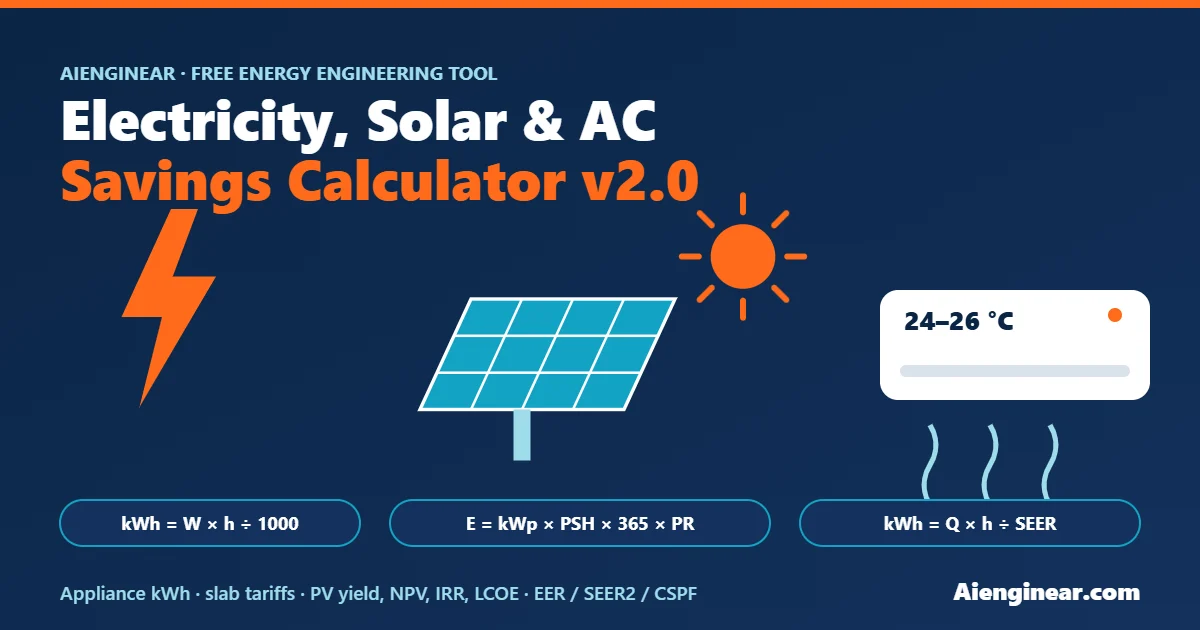
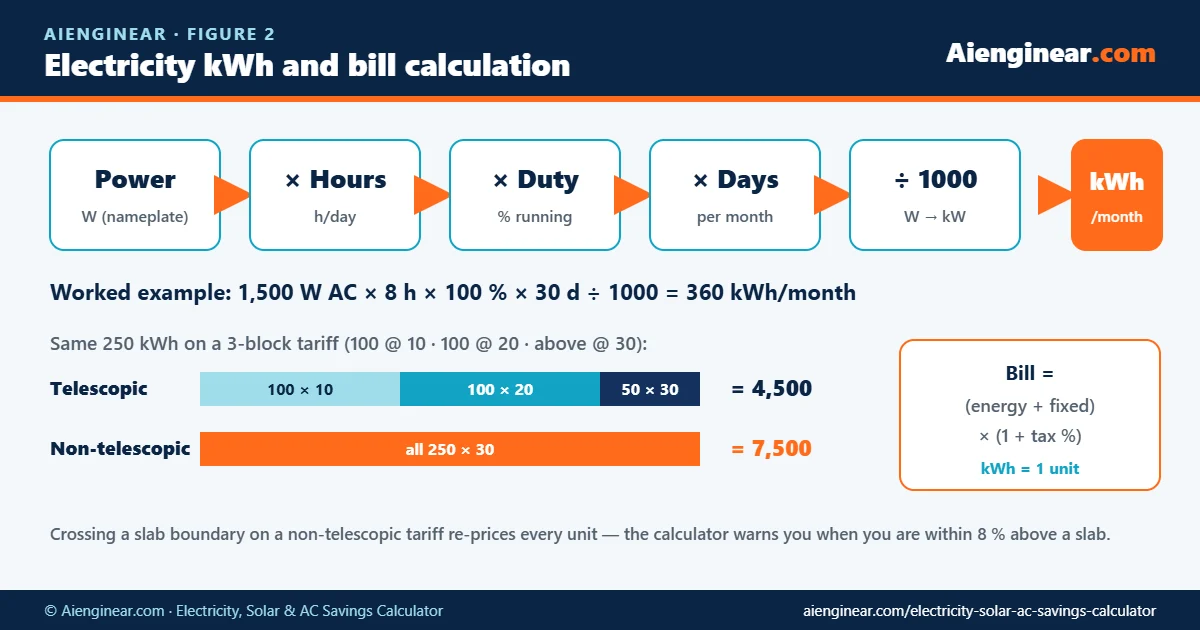
Appliance energy (kWh) = power (W) × hours of use × duty cycle ÷ 1,000. Multiply by your tariff (or apply your slab blocks), add fixed charges and taxes, and you have the bill. A solar PV system produces roughly kWp × peak sun hours × 365 × performance ratio per year, so 5 kWp at 5.5 sun-hours and PR 0.80 gives about 8,030 kWh. An air conditioner uses cooling delivered ÷ efficiency; replacing an EER 9.5 (BTU/Wh) unit with a CSPF 5.2 inverter unit cuts its energy by about 46 %.
The Aienginear Electricity, Solar & AC Savings Calculator turns those three formulas into one practical tool. List your appliances, choose a flat or slab tariff, size a rooftop solar system with a full 25-year cash flow (payback, NPV, IRR and LCOE), and compare an old air conditioner with an efficient inverter model. Every result can be printed as a branded PDF report or exported to CSV. It works in any country: pick a currency and enter your own tariff.
How to use the Electricity, Solar & AC Savings Calculator
- Pick a region example (optional). It loads an illustrative currency, tariff, sun hours and cost set for Pakistan, India, UAE, Saudi Arabia, the USA, the UK or the euro area. Replace every value with your own bill and quotes.
- Bill & appliances: add appliances from the preset list or type your own. Enter rated watts, quantity, hours per day, duty cycle and days per month. Choose a flat rate or a telescopic / non-telescopic slab tariff and add fixed charges and taxes.
- Solar PV & ROI: let the tool size the array from your consumption (target offset %) or enter kWp manually. Set peak sun hours, performance ratio, cost per kWp, self-consumption and export rate. Read off payback, NPV, IRR and LCOE, and open the year-by-year cash flow.
- Air conditioner: enter capacity in TR, BTU/h or kW, operating hours and days, then the efficiency of the existing and the new unit in any metric (EER, SEER, SEER2, COP or CSPF). Add a thermostat change to see the combined saving and payback.
- Report: review the summary and recommendations, then print a branded PDF, download a CSV, or save your inputs in the browser for next month.
What is new in version 2.0
Version 1 multiplied a single wattage by hours and a flat rate. We rebuilt the calculator from the ground up so the results match how utilities bill and how engineers appraise solar and HVAC projects:
- Multi-appliance table with quantity and duty cycle, so refrigerators and fixed-speed ACs are no longer over-counted.
- Slab tariffs in both telescopic and non-telescopic form, plus fixed charges and taxes, with a warning when you sit just above a slab boundary.
- Solar yield based on the performance ratio defined in IEC 61724-1:2021, with module degradation, self-consumption versus export, tariff escalation, O&M and a year-12 inverter replacement.
- Full financial metrics: simple and discounted payback, NPV, IRR and LCOE, and a 25-year cumulative cash-flow chart.
- AC comparison by EER, SEER, SEER2, COP or CSPF with correct BTU/Wh to W/W conversion and a separate thermostat-setpoint saving.
- Printable Aienginear report, CSV export, saved inputs and a 16-point calculation self-test that runs every time the tool loads.
How to calculate electricity consumption (kWh)
Utilities bill energy in kilowatt-hours. One kWh, often called one unit, is the energy used by a 1,000 W load running for one hour. To estimate the energy of any appliance, start from its rated power and the time it actually draws that power:
Bill = (energy charge + fixed charge) × (1 + taxes %)
Duty cycle is the step most simple calculators skip. A refrigerator is plugged in for 24 hours but its compressor runs perhaps 35–50 % of the time; a fixed-speed AC cycles on and off with the thermostat. Using nameplate watts × 24 h for a fridge can overstate its energy two- to three-fold.
Worked example. A 1,500 W air conditioner runs 8 hours a day at full power for 30 days: 1,500 × 8 × 30 ÷ 1,000 = 360 kWh per month. At a flat 0.15 per kWh the energy charge is 54 per month in your currency. If the same unit is an inverter model averaging 65 % of its rated input, the energy drops to 234 kWh.
Typical appliance power and monthly energy
Use the table as a starting point, then replace the watts with the figure on your appliance label or a plug-in energy meter reading.
Aienginear Table 1
Typical appliance power and monthly energy use
30 days per month · kWh = W × h × duty × 30 ÷ 1,000
| Appliance | Rated power (W) | Use per day | Duty cycle | kWh / month |
|---|---|---|---|---|
| LED bulb | 9 | 6 h | 100 % | 1.6 |
| Ceiling fan, AC induction motor | 75 | 12 h | 100 % | 27.0 |
| Ceiling fan, BLDC (DC) motor | 30 | 12 h | 100 % | 10.8 |
| Refrigerator 300–400 L | 150 | 24 h | 40 % | 43.2 |
| Deep freezer | 200 | 24 h | 50 % | 72.0 |
| Inverter AC 1.5 TR (average input) | 1,500 | 8 h | 65 % | 234 |
| Fixed-speed AC 1.5 TR | 1,900 | 8 h | 85 % | 388 |
| Room air cooler | 200 | 8 h | 100 % | 48.0 |
| LED TV 43–55 in | 100 | 5 h | 100 % | 15.0 |
| Wi-Fi router | 10 | 24 h | 100 % | 7.2 |
| Laptop | 60 | 6 h | 100 % | 10.8 |
| Desktop PC with monitor | 250 | 6 h | 100 % | 45.0 |
| Washing machine | 500 | 1 h | 100 % | 15.0 |
| Electric iron | 1,100 | 0.5 h | 60 % | 9.9 |
| Microwave oven | 1,200 | 0.3 h | 100 % | 10.8 |
| Electric kettle | 2,000 | 0.25 h | 100 % | 15.0 |
| Water pump 1 hp | 750 | 1 h | 100 % | 22.5 |
| Electric water heater 2 kW | 2,000 | 2 h | 70 % | 84.0 |
| EV charger 7.2 kW (Level 2) | 7,200 | 1.5 h | 100 % | 324 |
Typical values for household products; actual power depends on model, size, age and climate. Measure with a plug-in meter for best accuracy. Aienginear.com
Engineer’s tip: in hot climates the air conditioner is usually 40–60 % of a household bill. Fix the AC first (setpoint, filters, inverter upgrade) before chasing small loads such as chargers and routers.
Flat and slab tariffs explained
Many utilities, including those in Pakistan, India and the Gulf states, price electricity in slabs (blocks). The calculator supports both forms:
- Telescopic slabs: each block is charged at its own rate. 250 kWh on blocks of 100 @ 10, 100 @ 20 and above @ 30 costs 100×10 + 100×20 + 50×30 = 4,500.
- Non-telescopic slabs: all units are charged at the rate of the highest block reached, so the same 250 kWh costs 250 × 30 = 7,500. Crossing a boundary by even one unit re-prices the whole bill.
- Fixed and demand charges, fuel adjustments and taxes sit on top. Enter fixed charges per month and a combined tax percentage so the calculator’s effective rate matches your bill.
The effective rate (total bill ÷ kWh) is the number to use when valuing solar or AC savings, because each kWh you avoid removes your most expensive units first.
Solar PV yield and system sizing
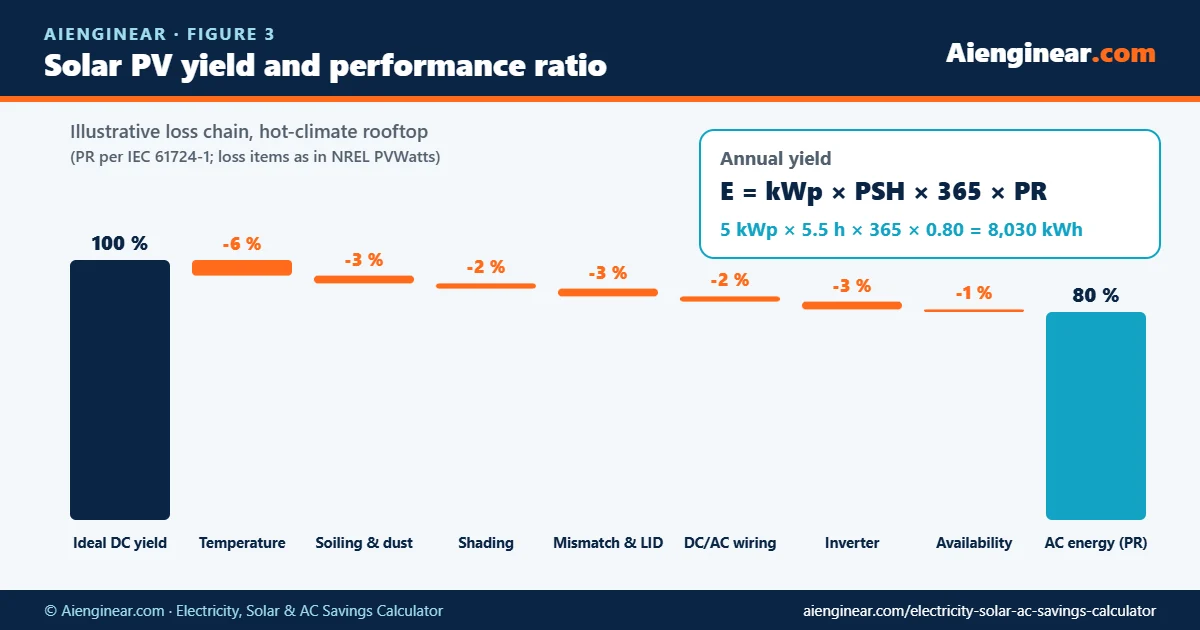
A grid-tied PV system’s annual energy is governed by three factors: the array rating in kWp, the solar resource at the site and the overall system losses. The calculator uses the industry-standard relationship:
Specific yield (kWh/kWp) = PSH × 365 × PR
Required kWp = annual load × target offset ÷ (PSH × 365 × PR)
- Peak sun hours (PSH) equal the daily irradiation on the panel plane in kWh/m², because standard test conditions use 1 kW/m². Take it from PVGIS, NREL PVWatts or the Global Solar Atlas for your exact site.
- Performance ratio (PR) is defined in IEC 61724-1 as final yield divided by reference yield. It captures temperature, soiling, wiring, mismatch, inverter and availability losses. 0.75–0.85 is typical; 0.80 is a sound default for a well-built rooftop.
- Degradation of crystalline modules is commonly around 0.5 % per year; the calculator compounds it over the analysis life.
Aienginear Table 2
Approximate peak sun hours and PV yield by city
Annual average, fixed-tilt array · PR = 0.80
| City | Peak sun hours (kWh/m²·day) | Specific yield (kWh/kWp·yr) | 5 kWp system (kWh/yr) |
|---|---|---|---|
| Karachi, Pakistan | 5.6 | 1,635 | 8,176 |
| Lahore, Pakistan | 5.0 | 1,460 | 7,300 |
| Multan, Pakistan | 5.4 | 1,577 | 7,884 |
| Islamabad, Pakistan | 5.0 | 1,460 | 7,300 |
| Quetta, Pakistan | 6.0 | 1,752 | 8,760 |
| Delhi, India | 5.2 | 1,518 | 7,592 |
| Mumbai, India | 5.1 | 1,489 | 7,446 |
| Dubai, UAE | 5.9 | 1,723 | 8,614 |
| Riyadh, Saudi Arabia | 6.2 | 1,810 | 9,052 |
| Cairo, Egypt | 5.9 | 1,723 | 8,614 |
| Phoenix, USA | 6.3 | 1,840 | 9,198 |
| New York, USA | 4.0 | 1,168 | 5,840 |
| Madrid, Spain | 4.9 | 1,431 | 7,154 |
| Berlin, Germany | 3.0 | 876 | 4,380 |
| London, UK | 2.8 | 818 | 4,088 |
| Sydney, Australia | 4.8 | 1,402 | 7,008 |
| Johannesburg, South Africa | 5.6 | 1,635 | 8,176 |
Rounded planning values for an optimally tilted, unshaded array. Use PVGIS, NREL PVWatts or the Global Solar Atlas for your exact coordinates, tilt and azimuth before buying. Aienginear.com
Aienginear Table 3
PV system loss budget
NREL PVWatts default losses and typical hot-climate ranges
| Loss item | PVWatts default | Typical range / hot-dusty sites |
|---|---|---|
| Soiling | 2 % | 3–6 % (dusty, low rainfall) |
| Shading | 3 % | 0–10 % (site specific) |
| Mismatch | 2 % | 1–2 % |
| DC and AC wiring | 2 % | 1.5–3 % |
| Connections | 0.5 % | 0.5 % |
| Light-induced degradation | 1.5 % | 1–2 % |
| Nameplate rating tolerance | 1 % | 0–1 % |
| Availability (downtime, grid outages) | 3 % | 1–5 % |
| Combined (multiplicative) | 14.1 % | — |
| Inverter efficiency (separate) | 96 % | 95–98.5 % |
| Module temperature (separate) | modelled | −0.30 to −0.40 %/°C above 25 °C cell |
PVWatts applies the combined 14 % system loss plus inverter efficiency and a temperature model. Together they typically give a PR of 0.75–0.85 for rooftop systems. Aienginear.com
Sizing example. A home using 484 kWh per month (5,808 kWh per year) in Karachi wants to offset 80 % of its energy. Required size = 5,808 × 0.80 ÷ (5.6 × 365 × 0.80) ≈ 2.9 kWp, which is five 580 Wp modules and about 13 m² of roof. The calculator rounds up and shows module count and area automatically.
Solar payback, NPV, IRR and LCOE
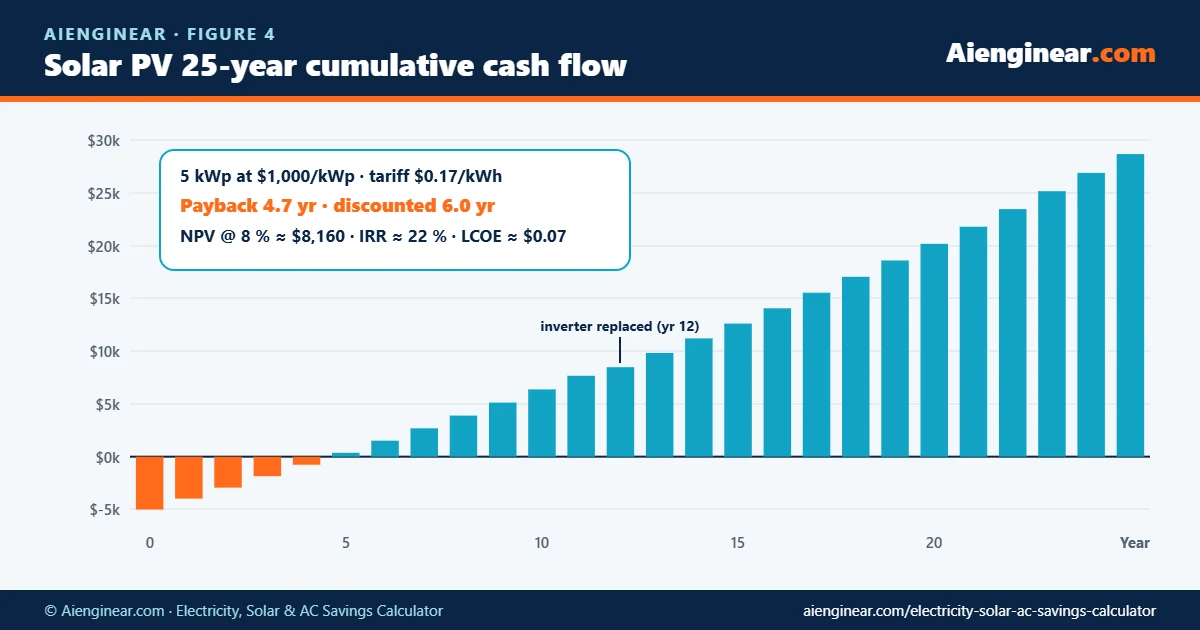
A credible solar appraisal looks beyond simple payback. The calculator builds a year-by-year cash flow in which year-n savings = self-consumed kWh × tariff × (1 + escalation)n−1 + exported kWh × export rate, minus O&M and a year-12 inverter replacement. From that cash flow it reports:
NPV = −C0 + Σ CFn ÷ (1 + r)n
IRR = discount rate r at which NPV = 0
LCOE = [C0 + Σ (O&Mn + Rn) ÷ (1 + r)n] ÷ Σ En ÷ (1 + r)n
Worked example. 5 kWp, 5.5 peak sun hours, PR 0.80 → 8,030 kWh in year 1. Installed cost 1,000 per kWp (5,000 total), avoided tariff 0.17, 70 % self-consumption, export at 0.05, 3 % tariff escalation, 1 % O&M, 8 % discount rate. Year-1 savings are about 1,076, simple payback 4.7 years, discounted payback 6.0 years, NPV about 8,160, IRR about 22 % and LCOE about 0.07 per kWh, well below the grid tariff.
Aienginear Table 4
Solar payback and IRR sensitivity
5 kWp · PSH 5.5 · PR 0.80 · 70 % self-use · export 0.05 · escalation 3 % · O&M 1 %
| Installed cost per kWp | Tariff 0.10 | Tariff 0.15 | Tariff 0.20 | Tariff 0.30 |
|---|---|---|---|---|
| 800 | 5.9 yr / 17.5 % | 4.2 yr / 25.0 % | 3.2 yr / 32.3 % | 2.2 yr / 46.5 % |
| 1,000 | 7.4 yr / 13.7 % | 5.2 yr / 20.0 % | 4.0 yr / 25.9 % | 2.8 yr / 37.4 % |
| 1,500 | 11.8 yr / 8.1 % | 7.8 yr / 12.9 % | 6.0 yr / 17.2 % | 4.2 yr / 25.2 % |
| 2,000 | 15.8 yr / 4.8 % | 10.4 yr / 9.0 % | 8.0 yr / 12.5 % | 5.5 yr / 18.9 % |
| 2,800 | 21.7 yr / 1.4 % | 15.5 yr / 5.1 % | 12.1 yr / 8.1 % | 7.7 yr / 13.1 % |
Each cell shows simple payback / IRR from the Aienginear calculator engine. Any currency works as long as cost and tariff use the same unit. Aienginear.com
Check your export rules. The value of surplus solar depends on local regulation. Several markets have moved from net metering (export credited at the retail rate) to net billing or gross metering, where exported units earn a lower buy-back rate. Pakistan, for example, has been shifting rooftop users from net metering to net billing. Enter your actual buy-back rate and a realistic self-consumption share; oversizing is rarely profitable when exports are paid at a fraction of the retail tariff.
Air conditioner energy use and savings
An air conditioner’s electrical energy equals the cooling it delivers divided by its efficiency. The calculator uses:
EAC (kWh/yr) = Q × h/day × days × load factor ÷ η (W/W)
η (W/W) = EER or SEER (BTU/Wh) ÷ 3.412
Worked example. One 1.5 TR (5.28 kW) unit runs 8 h a day for 200 cooling days at a 70 % average load. The existing fixed-speed unit has an EER of 9.5 BTU/Wh (2.78 W/W) and uses about 2,122 kWh a year. A new inverter unit rated CSPF 5.2 W/W uses about 1,136 kWh; raising the thermostat from 22 °C to 25 °C (≈3 % per °C) trims it to 1,034 kWh. The saving is about 1,088 kWh (51 %) per year, worth 185 a year at 0.17 per kWh, so a 900 replacement pays back in roughly 4.9 years.
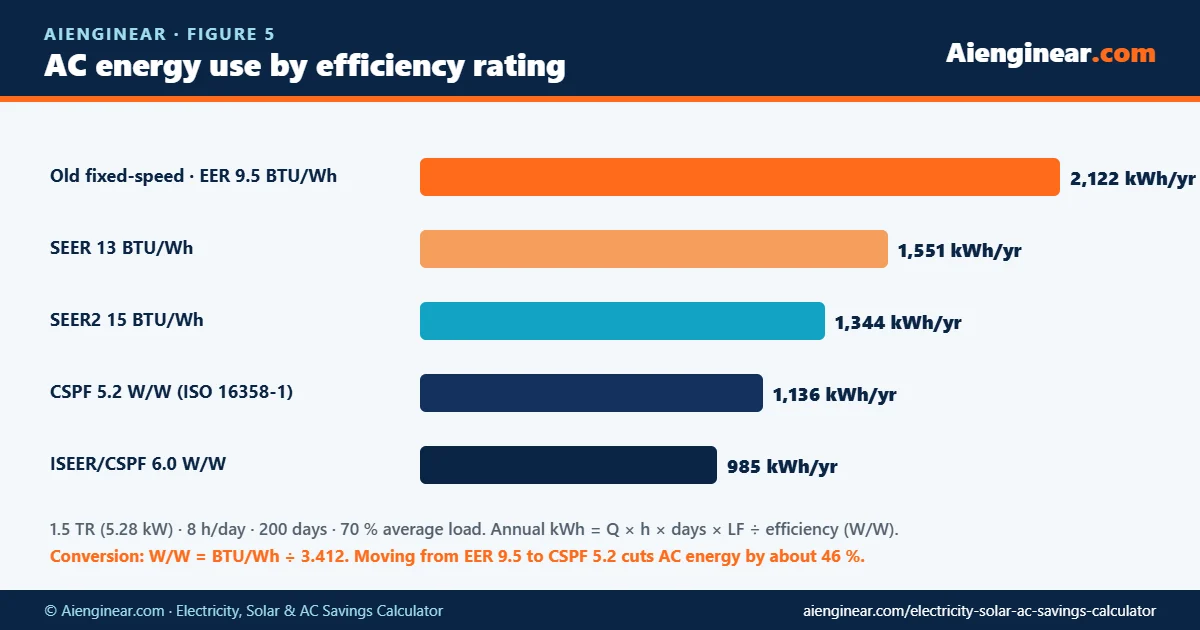
Inverter (variable-speed) compressors save energy because they run at reduced speed for most of the season instead of cycling between full power and off. Seasonal metrics such as SEER2 and CSPF capture this part-load advantage; a full-load EER does not, which is why the calculator lets you choose the metric printed on each unit’s label.
EER, SEER, SEER2 and CSPF compared
Aienginear Table 5
Air-conditioner efficiency metrics and conversions
Convert every rating to W/W before comparing
| Metric | Unit | Standard / test basis | What it measures | To W/W |
|---|---|---|---|---|
| EER | BTU/Wh | AHRI 210/240; ISO 5151 (as W/W) | Full-load efficiency at a single rating point (35 °C outdoor) | ÷ 3.412 |
| COP / EER (metric) | W/W | ISO 5151:2017; EN 14511 | Full-load cooling or heating output ÷ electrical input | — |
| SEER | BTU/Wh | AHRI 210/240 (pre-2023 USA) | Seasonal efficiency over a standard US cooling season | ÷ 3.412 |
| SEER2 | BTU/Wh | AHRI 210/240-2023 (M1 test procedure) | Seasonal efficiency with higher external static pressure; numerically about 5 % below SEER for the same ducted unit | ÷ 3.412 |
| CSPF | W/W | ISO 16358-1:2013 | Cooling seasonal performance factor using outdoor temperature bin hours | — |
| ISEER | W/W | BEE India, based on ISO 16358-1 | CSPF with Indian bin hours; basis of India’s star labels | — |
| SEER (EU) | W/W | EN 14825 | Seasonal efficiency for EU climates; basis of EU energy labels | — |
Compare like with like: a seasonal rating (SEER2, CSPF) is always higher than the same unit’s full-load EER. 1 TR = 12,000 BTU/h = 3.517 kW. Aienginear.com
Thermostat setpoint. Each degree you raise the cooling setpoint reduces the indoor-outdoor temperature difference and therefore the cooling load. Field studies commonly report roughly 3–5 % less AC energy per °C; the calculator uses an editable 3 % default. A setpoint of 24–26 °C, combined with ceiling fans for air movement, generally stays within the ASHRAE 55 comfort zone for lightly clothed occupants.
How to reduce your electricity bill: actions ranked by impact
- Optimise the air conditioner. Set 24–26 °C, clean filters every 2–4 weeks in summer, shade the outdoor unit and seal doors and windows. Replace units older than about ten years with a high-CSPF or SEER2 inverter model.
- Install rooftop solar sized to daytime use. Shift pumping, laundry and water heating to sunny hours to raise self-consumption, which is worth more than exported units.
- Stay below slab boundaries. On non-telescopic tariffs, a few units over a boundary can raise the whole bill; the calculator flags this.
- Replace AC-motor ceiling fans with BLDC fans. They use roughly 40–60 % less power and run for long hours.
- Switch all lighting to LED and add timers or occupancy sensors in low-use areas.
- Replace old refrigerators and freezers and keep door seals and condenser coils clean.
- Cut standby loads with switched power strips for TV and computer equipment.
- Track your consumption monthly against the calculator to spot faulty appliances early.
Accuracy and limitations
- The calculator is a preliminary estimating tool. Results are only as good as the watts, hours and tariff you enter; check them against at least two actual bills.
- Solar yield uses an annual-average PSH and a single PR. Detailed design needs hourly simulation (PVsyst, SAM or PVWatts), a shading analysis and the installer’s string design.
- Tariff escalation, export rates and incentives change with regulation; the financial results are sensitive to all three.
- AC savings assume the same cooling delivered by both units. Oversized or poorly installed equipment, duct leakage and refrigerant charge errors can reduce real savings.
- For commercial and industrial sites, demand (kW or kVA) charges, power factor penalties and time-of-use rates can dominate the bill; treat the result as an energy-only estimate.
Quality check: the tool runs 16 automatic engine tests (kWh, slab maths, PV yield, NPV, IRR, payback, LCOE and unit conversions) every time it loads. The status is shown in the footer as Self-test: 16/16 passed.
Standards and references used in this calculator
Aienginear Table 6
Standards behind the Aienginear energy calculator
Codes and methods referenced in v2.0
| Standard | Scope | How it is used |
|---|---|---|
| IEC 61724-1:2021 | PV system performance monitoring | Definition of performance ratio, reference and final yield |
| IEC 61215-1:2021 / IEC 61730 | PV module design qualification and safety | Module ratings at STC used for kWp |
| IEC 62446-1:2016 + A1:2018 | Grid-connected PV documentation, commissioning and inspection | Checklist after installation |
| IEEE 1547-2018 | Interconnection of distributed energy resources | Grid-connection requirements for inverters |
| NREL PVWatts (methodology) | PV performance model and default losses | Loss budget in Table 3 |
| ISO 16358-1:2013 | Air-cooled air conditioners: seasonal performance (CSPF) | Seasonal efficiency metric |
| ISO 5151:2017 | Non-ducted air conditioners: testing and rating | Full-load EER / COP |
| AHRI 210/240-2023 | Unitary air-conditioning equipment rating (SEER2, EER2) | US seasonal efficiency metric |
| EN 14825 | Seasonal performance of air conditioners (EU SEER) | EU energy labels |
| ASHRAE 55-2023 | Thermal environmental conditions for human occupancy | Thermostat setpoint guidance |
| ISO 50001:2018 | Energy management systems | Monitoring and continual improvement |
Always confirm local utility, building and electrical code requirements before installation. Aienginear.com
Related Aienginear tools and guides
Key takeaways
- Energy (kWh) = watts × hours × duty cycle ÷ 1,000; one kWh is one billing unit.
- Use your effective rate (bill ÷ kWh), including slabs, fixed charges and taxes, to value any saving.
- Solar yield ≈ kWp × peak sun hours × 365 × PR; PR 0.75–0.85 is typical (IEC 61724-1).
- Judge solar by NPV, IRR and LCOE as well as payback, and use your real export rate.
- Convert AC ratings to W/W before comparing: W/W = BTU/Wh ÷ 3.412. Seasonal metrics (SEER2, CSPF) suit inverter units.
- Raising the AC setpoint to 24–26 °C typically saves about 3–5 % of AC energy per °C.
Frequently asked questions
What is 1 unit of electricity?
One unit is one kilowatt-hour (kWh): the energy used by a 1,000 W load in one hour, or a 100 W load in ten hours. Utilities bill in kWh.
How do I calculate the electricity used by an appliance?
Multiply its power in watts by the hours it runs per day, the duty cycle and the number of days, then divide by 1,000. A 150 W fridge running its compressor 40 % of 24 hours for 30 days uses 150 × 24 × 0.4 × 30 ÷ 1,000 = 43.2 kWh per month.
How many kWh does a 1.5 ton AC use per month?
It depends on efficiency and hours. A fixed-speed 1.5 TR unit drawing about 1.9 kW for 8 hours a day uses roughly 390–450 kWh per month in peak summer; an efficient inverter unit typically uses 200–280 kWh for the same cooling.
What is the difference between telescopic and non-telescopic slab tariffs?
With telescopic slabs each block of units is charged at its own rate. With non-telescopic slabs every unit is charged at the rate of the highest block reached, so crossing a boundary can raise the whole bill sharply.
How many solar panels do I need for my home?
Divide your annual kWh, multiplied by the share you want to offset, by peak sun hours × 365 × performance ratio to get kWp, then divide by the module rating. For 5,808 kWh, an 80 % offset, 5.6 sun-hours and PR 0.80 you need about 2.9 kWp, or five 580 Wp panels.
What are peak sun hours?
Peak sun hours are the daily solar irradiation on the panel surface expressed in kWh/m². Because panels are rated at 1 kW/m², 5.5 kWh/m² per day equals 5.5 hours of full-rated sun.
What is a good performance ratio for a solar PV system?
A performance ratio of 0.75–0.85 is typical for grid-tied rooftop systems. Hot, dusty or partly shaded sites sit at the lower end; well-ventilated, clean arrays in cooler climates reach the upper end.
How long does solar take to pay back?
Payback depends mainly on installed cost per kWp, your tariff, sun hours and how much solar you use yourself. At 1,000 per kWp and a 0.17 tariff with 5.5 sun-hours, payback is under five years; at 2,800 per kWp and a 0.10 tariff it can exceed 20 years.
What is the difference between EER, SEER, SEER2 and CSPF?
EER is full-load efficiency at one rating point. SEER, SEER2 and CSPF are seasonal ratings that include part-load operation. EER, SEER and SEER2 are in BTU/Wh; CSPF and ISEER are in W/W. Divide BTU/Wh by 3.412 to convert to W/W.
Does raising the thermostat really save electricity?
Yes. Each degree Celsius higher reduces the cooling load, commonly saving about 3–5 % of AC energy. Moving from 22 °C to 25 °C can cut AC energy by roughly 9–15 %.
Aienginear · Quiz
Test your knowledge: electricity, solar and AC savings
10 questions · instant feedback with explanations
References
- IEC 61724-1:2021, Photovoltaic system performance — Part 1: Monitoring. International Electrotechnical Commission.
- ISO 16358-1:2013, Air-cooled air conditioners and air-to-air heat pumps — Testing and calculating methods for seasonal performance factors — Part 1: Cooling seasonal performance factor.
- ISO 5151:2017, Non-ducted air conditioners and heat pumps — Testing and rating for performance.
- AHRI Standard 210/240-2023, Performance Rating of Unitary Air-conditioning and Air-source Heat Pump Equipment.
- ANSI/ASHRAE Standard 55-2023, Thermal Environmental Conditions for Human Occupancy.
- NREL, PVWatts Calculator and its technical reference for default system losses.
- European Commission JRC, PVGIS photovoltaic geographical information system.
- World Bank / Solargis, Global Solar Atlas.
- Jordan, D.C. and Kurtz, S.R., Photovoltaic Degradation Rates — An Analytical Review, Progress in Photovoltaics, 2013.

Written by Muhammad Raza
Founder of Aienginear. Engineering and digital solutions professional with 26+ years managing projects, plant shutdowns and turnarounds in oil & gas, petrochemical and power generation.