
ELECTRICAL LOAD · ENERGY COST · UPDATED OCTOBER 2026
Quick answer: how do you calculate household electrical load and electricity cost?
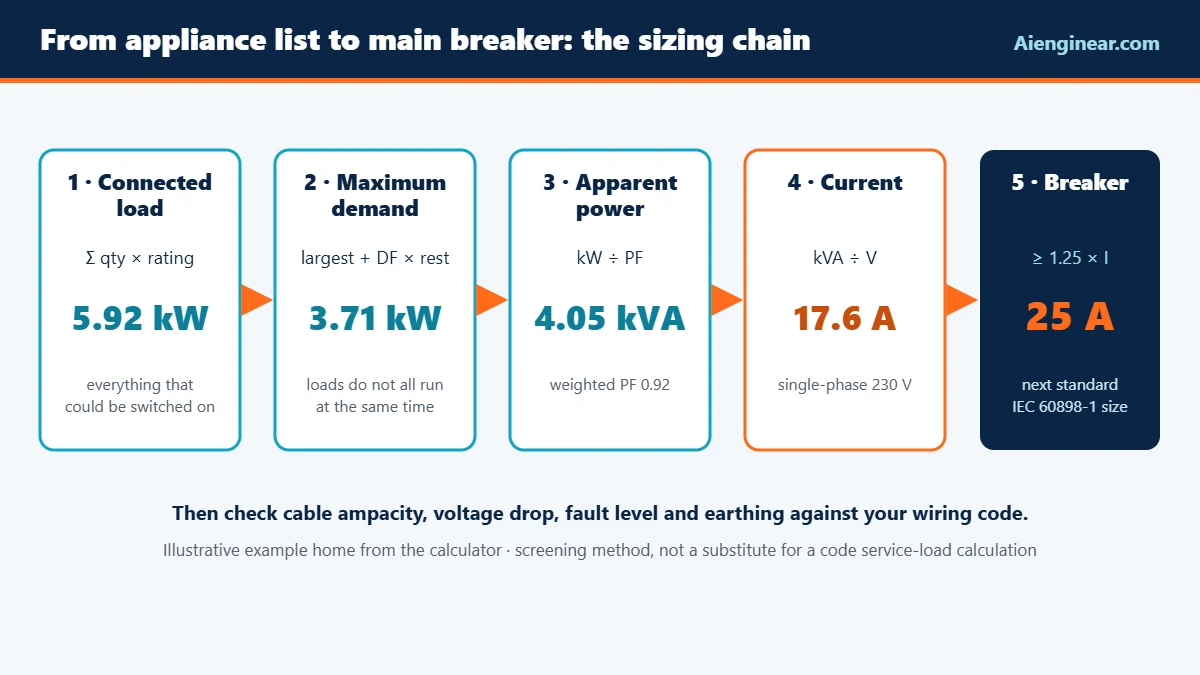
Energy (kWh) = power (W) × hours of use × duty cycle ÷ 1,000. Multiply the monthly kWh by your tariff, add fixed charges and taxes, and you have the bill. For sizing, add every rating to get the connected load, apply a demand factor to get the maximum demand, divide by power factor for kVA, and divide kVA by voltage (or by √3 × line voltage on three-phase) for current in amperes. A 3.7 kW demand at PF 0.92 on 230 V draws about 17.6 A, so a 25 A main breaker is the next standard size after a 125 % allowance.
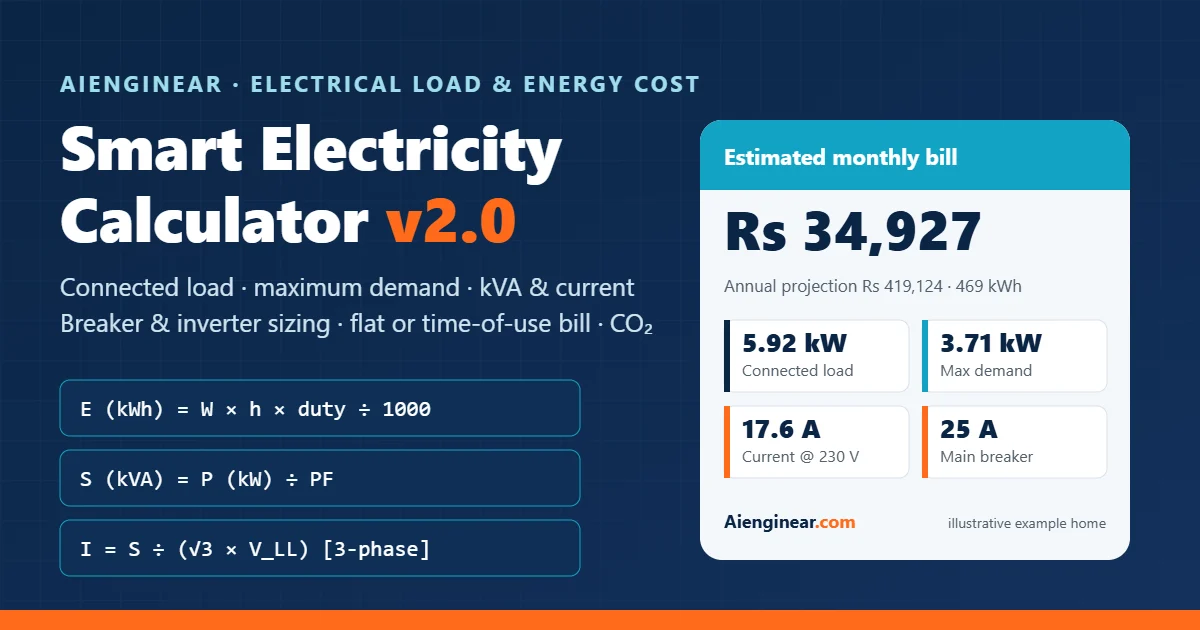
The Aienginear Smart Electricity Calculator goes beyond a simple bill estimate. Enter your appliances once and it returns the monthly and annual bill on a flat or time-of-use tariff, the connected load and diversified maximum demand, kVA and line current for single- or three-phase supply, an indicative main breaker size, inverter/UPS and battery sizing for backup, standby (phantom) losses, CO₂ emissions and a ranked list of savings actions. Every result can be printed as a branded PDF report or exported to CSV.
How to use the calculator
- Pick a region example. It loads an editable currency, voltage, tariff, tax and grid CO₂ factor. Replace the rates with the figures printed on your own bill.
- Choose the supply. Single-phase (including North American 120/240 V split-phase at 240 V) or balanced three-phase with line-to-line voltage.
- Select the tariff type. Flat rate, or time-of-use with separate peak and off-peak prices and the length of the daily peak window.
- Build the appliance list. Choose a preset or type a name, then set quantity, nameplate rating (W, kW or HP), hours per day, duty cycle, hours in the peak window, power factor and standby watts. Tick Backup for loads that must run on an inverter.
- Adjust the demand and backup settings (demand factor, breaker allowance, backup hours, battery depth of discharge, inverter efficiency and margin).
- Read the results and the savings advisor, then press Print / save PDF report or Download CSV. Your inputs are remembered in this browser.
What is new in version 2.0
Version 1 multiplied a single wattage by hours and a load slider to give a bill and one tip. Version 2.0 is a rebuilt engineering engine with a publication self-test:
- Unlimited appliance rows with quantity, W/kW/HP units, duty cycle, power factor and standby power.
- Connected load, diversified maximum demand, kVA, load-weighted power factor and line current for single- or three-phase supply.
- Indicative main breaker size from the IEC 60898-1 / UL 489 preferred ratings with an adjustable continuous-load allowance.
- Inverter/UPS continuous and surge rating, and battery energy for a chosen backup time.
- Time-of-use billing with peak and off-peak energy split, fixed charge and tax build-up.
- Standby energy, CO₂ emissions, cost-ranked breakdown, rule-based savings advisor, branded print report and CSV export.
- 16 hand-checked reference cases run on every page load; results are shown only after the self-test passes.
How to calculate electricity consumption
Electricity is billed in kilowatt-hours (kWh), often called units. One kWh is the energy a 1,000 W load uses in one hour. For each appliance:
Emonth = Eday × billing days
The duty cycle is the share of switched-on time that the appliance actually draws its rated power. Lights, fans and televisions run at 100 %. Refrigerators, freezers, water heaters, irons and inverter air conditioners are controlled by a thermostat or variable-speed drive, so they draw full power only part of the time. Ignoring duty is the most common reason simple calculators overestimate fridge and AC energy.
Example. A 2,000 W kettle used 0.3 h a day for 30 days uses 2,000 × 0.3 × 30 ÷ 1,000 = 18 kWh per month. At 62 per kWh plus 20 % tax that is about 1,339 in local currency.
Typical appliance ratings
Aienginear Table 1
Appliance power, power factor and monthly energy
30-day month · kWh excludes standby · W × h × duty × 30 ÷ 1,000
| Appliance | Rated power (W) | Power factor | Use per day | Duty cycle | Standby (W) | kWh / month |
|---|---|---|---|---|---|---|
| LED bulb (9–12 W) | 10 | 0.90 | 6 h | 100 % | 0 | 1.8 |
| Ceiling fan, conventional AC motor | 75 | 0.90 | 12 h | 100 % | 0 | 27.0 |
| Ceiling fan, BLDC | 32 | 0.95 | 12 h | 100 % | 0.5 | 11.5 |
| Inverter AC 1.5 ton (≈5.3 kW cooling) | 1,500 | 0.95 | 8 h | 60 % | 3 | 216.0 |
| Fixed-speed AC 1.5 ton | 1,800 | 0.85 | 8 h | 85 % | 2 | 367.2 |
| Refrigerator, conventional | 150 | 0.80 | 24 h | 40 % | 0 | 43.2 |
| Refrigerator, inverter compressor | 110 | 0.95 | 24 h | 45 % | 0 | 35.6 |
| Water pump 1 HP | 900 | 0.80 | 1 h | 100 % | 0 | 27.0 |
| Washing machine (automatic) | 500 | 0.85 | 1 h | 60 % | 1 | 9.0 |
| Electric iron | 1,000 | 1.00 | 0.5 h | 50 % | 0 | 7.5 |
| Electric kettle | 2,000 | 1.00 | 0.3 h | 100 % | 0 | 18.0 |
| Microwave oven | 1,200 | 0.95 | 0.3 h | 100 % | 2 | 10.8 |
| Electric water heater / geyser | 2,000 | 1.00 | 3 h | 50 % | 0 | 90.0 |
| LED TV 43–55 in | 100 | 0.90 | 5 h | 100 % | 0.5 | 15.0 |
| Desktop PC with monitor | 200 | 0.95 | 6 h | 70 % | 2 | 25.2 |
| Wi-Fi router / ONT | 12 | 0.90 | 24 h | 100 % | 0 | 8.6 |
| EV charger, Level 2 | 7,200 | 0.99 | 1.5 h | 100 % | 2 | 324.0 |
Typical values used as calculator presets; actual power depends on model, size, age, climate and usage. Check the nameplate or measure with a plug-in energy meter. Aienginear.com
Connected load vs maximum demand
Connected load is the sum of every appliance rating multiplied by its quantity: the load if everything were switched on at once. In practice that never happens. The maximum demand is the highest load that realistically occurs together, and it is what the supply cable, main breaker, sanctioned (contracted) load and backup inverter must carry.
Maximum demand MD = Plargest unit + DF × (CL − Plargest unit)
The calculator takes the largest single item at 100 % and applies a demand factor (DF), 0.5 by default, to everything else. This mirrors the principle used in wiring codes, where the first block of load is counted in full and the remainder at a reduced percentage. Codes publish their own tables (for example the dwelling methods in NFPA 70 Article 220, or diversity guidance used with BS 7671), so use the code’s method when you size a service for approval.
Power factor, kVA and the power triangle
Motors, compressors and electronic power supplies draw current that is not perfectly in step with the voltage. Active power (kW) does the useful work and is what your energy meter bills. Apparent power (kVA) is voltage × current and is what cables, breakers, transformers and inverters must be rated for. Their ratio is the power factor (PF), defined in IEEE Std 1459.
Load-weighted PF = Σ P ÷ Σ (P ÷ PFi)
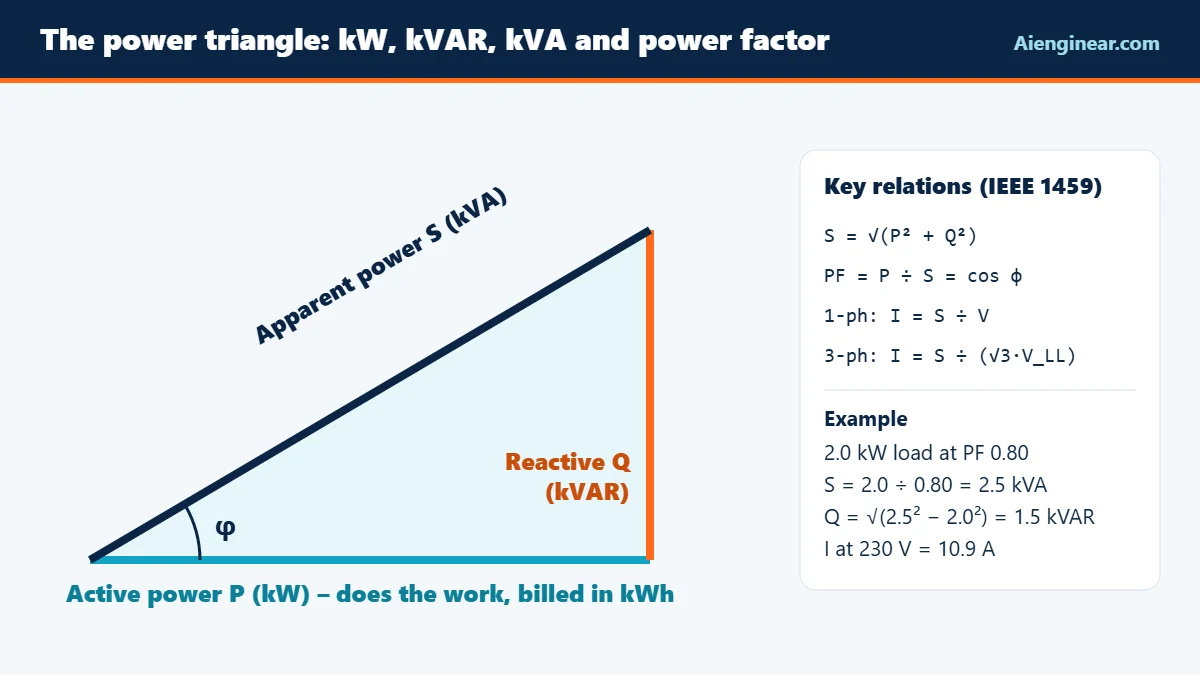
Adding apparent powers arithmetically, as the calculator does, slightly overstates kVA when loads have different phase angles. That is the conservative direction for sizing equipment.
Current and main breaker sizing
Breaker In ≥ I × allowance (125 % default) → next standard rating
The 125 % default reflects the common rule that continuous loads should not exceed 80 % of a breaker’s rating (NFPA 70 applies 125 % of continuous load for branch circuits and feeders). The result is rounded up to the preferred ratings of IEC 60898-1 and UL 489: 6, 10, 13, 16, 20, 25, 32, 40, 50, 63, 80, 100 and 125 A, then larger moulded-case sizes. Table 2 gives a quick check of current per kilowatt.
Aienginear Table 2
Line current drawn per 1 kW of load
I = 1,000 ÷ (V × PF) single-phase · I = 1,000 ÷ (√3 × V × PF) three-phase
| Supply | Voltage | Amps per kW at PF 1.00 | Amps per kW at PF 0.85 |
|---|---|---|---|
| Single-phase | 120 V | 8.33 | 9.80 |
| Single-phase | 230 V | 4.35 | 5.12 |
| Single-phase / split-phase | 240 V | 4.17 | 4.90 |
| Three-phase, balanced | 400 V | 1.44 | 1.70 |
| Three-phase, balanced | 415 V | 1.39 | 1.64 |
| Three-phase, balanced | 480 V | 1.20 | 1.42 |
Values are per kW of real power. Motor starting current can be 3 to 7 times running current for a short time and is handled by the breaker’s trip curve (type B, C or D). Aienginear.com
The breaker is only part of the design. The cable must carry the design current after installation and grouping derating, voltage drop must stay within limits, the breaker’s breaking capacity must exceed the prospective fault current, and earthing and residual-current protection must meet your wiring code. Treat the calculator’s breaker as a screening value for an electrician to verify.
Inverter, UPS and battery sizing
Tick Backup on the loads that must keep running during outages. The calculator sums their apparent power, adds a margin (25 % by default) for the continuous rating, and checks the momentary surge of the largest motor load (compressors and pumps can draw several times their running power while starting).
Battery (kWh) = average backup load (kW) × backup hours ÷ (DoD × ηinverter)
For example, a refrigerator (150 W, PF 0.8, 40 % duty) and a 100 W TV need (187.5 + 100) × 1.25 ≈ 360 VA continuous, with about 850 VA of surge capability for the fridge compressor start. Over 4 h their average consumption is about 0.32 kWh, so with 80 % usable depth of discharge and 90 % inverter efficiency the battery needs about 0.45 kWh nominal capacity. The calculator also shows a worst-case figure assuming every backup load runs flat out.
Time-of-use tariffs and load shifting
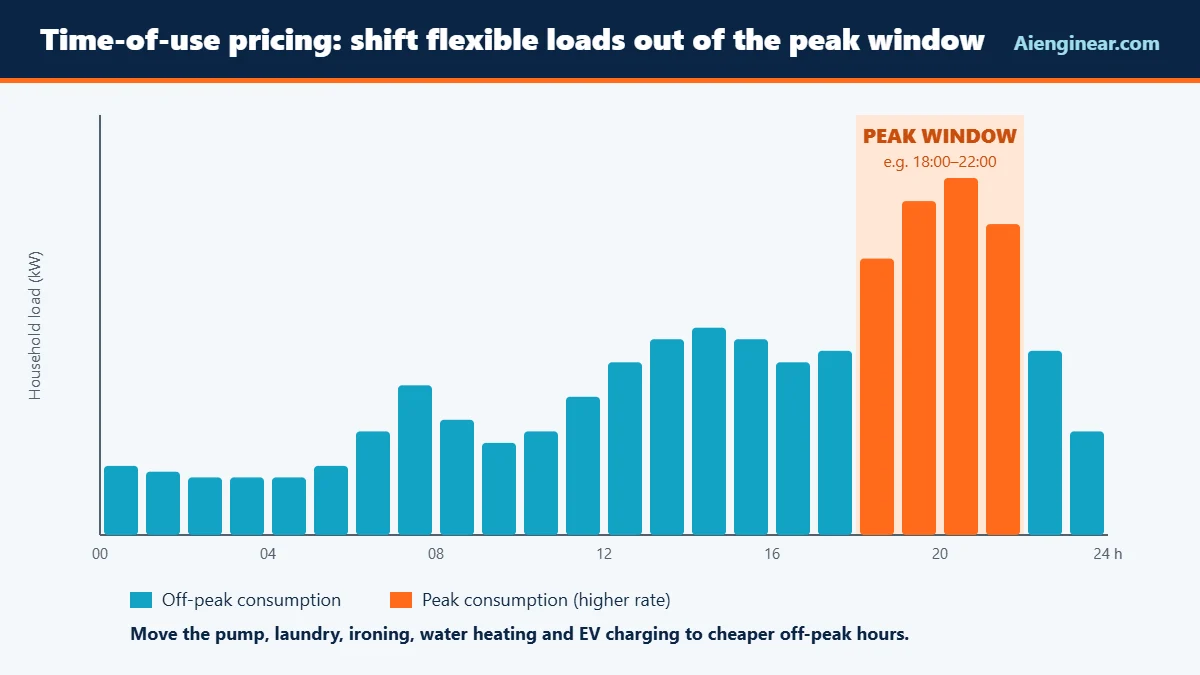
Many utilities charge more for energy used during a daily peak window, typically in the evening. Under a time-of-use (ToU) tariff the bill becomes:
Enter, for each appliance, how many of its daily hours fall in the peak window. The calculator splits energy and cost accordingly and estimates how much you would save by moving flexible loads to off-peak hours.
Aienginear Table 3
Example savings from shifting flexible loads out of the peak window
Illustrative Pakistan-style ToU rates: peak Rs 72, off-peak Rs 55 per kWh, 20 % tax · 30 days
| Load moved to off-peak | Energy shifted (kWh/month) | Saving per kWh incl. tax | Monthly saving |
|---|---|---|---|
| Water pump 900 W, 1 h/day | 27.0 | Rs 20.4 | Rs 551 |
| Washing machine 500 W, 1 h, 60 % duty | 9.0 | Rs 20.4 | Rs 184 |
| Ironing 1,000 W, 0.5 h, 50 % duty | 7.5 | Rs 20.4 | Rs 153 |
| Water heater 2,000 W, 1 h, 50 % duty | 30.0 | Rs 20.4 | Rs 612 |
| Total | 73.5 | Rs 1,499 |
Saving per kWh = (peak rate − off-peak rate) × (1 + tax). Replace with your utility’s published ToU rates and peak hours. Aienginear.com
Standby (phantom) power
Televisions, set-top boxes, computers, chargers and appliances with displays draw a small current even when switched off. IEC 62301 defines how this standby power is measured. A few watts per device add up because they run for most of the day: 10 devices at 2 W each waste 0.38 kWh per day if they are switched on for 5 hours, roughly 11 kWh per month. The calculator multiplies each standby rating by its off hours and reports the total and its cost.
Worked example: a typical home
Click Load example home in the calculator to load this list: one 1.5-ton inverter AC (8 h), two conventional and three BLDC ceiling fans, eight LED bulbs, a refrigerator, a 43–55 in LED TV, a 1 HP water pump, an automatic washing machine, an iron, a microwave, a desktop PC, a Wi-Fi router and three phone chargers, on a 230 V single-phase supply with the Pakistan example tariff (Rs 62/kWh flat, 20 % tax).
Aienginear Table 4
Example home: calculator results
Single-phase 230 V · demand factor 0.5 · 125 % breaker allowance · all loads ticked for backup
| Result | Value | How it is obtained |
|---|---|---|
| Connected load | 5.92 kW | Σ qty × rating |
| Maximum demand | 3.71 kW | 1.50 kW largest + 0.5 × remainder |
| Load-weighted power factor | 0.92 | Σ P ÷ Σ (P ÷ PF) |
| Apparent power at demand | 4.05 kVA | 3.71 kW ÷ 0.92 |
| Line current | 17.6 A | 4,050 VA ÷ 230 V |
| Indicative main breaker | 25 A | next standard size ≥ 1.25 × 17.6 = 22.0 A |
| Monthly energy | 469 kWh | Σ daily kWh × 30 |
| Monthly bill, flat tariff | Rs 34,927 | 469.4 × 62 × 1.20 |
| Monthly bill, ToU (72 / 55, 4 h peak) | Rs 34,020 | peak and off-peak split × 1.20 |
| Standby energy | 5.6 kWh/month | standby W × off hours |
| Inverter continuous / surge | 8.08 / 8.72 kVA | all loads on backup, 25 % margin |
| Battery for 4 h backup | 3.58 kWh | average backup load, DoD 80 %, η 90 % |
| CO₂ | 188 kg/month | 469 kWh × 0.40 kg/kWh |
Output of calculator engine 2.0.0 for the built-in example; your results depend on your inputs. Aienginear.com
Two insights stand out. The inverter AC alone is almost half of the energy cost, so its set-point and running hours matter more than every light in the house. And backing up the AC is what pushes the inverter above 8 kVA; a backup limited to lights, fans, refrigerator, TV and router needs only about 0.9 kVA.
How this calculator compares
Aienginear Table 5
Aienginear Smart Electricity Calculator vs typical online bill calculators
Feature checklist · October 2026
| Capability | Typical online bill calculator | Aienginear v2.0 |
|---|---|---|
| Appliance kWh and monthly bill | Yes | Yes, with quantity, duty cycle and standby |
| Units | Watts only | W, kW or HP |
| Time-of-use tariff | Rarely | Peak / off-peak split per appliance |
| Fixed charge and tax build-up | Sometimes | Yes, itemised |
| Connected load and maximum demand | No | Yes, with adjustable demand factor |
| kVA, power factor and current | No | Single- and three-phase |
| Main breaker size | No | Next IEC 60898-1 / UL 489 rating |
| Inverter / UPS and battery size | Separate tool | Built in, with surge check |
| CO₂ emissions | Sometimes | Yes, editable grid factor |
| Printable report and CSV | Rarely | Branded PDF report and CSV |
| Calculation self-test | No | 16 reference cases on every load |
Comparison against the common feature set of free web electricity calculators, not any named product. Aienginear.com
Standards and methods
Aienginear Table 6
Standards and references behind the calculator
What each document contributes
| Standard / source | Scope | Used for |
|---|---|---|
| IEEE Std 1459-2010 | Definitions of electric power quantities | Active, reactive and apparent power; power factor |
| IEC 60038:2009 | IEC standard voltages | 230/400 V and 120/240 V nominal supplies |
| IEC 60898-1 / UL 489 | Circuit-breakers for household and similar installations | Preferred breaker current ratings |
| NFPA 70 (NEC), Article 220 | Branch-circuit, feeder and service load calculations | Demand-factor principle; 125 % continuous-load rule |
| IEC 60364 series / BS 7671 | Low-voltage electrical installations | Cable, protection and earthing checks that follow sizing |
| IEC 62301 | Household appliances: measurement of standby power | Standby (phantom) load inputs |
| GHG Protocol Scope 2 Guidance | Electricity emissions accounting | kg CO₂ per kWh location-based factor |
Standards are cited for method alignment only; the calculator is a preliminary screening tool and does not certify compliance with any code. Aienginear.com
Limitations. Results are estimates for budgeting and early screening. Real bills include slab structures, fuel and other adjustments, meter rent and rounding that differ by utility. Maximum demand uses a simplified demand-factor method; harmonic currents, unbalanced phases, motor starting, cable derating and fault levels are not modelled. Always have a qualified electrician or engineer verify any breaker, cable, earthing or inverter selection.
Related Aienginear calculators
Key takeaways
- Energy (kWh) = watts × hours × duty cycle ÷ 1,000; apply duty cycles to fridges, ACs and heaters.
- Size supply, breaker and backup on maximum demand, not connected load, and on kVA, not kW.
- Current = kVA ÷ V (single-phase) or kVA ÷ (√3 × VLL) (three-phase); a breaker is chosen at about 125 % of continuous current.
- On a time-of-use tariff, moving pumps, laundry, ironing, water heating and EV charging off-peak is the cheapest saving.
- Air conditioning usually dominates the bill in hot climates: inverter units and a higher set-point give the largest reductions.
Frequently asked questions
How do I calculate the electricity cost of an appliance?
Multiply its power in watts by the hours it runs per day and by its duty cycle, divide by 1,000 to get kWh per day, and multiply by the billing days and your price per kWh. For example, 1,500 W × 8 h × 60 % ÷ 1,000 = 7.2 kWh/day, or 216 kWh per month.
What is the difference between connected load and maximum demand?
Connected load is the total of all appliance ratings. Maximum demand is the highest load that actually runs at the same time, found by applying a demand or diversity factor. Cables, breakers, sanctioned load and inverters are sized on maximum demand.
How do I convert kW to kVA?
Divide kW by the power factor: kVA = kW ÷ PF. A 4 kW load at a power factor of 0.8 needs 5 kVA of capacity. With a power factor of 1.0 (resistive loads), kW and kVA are equal.
How many amps does a 1.5-ton AC draw?
Running current is roughly power ÷ (voltage × PF). A 1.5-ton inverter AC drawing 1,500 W at PF 0.95 on 230 V takes about 6.9 A; a fixed-speed unit at 1,800 W and PF 0.85 takes about 9.2 A, with a short starting surge several times higher.
What size main breaker do I need for my house?
Calculate maximum demand in kVA, convert it to current, multiply by about 1.25 for continuous loading and choose the next standard breaker rating. The calculator does this for screening; the final size must suit the cable, fault level and your wiring code.
What size inverter do I need for my home?
Add the apparent power (W ÷ PF) of the loads you want to back up, add a 20–30 % margin, and check that the inverter’s surge rating covers the starting of the largest motor such as a fridge, pump or AC compressor.
How do I calculate battery capacity for backup?
Multiply the average backup load in kW by the backup hours, then divide by the usable depth of discharge and the inverter efficiency. For 0.5 kW over 4 h with 80 % DoD and 90 % efficiency: 0.5 × 4 ÷ (0.8 × 0.9) ≈ 2.8 kWh.
What is a time-of-use tariff?
A tariff with a higher price per kWh during a daily peak window and a lower price at other times. Shifting flexible loads into off-peak hours lowers the bill without reducing total energy use.
How much electricity does standby power use?
Each device usually draws 0.5–3 W when off but plugged in. Because it runs for most of the day, ten such devices can add 10–20 kWh per month. Switched power strips or smart plugs remove most of it.
Why is my actual bill different from the calculator?
Utility bills can include slab pricing, fuel or quarterly adjustments, meter rent, fixed and demand charges, and taxes that change over time. Enter the exact rates from your own bill, and compare the calculator’s kWh with the units on the bill to calibrate your hours and duty cycles.
Aienginear · Quiz
Test your knowledge: electrical load and energy cost
10 questions · instant feedback with explanations
References
- IEEE Std 1459-2010, IEEE Standard Definitions for the Measurement of Electric Power Quantities Under Sinusoidal, Nonsinusoidal, Balanced, or Unbalanced Conditions. IEEE.
- IEC 60038:2009, IEC standard voltages. International Electrotechnical Commission.
- IEC 60898-1, Electrical accessories – Circuit-breakers for overcurrent protection for household and similar installations – Part 1. IEC.
- UL 489, Molded-Case Circuit Breakers, Molded-Case Switches and Circuit-Breaker Enclosures. UL Standards & Engagement.
- NFPA 70, National Electrical Code, Article 220: Branch-Circuit, Feeder, and Service Load Calculations. National Fire Protection Association.
- IEC 60364 series, Low-voltage electrical installations; BS 7671, Requirements for Electrical Installations (IET Wiring Regulations).
- IEC 62301, Household electrical appliances – Measurement of standby power. IEC.
- World Resources Institute / WBCSD, GHG Protocol Scope 2 Guidance (2015).
- U.S. Department of Energy, Estimating Appliance and Home Electronic Energy Use, energy.gov.
Calculator v2.0.0, engine 2.0.0 · Article updated October 2026 by Muhammad Raza, Aienginear.com.

Written by Muhammad Raza
Founder of Aienginear. Engineering and digital solutions professional with 26+ years managing projects, plant shutdowns and turnarounds in oil & gas, petrochemical and power generation.