
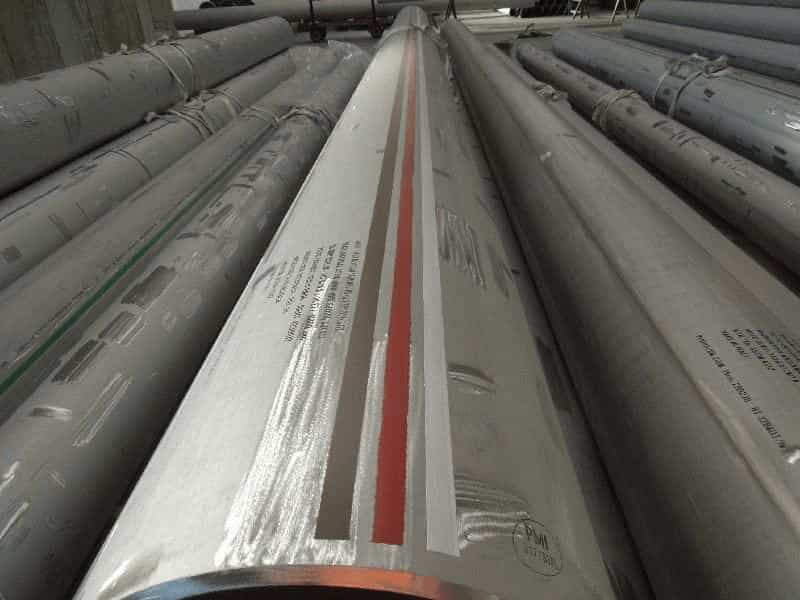
Pipe color codes come in two separate families. Fluid-service codes (ASME A13.1 in the USA, BS 1710 in the UK, IS 2379 in India, ISO 20560-1 internationally) tell operators what is flowing inside a pipe – for example red for fire-quenching water, yellow for flammable fluids and green for water under ASME A13.1. Material codes (PFI ES-22) tell fabricators what the pipe is made of – for example one green stripe for A106 Gr. B and one black stripe for TP304 stainless. Never mix the two systems on the same drawing or specification.
Standards covered in this guide (reviewed October 2026)
- ASME A13.1-2023 – Scheme for the Identification of Piping Systems (current edition; supersedes 2020 and earlier).
- BS 1710:2014 – Specification for identification of pipelines and services (colors referenced to BS 4800).
- IS 2379:1990 (reaffirmed, with Amendment No. 1) – Pipelines – Identification Colour Code (shades to IS 5).
- ISO 20560-1:2024 – Safety information for the content of piping systems and tanks – Part 1: Piping systems.
- PFI ES-22 – Recommended Practice for Color Coding of Piping Materials (Pipe Fabrication Institute).
- Related: OSHA 29 CFR 1910.144 and ANSI Z535.1 (safety colors), ISO 14726 (ships), AS 1345 (Australia), API RP 578 (positive material identification).
1. Fluid Identification vs Material Identification
Most confusion about the term "pipe color code" comes from treating two different systems as one. A plant operator walking a pipe rack needs to know the hazard and contents of a line before opening a valve. A fabrication-shop storeman needs to know whether a spool is A106 Gr. B carbon steel or A335 P22 chrome-moly before it is welded. Each need has its own standard, its own colors and its own point in the project life cycle.
| Attribute | Fluid-service identification | Material identification |
|---|---|---|
| Main standards | ASME A13.1, BS 1710, IS 2379, ISO 20560-1, AS 1345, ISO 14726 (marine) | PFI ES-22, plus project/owner material color specs |
| Identifies | Contents, hazard class, flow direction | Material grade (carbon, alloy, stainless, nickel, aluminum) |
| Applied | After installation and painting, on the finished system | At the mill, stockist or fabrication shop, before welding |
| Method | Painted ground color, color bands or adhesive markers with legend and arrow | Longitudinal stripe on pipe, band on flange hub, stripe on fittings |
| Who relies on it | Operators, maintenance crews, fire and rescue responders | Warehouse, welders, QA/QC, inspectors |
| Replaces other ID? | Does not replace P&ID line numbers or permit-to-work isolation | Does not replace mill stencil, heat number or PMI testing |
2. PFI ES-22 Pipe Color Code for Piping Materials
PFI ES-22, published by the Pipe Fabrication Institute, is the most widely used recommended practice for identifying piping material grades by color. It is written for fabrication shops, stockists and laydown yards where hundreds of similar-looking spools, fittings and flanges are stored side by side. A single mix-up – for example a carbon steel elbow welded into a P91 high-energy steam line – can cause creep or hydrogen failure years later, so a fast visual check matters.
How PFI ES-22 colors are applied
- Pipe: a continuous longitudinal stripe of paint, dye or tape along the full length, so every cut piece keeps its identity.
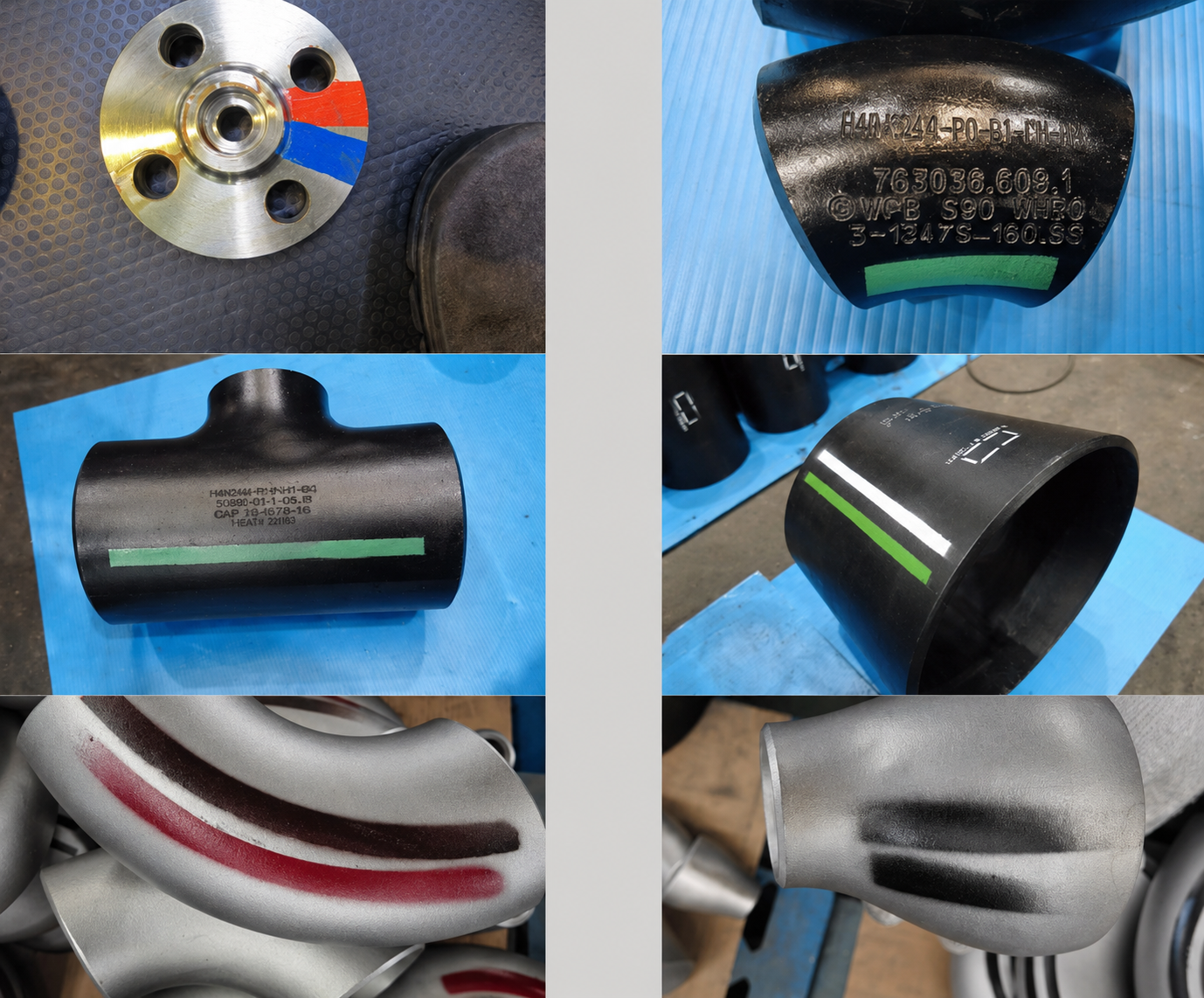
- Flanges: a color band on the back of the flange, where the back face meets the hub.
- Fittings: a stripe running from bevel to bevel (elbows, tees, reducers, caps).
- Weld bevels stay clean: paint must not be applied to weld preparation surfaces.
- Paint chemistry: for stainless steel and nickel alloys use markers that are low in chlorides, sulfur and low-melting metals (zinc, lead) to avoid stress corrosion cracking and liquid-metal embrittlement.
Carbon steel and high-yield line pipe
| Material | Typical ASTM / API spec | UNS | PFI ES-22 color marking |
|---|---|---|---|
| Carbon steel, ERW pipe | ASTM A53 Gr. B (ERW) | K03005 | 1 solid White |
| Carbon steel, seamless | ASTM A53 Gr. B (Smls) | K03005 | No marking |
| Carbon steel, killed, seamless | ASTM A106 Gr. B | K03006 | 1 solid Green |
| Carbon steel, higher strength | ASTM A106 Gr. C | K03501 | 2 solid Green |
| Carbon steel, low temperature (impact tested) | ASTM A333 Gr. 6 | K03006 | 1 solid Red |
| High-yield line pipe, 52 ksi | API 5L X52 | – | 1 solid Yellow + 1 solid Green |
| High-yield line pipe, 60 ksi | API 5L X60 | – | 1 solid Yellow + 1 solid Pink |
| High-yield line pipe, 65 ksi | API 5L X65 | – | 2 solid Yellow |
| High-yield line pipe, 70 ksi | API 5L X70 | – | 1 solid Yellow + 1 solid Orange |
Low-alloy chrome-moly steels
| Material | Typical ASTM / API spec | UNS | PFI ES-22 color marking |
|---|---|---|---|
| C–½Mo | ASTM A335 P1 | K11522 | 1 solid Orange |
| 1Cr–½Mo | ASTM A335 P12 | K11562 | 1 solid Orange + 1 solid Blue |
| 1¼Cr–½Mo | ASTM A335 P11 | K11597 | 1 solid Yellow |
| 2¼Cr–1Mo | ASTM A335 P22 | K21590 | 1 solid Blue |
| 5Cr–½Mo | ASTM A335 P5 | K41545 | 1 solid Blue + 1 solid Yellow |
| 9Cr–1Mo | ASTM A335 P9 | S50400 | 2 solid Orange |
| 9Cr–1Mo–V (CSEF) | ASTM A335 P91 | K91560 | 1 solid Pink + 1 solid Gray |
| 9Cr–2W (CSEF) | ASTM A335 P92 | K92460 | 1 solid Green + 1 solid Gray |
Stainless steels
| Material | Typical ASTM / API spec | UNS | PFI ES-22 color marking |
|---|---|---|---|
| Type 405 (ferritic) | ASTM A268 TP405 | S40500 | 1 solid Green + 1 solid Black |
| Type 410 (martensitic) | ASTM A268 TP410 | S41000 | 1 solid Green + 1 solid Red |
| Type 304 | ASTM A312 TP304 | S30400 | 1 solid Black |
| Type 304L | ASTM A312 TP304L | S30403 | 2 solid Black |
| Type 304H | ASTM A312 TP304H | S30409 | Intermittent Black |
| Type 309 | ASTM A358 Gr. 309 | S30900 | 1 solid Black + 1 solid Brown |
| Type 310 | ASTM A358 Gr. 310 | S31000 | 1 solid Green + 1 solid Orange |
| Type 316 | ASTM A312 TP316 | S31600 | 1 solid Gray |
| Type 316L | ASTM A312 TP316L | S31603 | 2 solid Gray |
| Type 316H | ASTM A312 TP316H | S31609 | Intermittent Gray |
| Type 317 | ASTM A312 TP317 | S31700 | 1 solid Brown + 1 solid Green |
| Type 317L | ASTM A312 TP317L | S31703 | 1 solid Brown + 1 solid Red |
| Type 321 | ASTM A312 TP321 | S32100 | 1 solid Pink |
| Type 321H | ASTM A312 TP321H | S32109 | 2 solid Pink |
| Type 347 | ASTM A312 TP347 | S34700 | 1 solid Brown |
| Type 347H | ASTM A312 TP347H | S34709 | 2 solid Brown |
Nickel alloys and aluminum
| Material | Typical ASTM / API spec | UNS | PFI ES-22 color marking |
|---|---|---|---|
| Nickel 200 | ASTM B161 | N02200 | 1 solid Black + 1 solid Pink |
| Alloy 800 (Incoloy 800) | ASTM B407 | N08800 | 1 solid Black + 1 solid Orange |
| Alloy 800H | ASTM B407 | N08810 | 1 solid Gray + 1 solid Red |
| Alloy 825 (Incoloy 825) | ASTM B423 | N08825 | 1 solid Gray + 1 solid Blue |
| Alloy 600 (Inconel 600) | ASTM B167 | N06600 | 2 solid Blue |
| Alloy 625 (Inconel 625) | ASTM B444 | N06625 | 1 solid Blue + 1 solid Pink |
| Alloy B-2 (Hastelloy B-2) | ASTM B622 | N10665 | 1 solid Red + 1 solid Orange |
| Alloy C-276 (Hastelloy C-276) | ASTM B622 | N10276 | 1 solid Red + 1 solid Blue |
| Alloy C-22 (Hastelloy C-22) | ASTM B622 | N06022 | 2 solid Red |
| Alloy G (Hastelloy G) | ASTM B622 | N06007 | 1 solid Red + 1 solid Yellow |
| Alloy 20 (Carpenter 20Cb-3) | ASTM B464 | N08020 | 1 solid Black + 1 solid Blue |
| Alloy 400 (Monel 400) | ASTM B165 | N04400 | 1 solid Black + 1 solid Yellow |
| Aluminum 3003 | ASTM B241 | A93003 | 1 solid Purple |
| Aluminum 6061 | ASTM B241 | A96061 | 1 solid Tan |
Engineering caution
- PFI ES-22 colors are supplementary. The legal identity of a component is its mill marking (spec, grade, heat number) and the material test report (EN 10204 3.1).
- For alloy systems, owners commonly require 100% positive material identification (PMI) per API RP 578 regardless of color.
- Many EPC contractors issue their own material color code tables. When a project table differs from ES-22, the project table governs – record it in the piping material specification.
3. ASME A13.1 Pipe Color Code and Marking Scheme
ASME A13.1, "Scheme for the Identification of Piping Systems", is the reference for fluid-service pipe marking in the United States and in many oil, gas and power projects worldwide. It is the document OSHA inspectors and US fire codes point to for pipe labels. The current edition is ASME A13.1-2023; the 2020 revision refined definitions, the legend and color sections and added guidance for abandoned piping. The core color scheme introduced in 2007 has not changed.
A compliant ASME marker has three elements: a color field that shows the hazard class, a legend naming the contents (and, where useful, temperature or pressure), and an arrow showing flow direction. GHS hazard pictograms may be added as supplementary information.
| Classification | What it covers | Marker colors (text on field) | Typical legends |
|---|---|---|---|
| Fire quenching fluids | Water, foam, CO2, clean-agent and other fire-fighting media | WHITE on RED | FIRE WATER, FOAM, CO2 |
| Toxic and corrosive fluids | Fluids that are toxic or corrosive, or produce such substances when released | BLACK on ORANGE | SULFURIC ACID, CHLORINE, AMMONIA |
| Flammable fluids | Liquids, vapors and gases that ignite and keep burning in air | BLACK on YELLOW | NATURAL GAS, HYDROGEN, GASOLINE |
| Oxidizing fluids | Fluids that readily support or accelerate combustion | BLACK on YELLOW | OXYGEN, NITROUS OXIDE |
| Combustible fluids | Liquids that burn but are not classed as flammable (higher flash point) | WHITE on BROWN | DIESEL, LUBE OIL, FUEL OIL |
| Potable, cooling, boiler feed and other water | Non-hazardous water services | WHITE on GREEN | COOLING WATER, BOILER FEED WATER |
| Compressed air | Air under pressure (non-hazardous) | WHITE on BLUE | PLANT AIR, INSTRUMENT AIR |
| User-defined | Owner-assigned services (often steam, condensate, vacuum, inert gas) | WHITE on PURPLE BLACK on WHITE WHITE on GRAY WHITE on BLACK | LP STEAM, NITROGEN, VACUUM |
ASME A13.1 marker and letter size
Marker size is chosen from the outside diameter of the pipe or insulation jacket, not the nominal bore. For pipe smaller than 3/4 in (19 mm) and for valves and fittings, a permanently attached legible tag is used instead.
| OD incl. insulation (in) | OD (mm) | Color field A (in) | Color field A (mm) | Letter height B (in) | Letter height B (mm) |
|---|---|---|---|---|---|
| 0.75 – 1.25 | 19 – 32 | 8 | 200 | 0.5 | 13 |
| 1.5 – 2 | 38 – 51 | 8 | 200 | 0.75 | 19 |
| 2.5 – 6 | 64 – 152 | 12 | 300 | 1.25 | 32 |
| 8 – 10 | 203 – 254 | 24 | 600 | 2.5 | 64 |
| Over 10 | Over 254 | 32 | 800 | 3.5 | 89 |
Worked example
A 6 in (DN 150) steam line has OD 6.625 in. With 2 in mineral wool insulation the jacket OD is about 10.6 in, which is over 10 in. Use a color field of at least 32 in (800 mm) with 3.5 in (89 mm) letters – not the 12 in marker that the bare pipe size would suggest.
4. BS 1710 Pipe Colour Code (UK)
BS 1710:2014 is the British Standard for identifying pipelines and services above and below ground in buildings, industrial plants and ships’ shore installations. It uses a two-level system:
- Basic identification colour – shows the fluid group. It is painted along the whole pipe or applied as a band at each identification point.
- Safety colour or code indication – a narrower band placed between two basic-colour bands to show a specific hazard or service (fire fighting, drinking water, etc.).
All colours are specified by BS 4800 reference numbers, which is what a painting or marker specification should quote. A flow arrow in black or white (whichever contrasts better) and the content name complete the marking.
| Pipe contents | Basic colour | BS 4800 ref. | Typical services |
|---|---|---|---|
| Water | Green | 12 D 45 | Potable, cooling, boiler feed, process and fire water |
| Steam | Silver-grey | 10 A 03 | All steam services |
| Oils (mineral, vegetable, animal) and combustible liquids | Brown | 06 C 39 | Fuel oil, lube oil, hydraulic oil |
| Gases (except air) | Yellow ochre | 08 C 35 | Natural gas, LPG vapor, nitrogen, oxygen |
| Acids and alkalis | Violet | 22 C 37 | Sulfuric acid, caustic soda |
| Air | Light blue | 20 E 51 | Compressed air, instrument air, vacuum |
| Other fluids | Black | 00 E 53 | Drainage and services not covered above |
| Electrical services and ventilation ducts | Orange | 06 E 51 | Conduits, cable ducts, ventilation |
| Purpose | Safety colour | BS 4800 ref. | How it is used |
|---|---|---|---|
| Fire fighting | Red | 04 E 53 | Band between basic color bands, e.g. green–red–green for fire water |
| Warning (dangerous contents) | Yellow with black diagonal stripes | 08 E 51 | Highlights hazardous fluids in addition to the basic color |
| Fresh (potable) water | Auxiliary blue | 18 E 53 | Green–blue–green identifies drinking water |
Band width: BS 1710 scales band sizes to the outside diameter including insulation, so a large insulated line needs wider bands than a small bare pipe. In practice UK marker suppliers offer bands from about 150 mm wide on small pipe up to 600 mm or more on large lines. State the minimum widths in the project painting specification so that contractors do not guess.
5. IS 2379 Pipe Colour Code for Pipeline Identification (India)
IS 2379:1990 from the Bureau of Indian Standards covers identification of fluids in pipelines in buildings and industrial installations that do not already follow a specific industry code. It is common in Indian and South Asian refineries, fertilizer plants and power stations. It excludes buried pipelines and electrical services.
The scheme uses a ground colour (fluid group), applied either over the whole pipe or as a length at each marking point, with one or two narrower colour bands superimposed to identify the exact fluid or its condition. Shades are named to IS 5 (Colours for ready mixed paints and enamels). The content name and a flow arrow are added in a contrasting colour; the standard gives separate arrow sizes for pipes up to DN 200 and above DN 200.
| Fluid group | Ground colour (IS 5 shade) |
|---|---|
| Water | Sea green |
| Steam | Aluminium (to IS 2339) |
| Oils and combustible liquids | Light brown |
| Acids | Dark violet |
| Alkalis | Smoke grey |
| Air | Sky blue |
| Gases | Canary yellow |
| Hydrocarbons and organic compounds | Dark admiralty grey |
| Fire-fighting water | Fire red |
| Contents | Ground colour | First colour band | Second colour band |
|---|---|---|---|
| Cooling water | Sea green | French blue | – |
| Boiler feed water | Sea green | Gulf red | – |
| Drinking water | Sea green | French blue | Signal red |
| Fire water | Fire red | – | – |
| Steam (all pressures) | Aluminium | – | – |
| Nitrogen | Canary yellow | Black | – |
| Oxygen | Canary yellow | White | – |
| LPG (gas) | Canary yellow | Oxide red | White |
| LPG (liquid) | Dark admiralty grey | Brilliant green | Dark violet |
| Sulphuric acid | Dark violet | Brilliant green | Light orange |
| Hydrochloric acid | Dark violet | Signal red | Light orange |
| Caustic solution | Smoke grey | Light orange | – |
6. ISO 20560-1 Piping Content Marking (International)
ISO 20560-1 was first published in 2020 and revised as a second edition in June 2024, which adjusted several color values (notably yellow and maroon). It is the first truly international standard for marking pipe contents and is increasingly specified on multinational projects in Europe, the Middle East and Asia. Part 2 covers tanks.
An ISO 20560-1 marker combines four elements: an identification color for the content group, the content name (or chemical formula), a flow direction arrow and, for hazardous contents, the relevant GHS hazard pictograms. Supplementary colors and technical data (pressure, temperature) may be added.
| Content group | Marker color |
|---|---|
| Water | White on green |
| Fire-fighting media | White on red |
| Air | White on blue |
| Gases (non-hazardous) | Black on grey |
| Acids | Black on orange |
| Alkalis | White on violet |
| Liquids and solids (other) | White on black |
| Hazardous contents (flammable, toxic, etc.) | Black on yellow + GHS pictogram |
7. Pipe Color Code Comparison: ASME vs BS vs IS vs ISO
Use this cross-reference when a project mixes vendors or owners from different regions, or when converting an existing plant from one scheme to another. The colors are not interchangeable – for example, green means water everywhere, but steam is silver-grey in BS 1710 and aluminium in IS 2379, while ASME A13.1 has no dedicated steam color.
| Service | ASME A13.1 (USA) | BS 1710 (UK) | IS 2379 (India) | ISO 20560-1 | AS 1345 (Australia) | ISO 14726 (Ships) |
|---|---|---|---|---|---|---|
| Water | Green | Green | Sea green | Green | Jade | Blue (fresh) / green (sea) |
| Fire fighting | Red | Green + red band | Fire red | Red | Signal red | Red |
| Steam | User-defined (often per hazard) | Silver-grey | Aluminium | Per content group / hazard | Silver grey | Silver |
| Compressed air | Blue | Light blue | Sky blue | Blue | Aqua | Maroon (air/sounding) |
| Flammable gas | Yellow | Yellow ochre (+ yellow warning) | Canary yellow | Yellow | Sand (+ golden yellow) | Yellow |
| Oils / fuels | Brown (combustible) or yellow (flammable) | Brown | Light brown | Black or yellow (hazardous) | Golden tan | Brown (fuel), orange (oils) |
| Acids and alkalis | Orange | Violet | Dark violet / smoke grey | Orange / violet | Lilac | Violet |
| Electrical | Not covered | Orange | Excluded | Not covered | Orange | – |
8. Where to Place Pipe Color Code Markers
A marker is only useful if someone can see it from where they stand. All the fluid-service standards agree on the same principle: identify every line at points where a person needs to make a decision – at valves, branches, penetrations and at intervals along straight runs.
| Location | ASME A13.1 | BS 1710 | IS 2379 |
|---|---|---|---|
| Valves and flanges | Next to valves and flanges | At valves and junctions | At battery-limit and isolation points |
| Change of direction / branches | Adjacent to changes in direction and branches | At junctions and changes of direction | At branches and changes of direction |
| Wall, floor and ceiling penetrations | Both sides of the penetration | Both sides of walls, floors and bulkheads | Both sides of walls and culverts |
| Straight runs | At frequent intervals (plants typically 6–15 m) | At regular intervals, closer in congested areas | At regular intervals along long yard runs |
| Overhead / below eye level | Below or above the horizontal centerline so it faces the viewer | Visible from the normal access route | Visible from the normal approach |
| Concealed / ducted services | Mark at access panels | Mark at every access point | Mark at accessible points |
9. How to Specify a Pipe Marking System for a Project
- Name the governing standard. Check the contract and owner specification: ASME A13.1 for US-based owners, BS 1710 for UK, IS 2379 for Indian PSU clients, ISO 20560-1 for many international projects. Use one scheme per facility.
- Build a fluid list. Take every service from the P&ID line list and classify it (flammable, toxic, water, air, user-defined). Steam, condensate and inert gas need an owner decision under ASME A13.1.
- Size the markers. Use OD over insulation to select marker length and letter height from the size table.
- Define the legend. Content name, line number if required, and flow arrow. Add GHS pictograms for hazardous fluids where ISO 20560 or owner rules ask for them.
- Choose marker material. Painted bands for hot or outdoor lines; UV-stable, temperature-rated adhesive or strap-on markers elsewhere. Check compatibility with stainless steel and insulation cladding.
- Coordinate with the painting spec. Ground or band colors must match the coating system (e.g. ISO 12944) and quote BS 4800, IS 5 or RAL references.
- Mark placement on drawings. Show marker locations on isometrics or a marking plan: valves, branches, penetrations and intervals.
- Fabrication control. Separately require PFI ES-22 (or project) material colors in the shop plus PMI for alloys.
- Maintain and update. Replace faded markers, re-mark after modifications and identify abandoned lines so they are never mistaken for live services.
10. Common Pipe Color Code Mistakes
11. Frequently Asked Questions
What is the standard color code for pipes?
There is no single world-wide code. In the USA, ASME A13.1 is used: red for fire-quenching fluids, orange for toxic and corrosive, yellow for flammable and oxidizing, brown for combustible, green for water and blue for compressed air. The UK uses BS 1710, India uses IS 2379 and international projects increasingly use ISO 20560-1.
What color is a fire water pipe?
Fire water and other fire-quenching lines are red: white text on a red marker under ASME A13.1, a red safety band between green bands under BS 1710, and fire red ground color under IS 2379.
What color is a steam pipe?
BS 1710 uses silver-grey and IS 2379 uses aluminium for steam. ASME A13.1 has no dedicated steam color, so owners assign one of the user-defined colors (purple, white, gray or black) or classify it by hazard.
What is PFI ES-22?
PFI ES-22 is the Pipe Fabrication Institute recommended practice for color coding piping materials. It identifies material grades with stripes and bands, for example one green stripe for A106 Grade B and one black stripe for TP304 stainless steel. It is used in fabrication shops, not for fluid identification.
How big should a pipe marker be?
Under ASME A13.1 the marker size is based on outside diameter including insulation: 8 in (200 mm) markers with 0.5 to 0.75 in letters for small pipe, rising to 32 in (800 mm) markers with 3.5 in (89 mm) letters for OD over 10 in.
Where should pipe labels be placed?
Next to valves and flanges, at branches and changes of direction, on both sides of walls and floors, and at regular intervals on straight runs. On overhead pipe, place the label below the centerline so it can be read from the floor.
Is ASME B13.1 a valid standard?
No. The pipe identification standard is ASME A13.1. References to ASME B13.1 are a common typo.
Does color coding replace positive material identification?
No. PFI ES-22 colors are a visual aid only. Alloy piping should still be verified with mill markings, material test reports and PMI testing per API RP 578.
12. Test Your Knowledge: Pipe Color Code Quiz
1. Under PFI ES-22, what marking identifies ASTM A106 Grade B pipe?
2. Under ASME A13.1, which marker colors indicate a flammable fluid?
3. What does an ASME A13.1 orange marker indicate?
4. Which basic identification colour does BS 1710 use for steam?
5. What is the IS 2379 ground colour for water services?
6. An insulated line has a jacket OD of 11 in. What ASME A13.1 letter height applies?
7. In PFI ES-22, how is TP316L stainless steel identified?
8. Where must PFI ES-22 paint NOT be applied?
Related Aienginear Guides and Tools
References and further reading
- ANSI Blog – ASME A13.1-2023 Identification of Piping Systems
- ISO 20560-1:2024 – official ISO catalogue page
- OSHA 29 CFR 1910.144 – Safety color code for marking physical hazards
- BSI – BS 1710:2014; Bureau of Indian Standards – IS 2379:1990; Pipe Fabrication Institute – ES-22 (purchase current editions from the publishers).

Written by Muhammad Raza
Founder of Aienginear. Engineering and digital solutions professional with 26+ years managing projects, plant shutdowns and turnarounds in oil & gas, petrochemical and power generation.