
Carbon steel is the fundamental material for industrial process piping due to its high tensile strength and versatility. Its performance depends heavily on the deoxidization manufacturing process—specifically, using fully “killed” steel to prevent porosity—and selecting the correct ASTM grade. While ASTM A106 (seamless) is mandated for high-temperature, high-pressure environments, ASTM A53 (welded or seamless) is standard for structural applications and low-pressure utilities.
Carbon Steel Piping
Carbon steel is one of the most extensively used materials in the process piping industry due to its strength, availability, and versatility. Before selecting carbon steel for industrial applications, it is essential to understand the different variations, manufacturing processes, and specific ASTM grades.
1. The Deoxidization Process: Killed vs. Semi-Killed Steel
During steel manufacturing, oxygen is deliberately injected into the molten metal to reduce its carbon content. The oxygen combines with excess carbon, forming a gas. However, excess oxygen is unavoidably left in the molten steel, which can cause porosity and oxide inclusions upon solidification.
· To prevent this, the oxygen is removed through a process known as deoxidizing. This is achieved by adding deoxidizing agents like silicon or aluminum. The degree of this process creates three main types of steel:
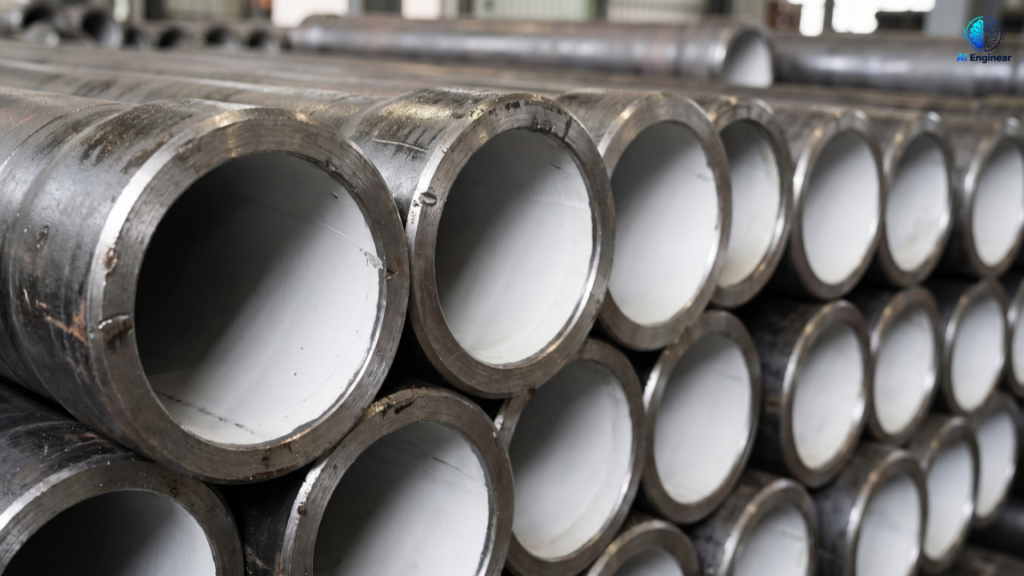
· Killed Carbon Steel: Completely deoxidized; no free oxygen remains. This results in uniform composition and superior toughness. Only fully killed steel is used in process piping.
· Semi-Killed Carbon Steel: Partially deoxidized, leaving some free oxygen. Properties fall between killed and rimmed steel.
· Rimmed Steel: Produced without Deoxidization. It is brittle, has poor elongation, and is not suitable for process piping.
2. Cast Iron vs. Cast Steel
It is critical to distinguish between cast iron and cast steel, as their carbon content and resulting properties differ significantly.
Cast Iron: A ferrous metal containing more than 2% Carbon by weight. Because it is hard and brittle, it is generally not used for standard process piping. However, ductile iron pipes are widely utilized in water distribution networks due to their excellent corrosion resistance. Gray cast iron (ASTM A48) and malleable iron (ASTM A47) are also common.
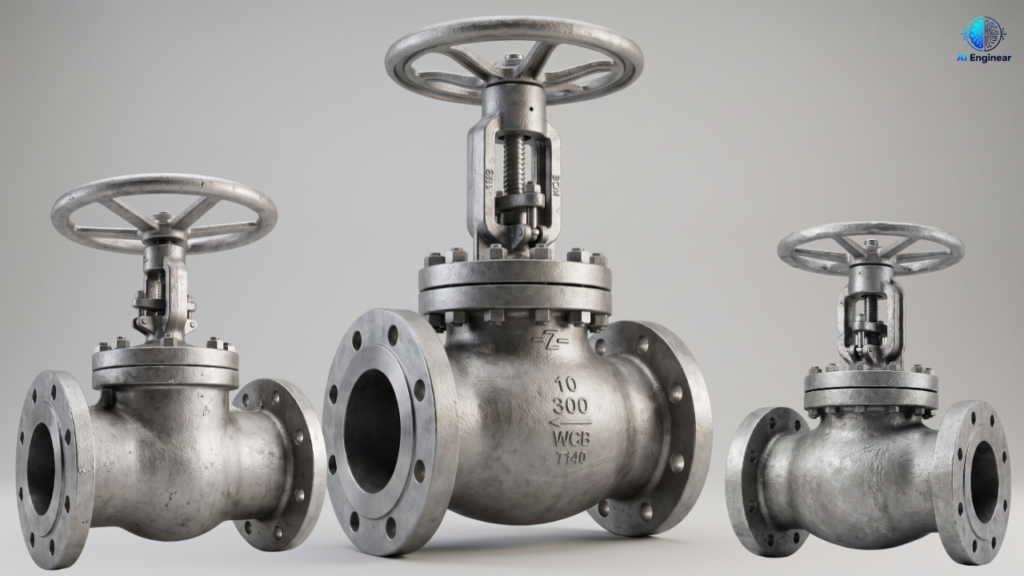
Cast Steel: A ferrous metal containing less than 2% Carbon by weight. Cast steel is frequently used in process industries for manufacturing valve bodies and cast fittings. A common example is ASTM A216 Gr WCB and A352 Gr LCB/C.
3. Carbon Steel (CS) in Process Piping
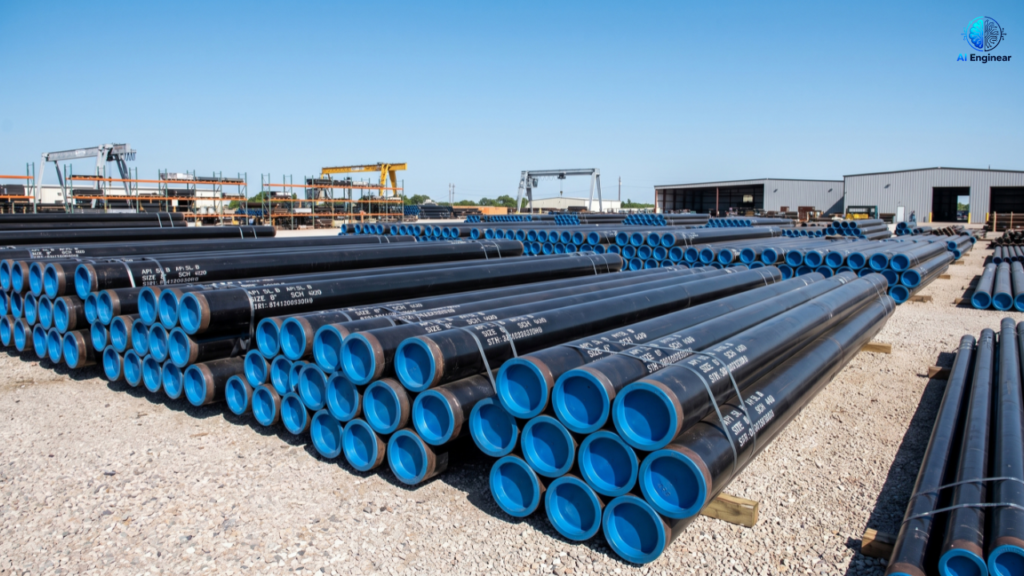
Carbon Steel (CS) technically falls under the cast steel definition in terms of carbon content but differs in manufacturing methods—it is produced via rolling, forging, and drawing. Iron is the primary element, but it is technically a type of alloy steel due to the presence of other elements:
· Metallic alloying elements: Manganese, Nickel, Chromium, Molybdenum, Vanadium, Aluminum, Copper, Silicon.
· Non-Metallic alloying elements: Carbon, Phosphorus, Sulfur.
4. Classification Based on Carbon Content
· Low Carbon Steel (Mild Steel): 0.05% to 0.25% Carbon.
· Medium Carbon Steel: 0.25% to 0.5% Carbon.
· High Carbon Steel: 0.5% to less than 2% Carbon.
5. Commonly Used ASTM Material Grades
Different forms of piping materials require specific ASTM/ASME standards. Below is a validated list of standard applications:
· Pipes: ASTM A53 Gr A/B, ASTM A106 Gr A/B/C, API 5L Gr B.
· Wrought Products (Fittings): ASTM A234 Gr WPA/B, ASTM A420 Gr WPL6.
· Forged Products (Valves, Flanges): ASTM A105, ASTM A350 Gr LF1/LF2, ASTM A182.
Deep Dive: ASTM A53 vs. ASTM A106 Pipe
A common engineering dilemma is choosing between A53 and A106 pipes. While both cover carbon steel pipes and have similar mechanical strengths (e.g., Grade B Yield Strength of 35,000 psi), their applications differ drastically.
| Feature | ASTM A53 | ASTM A106 |
| Manufacturing Process | Seamless or Welded (ERW) | Strictly Seamless only |
| Silicon Content | Not specified (0%) | Min 0.10% (Improves heat resistance) |
| Intended Application | Low-to-medium pressure, structural, water/air transport | High-temperature services (up to 750°F), high pressure |
6. Chemical Composition and Mechanical Properties (Verified)
The table below highlights the chemical analysis and mechanical requirements for widely used Carbon Steel and Alloy specs (ASTM A53 & A106):
| Specification | Carbon (C) Max % | Manganese (Mn) % | Yield Strength (Min) | Tensile Strength (Min) |
| ASTM A53 Grade B | 0.30 | 1.20 Max | 240 MPa (35,000 psi) | 415 MPa (60,000 psi) |
| ASTM A106 Grade B | 0.30 | 0.29 – 1.06 | 240 MPa (35,000 psi) | 415 MPa (60,000 psi) |
| ASTM A106 Grade C | 0.35 | 0.29 – 1.06 | 275 MPa (40,000 psi) | 485 MPa (70,000 psi) |
Carbon Steel, Alloy Steel, Low Temp, Pipe & Tubes Specification
| Specification | CHEMICAL ANALYSIS | Mechanical Properties | SPECIFIC REQUIREMENT | ||||||||
|---|---|---|---|---|---|---|---|---|---|---|---|
| C% | Mn% | P% MAX | S% MAX | Si% | Cr% | Mo% | Tensile Strength (Mpa) | Yield Strength (Mpa) | Elongation 50mm MIN Longitudinal | ||
| ASTM A 53/A | 0.25MAX | 0.95MAX | 0.05 | 0.06 | – | – | – | 331MIN | 207 MIN | 36 | |
| ASTM A 53/B | 0.30MAX | 1.20MAX | 0.05 | 0.06 | – | – | – | 413MIN | 240MIN | 29.5 | Cr Mo Cu Ni Va 0.40 0.15 0.40 0.40 0.08 five elements not to exceed 1% |
| ASTM A 106/A | 0.25MAX | 0.27-0.93 | 0.025 | 0.025 | 0.10MIN | 0.40MAX | 0.15MAX | 330MIN | 205MIN | 35/28 | |
| ASTM A 106/B | 0.30MAX | 0.29-1.06 | 0.025 | 0.025 | 0.10MIN | 0.40MAX | 0.15MAX | 415MIN | 240MIN | 30/22 | |
| ASTM A 106/C | 0.35MAX | 0.29-1.06 | 0.025 | 0.025 | 0.10MIN | 0.40MAX | 0.15MAX | 485MIN | 275MIN | 30/22 | |
| ASTM A 179 | 0.06-0.18 | 0.27-0.63 | 0.048 | 0.048 | – | – | – | 325MIN | 180MIN | 35 | Hardness 72 HRB MAX |
| ASTM A 214 | 0.18MAX | 0.27-0.63 | 0.05 | 0.05 | – | – | – | 385MIN | 180MIN | 35 | Hardness 72 HRB MAX |
| ASTM A 192 | 0.06-0.18 | 0.27-0.63 | 0.048 | 0.048 | 0.25MAX | – | – | 325MIN | 180MIN | 35 | Hardness 77 HRB MAX |
| ASTM A 209/T1 | 0.10-0.20 | 0.30-0.80 | 0.045 | 0.045 | 0.10-0.50 | – | 0.44-0.65 | 380MIN | 205MIN | 30/22 | Hardness 80 HRB MAX |
| ASTM A 209/T1a | 0.15-0.25 | 0.30-0.80 | 0.045 | 0.045 | 0.10-0.50 | – | 0.44-0.65 | 365MIN | 195MIN | 30/22 | Hardness 81 HRB MAX |
| ASTM A 209/T1B | 0.14MAX | 0.30-0.80 | 0.045 | 0.045 | 0.10-0.50 | – | 0.44-0.65 | 415MIN | 220MIN | 30/22 | Hardness 77 HRB MAX |
| ASTM A 210/A-1 | 0.27MAX | 0.93MAX | 0.048 | 0.058 | 0.10MIN | – | – | 415MIN | 255MIN | 30/22 | Hardness 79 HRB MAX |
| ASTM A 210/C | 0.35MAX | 0.29-1.06 | 0.048 | 0.058 | 0.10MIN | – | – | 485MIN | 275MIN | 30/22 | Hardness 89 HRB MAX |
| ASTM A 213/T2 | 0.10/0.20 | 0.30-0.61 | 0.045 | 0.045 | 0.10-0.30 | 0.50-0.81 | 0.44-0.65 | 415MIN | 205MIN | 30/22 | Hardness 85 HRB MAX |
| ASTM A 213/T5 | 0.15MAX | 0.30-0.60 | 0.03 | 0.03 | 0.50MAX | 4.00-6.00 | 0.44-0.65 | 415MIN | 205MIN | 30/22 | Hardness 85 HRB MAX |
| ASTM A 213/T11 | 0.15MAX | 0.30-0.60 | 0.03 | 0.03 | 0.50-1.00 | 1.00-1.50 | 0.44-0.65 | 415MIN | 205MIN | 30/22 | Hardness 85 HRB MAX |
| ASTM A 213/T12 | 0.15MAX | 0.30-0.61 | 0.045 | 0.045 | 0.50MAX | 0.80-1.25 | 0.44-0.65 | 415MIN | 220MIN | 30/22 | Hardness 85 HRB MAX |
| ASTM A 213/T22 | 0.15MAX | 0.30-0.60 | 0.03 | 0.03 | 0.50MAX | 1.90-2.60 | 0.87-1.13 | 415MIN | 205MIN | 30/22 | Hardness 85 HRB MAX |
| ASTM A 333/1 | 0.30MAX | 0.40-1.06 | 0.025 | 0.025 | – | – | – | 380MIN | 205MIN | 25/20 | Impact AS -50F FOR 40X10J/18/14 90 HRB MAX |
| ASTM A 333/6 | 0.30MAX | 0.29-1.06 | 0.025 | 0.025 | 0.10MIN | – | – | 415MIN | 240MIN | 30/22 | |
| ASTM A 334/1 | 0.30MAX | 0.40-1.06 | 0.025 | 0.025 | – | – | – | 380MIN | 205MIN | 35/28 | |
| ASTM A 334/6 | 0.30MAX | 0.29-1.06 | 0.025 | 0.025 | 0.10MIN | – | – | 415MIN | 240MIN | 30/22 | |
| ASTM A 335/P1 | 0.10-0.20 | 0.30-0.80 | 0.025 | 0.025 | 0.10-0.50 | – | 0.44-0.65 | 380MIN | 205MIN | 30/22 | |
| ASTM A 335/P2 | 0.10-0.20 | 0.30-0.61 | 0.025 | 0.025 | 0.10-0.30 | 0.50-0.81 | 0.44-0.65 | 380MIN | 205MIN | 30/22 | |
| ASTM A 335/P5 | 0.15MAX | 0.30-0.60 | 0.025 | 0.025 | 0.50MAX | 4.00-6.00 | 0.45-0.65 | 415MIN | 205MIN | 30/22 | |
| ASTM A 335/P9 | 0.15MAX | 0.30-0.60 | 0.025 | 0.025 | 0.25-1.00 | 8.00-10.00 1.00-1.50 |
0.09-1.10 | 415MIN | 172MIN | 30/22 | |
| ASTM A 335/P11 | 0.15MAX | 0.30-0.60 | 0.025 | 0.025 | 0.50-1.00 | 0.80-1.25 | 0.44-0.65 | 415MIN | 205MIN | 30/22 | |
| ASTM A 335/P12 | 0.15MAX | 0.30-0.61 | 0.025 | 0.025 | 0.50MAX | 1.90-2.60 | 0.44-0.65 | 415MIN | 205MIN | 50/22 | |
| ASTM A 335/P22 | 0.15MAX | 0.30-0.60 | 0.025 | 0.025 | 0.50MAX | – | 0.87-1.13 | 415MIN | 205MIN | 30/22 | |
| ASTM A 199/T5 | 0.50-0.15 | 0.30-0.60 | 0.03 | 0.03 | 0.50MAX | 4.00-6.00 | 0.45-0.65 | 415MIN | 170MIN | 30/22 | Hardness 85 HRB MAX |
| ASTM A 199/T11 | 0.50-0.15 | 0.30-0.60 | 0.03 | 0.03 | 0.50-1.00 | 1.00-1.50 | 0.44-0.65 | 415MIN | 170MIN | 30/22 | Hardness 85 HRB MAX |
| API 5L Grade B | 0.28MAX | 1.20MAX | 0.030 | 0.030 | – | – | – | 414MIN | 241MIN | Varies by wall thickness | PSL 1. Max Cu, Ni, Cr = 0.50% |
| API 5L X42 | 0.28MAX | 1.30MAX | 0.030 | 0.030 | – | – | – | 414MIN | 290MIN | Varies by wall thickness | PSL 1. Max Cu, Ni, Cr = 0.50% |
| API 5L X52 | 0.28MAX | 1.40MAX | 0.030 | 0.030 | – | – | – | 460MIN | 359MIN | Varies by wall thickness | PSL 1. Max Cu, Ni, Cr = 0.50% |
| API 5L X60 | 0.28MAX | 1.40MAX | 0.030 | 0.030 | – | – | – | 517MIN | 414MIN | Varies by wall thickness | PSL 1. Max Cu, Ni, Cr = 0.50% |
Different Types of Carbon Steel Piping Material
Different types of carbon steel piping materials are selected based on temperature, pressure, fluid service, fabrication method, corrosion allowance, toughness requirements, and applicable piping codes. In process plants, refineries, power plants, chemical facilities, and oil and gas systems, carbon steel remains one of the most widely used piping materials because it offers good strength, weldability, availability, and cost efficiency.
Carbon steel piping materials commonly include seamless and welded pipes, butt-weld fittings, forged fittings, flanges, valves, and cast steel components. Common pipe specifications include ASTM A53, ASTM A106, API 5L, ASTM A333, ASTM A134, ASTM A135, ASTM A139, ASTM A691, and ASTM A106 Grade B. Typical carbon steel fittings include ASTM A234 WPB, while forged flanges and fittings are often manufactured to ASTM A105. For low-temperature services, ASTM A350 LF2 and ASTM A420 WPL6 are commonly used because they provide improved notch toughness.
For process piping, fully killed carbon steel is generally preferred because it is completely deoxidized during manufacturing. This produces a more uniform chemical composition and greater toughness than semi-killed or rimmed steel. Semi-killed steel is only partially deoxidized, whereas rimmed steel can exhibit greater porosity and is generally unsuitable for critical process piping applications.
Carbon steel is also classified by carbon content. Low-carbon steel typically contains about 0.05% to 0.25% carbon and is widely used where good weldability and ductility are required. Medium-carbon steel generally contains about 0.25% to 0.50% carbon and provides higher strength but lower weldability. High-carbon steel contains approximately 0.50% to less than 2% carbon and is normally used for specialized mechanical applications rather than standard process piping.
Cast steel should not be confused with cast iron. Cast iron contains 2% or more carbon and is hard but brittle, making it unsuitable for most pressurized process piping systems. Cast steel contains less than 2% carbon and is commonly used for valve bodies, cast fittings, and pressure-containing components. Common cast steel grades include ASTM A216 WCB for general-temperature service and ASTM A352 LCB or LCC for low-temperature service.
When selecting carbon steel piping material, engineers should verify compliance with the governing design code, such as ASME B31.3 for process piping, ASME B31.1 for power piping, or applicable pipeline standards. Material selection must also consider design pressure, design temperature, corrosion rate, weldability, impact-test requirements, fluid properties, and inspection requirements.
For reliable piping design, carbon steel material grades should always be checked against the latest applicable ASTM, ASME, API, and project material specifications. The material standard alone does not confirm suitability; the selected grade, schedule, manufacturing method, heat treatment, testing requirements, and service conditions must all be reviewed before final approval.
Frequently Asked Questions About Carbon Steel Piping Material
What is carbon steel piping material?
Carbon steel piping is a steel-based material primarily composed of iron and carbon, with small amounts of elements such as manganese, silicon, phosphorus, sulfur, chromium, nickel, and copper. It is widely used in process plants, oil and gas facilities, power plants, water systems, and industrial piping because it offers good strength, weldability, availability, and cost-effectiveness.
What are the main types of carbon steel used in piping?
The main types are low-carbon steel, medium-carbon steel, and high-carbon steel. Low-carbon steel is the most common category for piping because it has good ductility and weldability. Common piping grades include ASTM A53, ASTM A106, API 5L Grade B, ASTM A333, ASTM A234 WPB, ASTM A105, and ASTM A350 LF2.
What is the difference between fully killed steel and semi-killed steel?
Fully killed steel is completely deoxidized during manufacturing, meaning there is little or no free oxygen remaining in the steel. This creates a more uniform structure and better toughness. Semi-killed steel is only partially deoxidized and may contain more internal variation. Fully killed carbon steel is generally preferred for process piping and pressure-containing applications.
Why is fully killed carbon steel preferred for process piping?
Fully killed carbon steel is preferred because it offers more consistent chemical composition, better toughness, improved weldability, and reduced risk of porosity. These properties are important for piping systems operating under pressure, experiencing temperature changes, subjected to cyclic service, and exposed to demanding industrial conditions.
What is the difference between cast iron and cast steel?
Cast iron generally contains 2% or more carbon and is hard but brittle. It is not normally suitable for pressurized process piping. Cast steel contains less than 2% carbon and has better toughness and ductility. Cast steel is commonly used for valve bodies, fittings, and pressure-containing components.
Which carbon steel pipe grade is commonly used for high-temperature service?
ASTM A106 Grade B is one of the most commonly used seamless carbon steel pipe grades for high-temperature service. Its suitability depends on the design temperature, pressure, fluid service, corrosion allowance, pipe schedule, and the applicable piping code.
What is ASTM A53 pipe used for?
ASTM A53 pipe is commonly used for general mechanical and pressure applications. It is available in seamless and welded forms and may be supplied as black steel pipe or hot-dip galvanized steel pipe. It is frequently used in utility piping, water lines, air systems, structural applications, and low- to moderate-pressure services.
What is the difference between ASTM A53 and ASTM A106 pipe?
ASTM A53 pipe can be seamless or welded and is commonly used for general service. ASTM A106 is a seamless carbon steel pipe designed for high-temperature service. ASTM A106 is usually selected where higher-temperature operating conditions require seamless pipe and more controlled material properties.
What is API 5L Grade B pipe used for?
API 5L Grade B pipe is commonly used for pipeline transportation systems carrying oil, natural gas, water, and other fluids. It is widely used in onshore pipelines, gathering systems, transmission lines, and related energy infrastructure.
What is ASTM A234 WPB?
ASTM A234 WPB is a common carbon steel specification for wrought butt-welding fittings. It is used for elbows, tees, reducers, caps, and other fittings connected by butt welding in carbon steel piping systems.
What is ASTM A105 material used for?
ASTM A105 is a carbon steel forging specification commonly used for pipe flanges, forged fittings, valves, and pressure-containing components. It is generally used in ambient and higher-temperature service, subject to the limits of the applicable design code and project specification.
Which carbon steel materials are used for low-temperature piping?
Common low-temperature carbon steel materials include ASTM A333 pipe, ASTM A420 WPL6 butt-weld fittings, ASTM A350 LF2 forged flanges and fittings, and ASTM A352 LCB or LCC cast valve materials. These materials may require impact testing to confirm adequate toughness at the minimum design metal temperature.
Is carbon steel suitable for corrosive fluids?
Carbon steel can be used for some corrosive fluids when the corrosion rate is acceptable, and a suitable corrosion allowance is included in the design. However, it may not be suitable for highly corrosive fluids, sour service, seawater, strong acids, chlorides, or oxygen-rich environments unless additional corrosion-control measures are used.
What factors should be considered when selecting carbon steel piping material?
Key factors include design pressure, design temperature, fluid type, corrosion rate, erosion risk, required pipe schedule, weldability, impact-test requirements, sour-service requirements, code compliance, inspection requirements, and availability. Material selection should be checked against the applicable project piping material specification and governing code.
Which codes and standards apply to carbon steel piping?
Common codes include ASME B31.3 for process piping, ASME B31.1 for power piping, and API 5L for line pipe. Material specifications are commonly issued under ASTM, ASME, and API standards. The final material selection must follow the latest approved edition required by the project and local regulations.