
A plant turnaround (TA), also called a planned shutdown or major outage, is a scheduled stop of an operating process unit so that work which cannot be done on-stream – statutory inspection, cleaning, catalyst change, repairs and project tie-ins – can be completed safely, then the unit is returned to service. Most refinery, petrochemical, fertilizer and power units run 2–6 years between turnarounds. Success depends on four things: a scope frozen about six months before shutdown, detailed job packs and a resourced critical-path schedule, positive isolation with disciplined permit-to-work, and a formal pre-startup safety review (PSSR) before hydrocarbons are reintroduced.
Turnarounds are the largest planned maintenance events in a process plant. A single refinery turnaround can consume a full year’s maintenance budget in a few weeks, bring thousands of contractor workers onto a site that normally runs with a few hundred, and decide whether the next 4–5 year run is reliable or plagued by unplanned trips. This guide explains the complete turnaround lifecycle – from strategy at T−24 months to the close-out report – with the codes, hold points, checklists and calculators that planners, supervisors and engineers actually use on site.
It is written from 26+ years of hands-on shutdown and turnaround delivery in oil & gas, petrochemical, cement, fertilizer and power plants, and aligned with current practice under OSHA 29 CFR 1910.119 (PSM), API 510/570/653, ASME PCC-1-2022 and ASME B31.3.
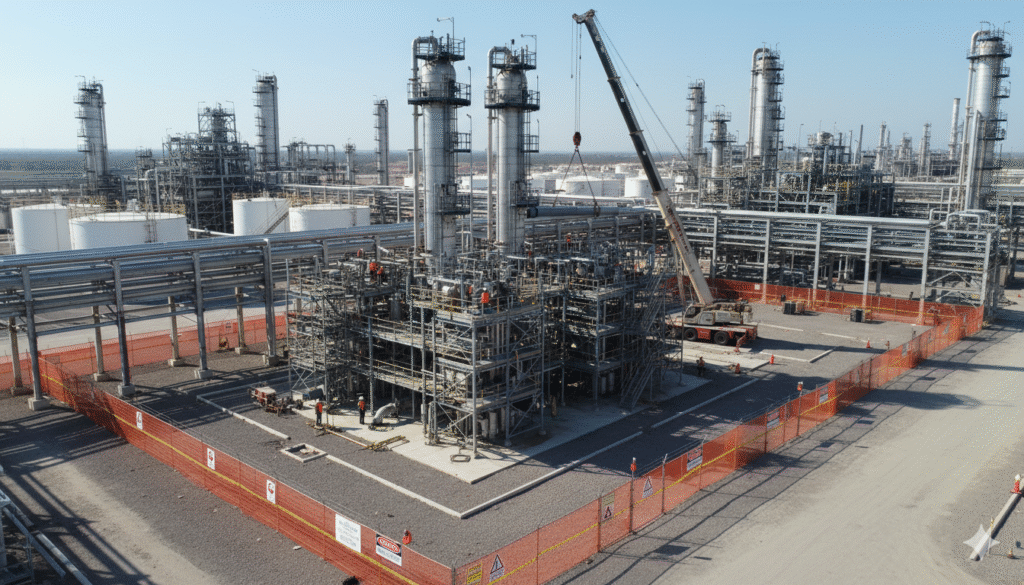
What is a plant turnaround, shutdown and outage?
The terms are often used interchangeably, but planners should use them precisely because each one implies a different level of planning, budget and approval. In refining and petrochemicals, “turnaround” is the umbrella term for any project that requires an operating unit to be stopped, worked on and restarted – the unit is literally “turned around”. Power generation usually calls the same event a major or planned outage.
| Event | Definition | Typical duration | Planning horizon | Typical scope |
|---|---|---|---|---|
| Major turnaround (TA) | Planned stop of a whole unit or complex for statutory inspection, overhaul and project tie-ins | 3–6 weeks | 18–24 months | Vessel and column internal inspection, exchanger bundle pulling, catalyst change, heater retubing, PRV overhaul, tie-ins |
| Planned shutdown | Planned stop of a unit or train with a limited, defined scope | 3–14 days | 3–9 months | Selected equipment repairs, cleaning, a few inspections |
| Pit stop / mini-TA | Short opportunistic stop, often to address fouling or a single defect | 1–5 days | 1–3 months | Exchanger cleaning, valve replacement, filter or strainer change |
| Planned outage (power) | Scheduled boiler, turbine or generator outage | Minor 1–3 weeks; major 6–10 weeks | 12–24 months | Boiler statutory inspection, turbine overhaul, generator inspection, DCS upgrades |
| Emergency / forced shutdown | Unplanned stop after a trip, leak or failure | Hours to weeks | None | Repair of the failed item plus any ready backlog work |
| Revamp / debottleneck | Turnaround combined with a capital project to change capacity or process | 4–10 weeks | 24–36 months | New equipment, piping modifications and tie-ins under MOC |
What drives turnaround timing and interval?
A turnaround date is not chosen arbitrarily. It is the earliest date at which one or more non-deferrable drivers fall due. Planners build an equipment-by-equipment “due date register” and the turnaround is set before the first critical item expires. The main drivers are:
- Statutory and code inspection due dates – internal inspection of pressure vessels, columns, exchangers and fired heaters that cannot be done on-stream.
- Risk-based inspection (RBI) per API RP 580/581, which can extend or shorten intervals based on the damage mechanisms identified under API RP 571.
- Catalyst life and fouling – reactor pressure drop, heater tube-metal temperatures and exchanger fouling factors that reduce throughput.
- Safety instrumented system (SIS) proof tests per IEC 61511 that need the process down.
- Capital project tie-ins that require the unit to be gas-free.
- Market and supply – low-demand seasons and coordination with upstream and downstream units.
| Equipment | Governing code / standard | Inspection type | Maximum interval (unless RBI) | Turnaround impact |
|---|---|---|---|---|
| Pressure vessels, columns, reactors | API 510 | Internal or on-stream | Lesser of 10 years or half the remaining life | Usually the main driver of TA interval |
| Pressure vessels | API 510 | External visual | Lesser of 5 years or the internal interval | Often done on-stream before T-0 |
| Process piping – Class 1 | API 570 | Thickness / external visual | 5 years / 5 years | CMLs that need insulation removal or are inaccessible go in TA scope |
| Process piping – Class 2 | API 570 | Thickness / external visual | 10 years / 5 years | Mostly on-stream; replacements in TA |
| Process piping – Class 3 | API 570 | Thickness / external visual | 10 years / 10 years | Mostly on-stream |
| Injection points | API 570 | Thickness | 3 years | Often require TA for internal checks |
| Pressure-relief devices | API 510 / API RP 576 | Bench test and overhaul | Up to 5 years typical service; 10 years clean, non-corrosive service | PRVs without spare isolation are removed only at TA |
| Atmospheric storage tanks | API 653 | External formal / internal | External: lesser of 5 years or RCA/4N; internal set by corrosion rate (RBI may extend) | Tank entry follows API Std 2015 |
| Fired heaters and boilers | API RP 573 / national boiler law | Internal and tube inspection | Jurisdiction-dependent; statutory boilers often 12–24 months | Frequently sets the TA date in power and fertilizer plants |
| Safety instrumented functions | IEC 61511 | Proof test | Per the SIL verification proof-test interval | Final elements (valves) usually tested at TA |
Turnaround lifecycle: phases and T-minus milestones
Best-practice operators manage the turnaround as a project with stage gates. Milestones are counted backwards from T-0 (the “zero date” when feed is cut) and forwards after startup. Influence over cost is highest early: a change made at T−12 months costs a fraction of the same change discovered during execution.
| Milestone | Typical timing | Key deliverables | Owner | Gate criteria |
|---|---|---|---|---|
| Turnaround strategy approved | T-24 to T-18 months | Objectives, interval decision, team charter, Class 5 estimate (AACE 18R-97) | Site management / TA manager | Due-date register reviewed; dates agreed with operations and supply |
| Preliminary scope list | T-18 to T-12 months | Inspection, RBI, maintenance backlog, MOC and project work lists | Inspection, maintenance, projects | Every item has a justification and requester |
| Long-lead items ordered | T-12 to T-9 months | Catalyst, exchanger bundles, heater tubes, large valves, special alloys, cranes | Procurement / TA planner | Delivery dates at least 4 weeks before T-0 |
| Contracting strategy | T-12 to T-6 months | Package split, contractor prequalification, rates, mobilisation plan | Contracts / TA manager | HSE and competence prequalification passed |
| Scope freeze | T-6 months | Frozen work list with Class 3 estimate | TA steering committee | Late work only via scope-change form with approval |
| Job packs complete | T-4 to T-3 months | Detailed job packs with steps, man-hours, materials, isolations and permits | Planners | 100% of frozen scope packed and reviewed |
| Schedule freeze and readiness review | T-3 months | Resource-levelled CPM schedule, critical path, isolation and blind lists, logistics plan | Scheduler / TA manager | Readiness review score accepted |
| Pre-shutdown works complete | T-1 month to T-0 | Scaffolding, insulation removal, laydown, temporary facilities, materials kitted | Execution team | Readiness checklist closed |
| Execution | T-0 to mechanical completion | Shutdown, decontamination, isolation, work, inspection, box-up | Area managers | Daily progress against schedule |
| Startup | Mechanical completion to feed-in | Leak test, de-isolation, PSSR, startup | Operations | PSSR signed; blind list fully reconciled |
| Close-out | T+1 to T+2 months | Close-out report, KPIs, lessons learned, as-built updates | TA manager | Report issued to management |
Phase 1–2: Scope development and scope freeze
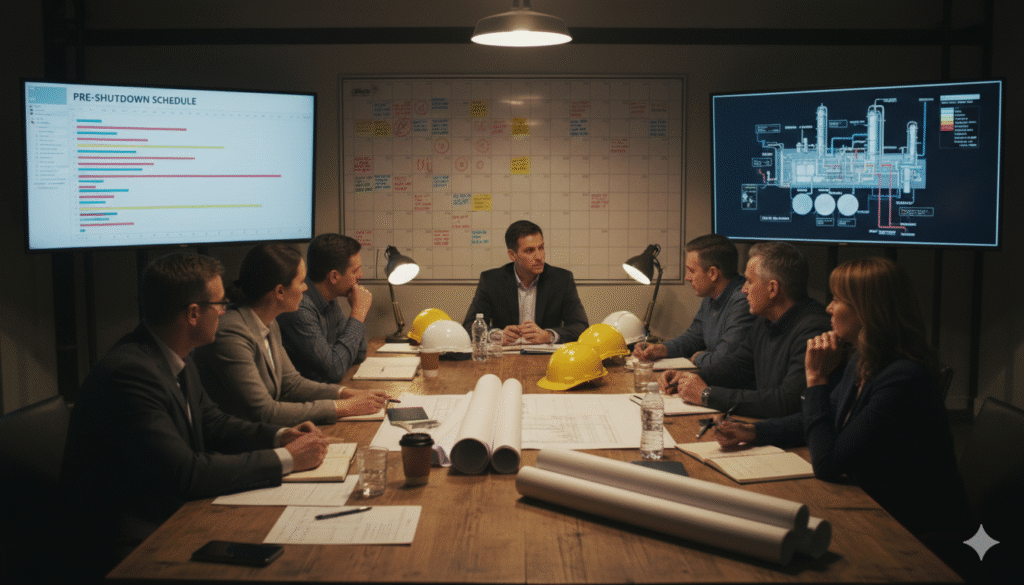
Scope is the single biggest lever on turnaround cost and duration. Every item on the work list must answer one question: “Does this work require the unit to be shut down?” If it can be done on-stream, before T-0, or deferred safely to the next opportunity, it does not belong in the turnaround.
| Scope source | Examples | Challenge question | Accept into TA if… |
|---|---|---|---|
| Inspection / RBI | Vessel internal inspection, CML thickness checks, PRV overhaul | Is the item due before the next TA, and can it be inspected on-stream? | Due before next TA and needs equipment opened |
| Maintenance backlog | Passing valves, leaking flanges, pump overhauls with no spare | Can it be done with the unit running, using spares or isolation? | No safe on-stream isolation exists |
| Operations | Fouled exchangers, damaged trays, high heater TMTs | What is the production or energy benefit versus cost? | Benefit justified and quantified |
| Projects / MOC | Tie-ins, new nozzles, control valve replacements | Is engineering complete and MOC approved? | Approved MOC and IFC drawings by scope freeze |
| Catalyst / chemicals | Reactor catalyst change, molecular sieve, resin | Is end-of-run confirmed by performance data? | Catalyst at end of life before next TA |
| Regulatory | Statutory boiler inspection, SIS proof tests | Is there a legal or code due date? | Always accepted – non-deferrable |
Scope freeze rule
After scope freeze (about T−6 months) no new work enters the turnaround without a signed scope-change request showing the reason, cost, man-hours, critical-path impact and approval by the turnaround steering committee. Uncontrolled late scope is the most common cause of turnaround overrun.
Phase 3: Detailed planning, job packs and scheduling
Each frozen work item is converted into a job pack – a self-contained package that allows a supervisor to execute the task without hunting for information. Job packs are then loaded into a critical-path (CPM) schedule built in Primavera P6, MS Project or similar, resource-levelled against the available crafts, cranes and laydown area.
| Section | Contents | Prepared by | Why it matters |
|---|---|---|---|
| Work scope | Equipment tag, description, work order number, scope-of-work statement | Planner | Prevents ambiguity and scope creep |
| Method statement and steps | Sequenced work steps with duration and craft man-hours | Planner / supervisor | Basis for the CPM schedule |
| Risk assessment | Job safety analysis (JSA), task risk assessment, special hazards (H2S, pyrophorics, benzene, radiation) | HSE / supervisor | Controls defined before work starts |
| Isolation details | Isolation certificate, blind / spade list with sizes and ratings, LOTO points | Operations / planner | Safe access to equipment |
| Permits required | Cold work, hot work, confined-space entry, lifting, radiography, excavation | Permit coordinator | Permits pre-prepared to save execution time |
| Drawings and data | P&IDs, isometrics, GA drawings, datasheets, previous inspection reports | Engineering | Correct parts and dimensions |
| Materials and spares | Bill of materials, gaskets, studs/nuts, PRV spares, reservation numbers, kitting location | Planner / warehouse | No waiting for materials |
| Tools and equipment | Cranes, rigging plans, torque/tensioning tools, hydrojetting units, scaffolding | Planner | Correct resources mobilised |
| Quality plan (ITP) | Inspection and test plan with hold/witness points, NDE, hydrotest, torque records | QA/QC | Built-in quality and traceability |
| Close-out | Box-up certificate, as-found / as-left report, joint tightness record | QC / supervisor | Evidence for PSSR and history |
Critical path and schedule control
The critical path is the longest chain of dependent activities through the turnaround; it has zero float and sets the earliest possible startup date. In most process units it runs through the largest columns, reactors (catalyst change), fired heaters or the slowest exchanger bundle work. Long activities should be broken down into steps of 12 hours or less, assigned to a named supervisor and progressed every shift. For a deeper treatment see our guide to long activities and the critical path in turnaround.
- Build the logic: link every job-pack step with finish-to-start relationships; isolations and decontamination are predecessors of all mechanical work.
- Load resources: assign craft man-hours, cranes and scaffolding; level to the peak headcount the site can support (welfare, permits, supervision, laydown).
- Protect the critical path: run critical-path work 24/7 on two 12-hour shifts, pre-position materials and assign the best crews.
- Hold contingency: carry an explicit allowance for emergent and discovery work (commonly 10–20% of man-hours) rather than hiding it in durations.
- Progress daily: measure earned value per shift and report SPI and CPI at the daily progress meeting.
Phase 4: Pre-shutdown activities
Everything that can be done safely before feed is cut should be done before T-0, because every hour moved out of the execution window is an hour of production gained. The checklist below expands the classic pre-shutdown list into a responsibility-based readiness tool.
| # | Activity | Responsible | Done by | Verification |
|---|---|---|---|---|
| Planning and safety | ||||
| 1 | Final scope, method statements and JSAs issued for every job | Planner / HSE | T-4 weeks | Job packs signed off |
| 2 | Turnaround-specific training: H2S awareness, confined space, work at height, fire watch, hole watch, gas testing, rescue | HSE | T-2 weeks | Training matrix; ID card endorsement |
| 3 | Permits, isolation certificates and blind list prepared in advance | Operations / permit office | T-1 week | Blind list numbered and tagged |
| 4 | Emergency response plan, rescue team and medical cover for peak headcount | HSE | T-1 week | Drill completed |
| Site preparation | ||||
| 5 | Site walk-downs: blind positions, entry points, valve tagging, scaffold scope, crane positions, insulation removal, fastener condition | Area supervisors | T-4 weeks | Walk-down sheets closed |
| 6 | Temporary laydown areas, site offices, welfare and waste skips approved | Logistics | T-3 weeks | Site layout plan |
| 7 | External scaffolding erected and tagged; insulation removed where safe on-stream | Scaffold / insulation contractor | T-1 week | Scaffold tags green |
| 8 | Tools moved to site tool containers; tested hoses ready for draining, purging and steaming | Supervisors | T-3 days | Hose test certificates |
| Materials and equipment | ||||
| 9 | Long-lead and kitted materials received: gaskets, studs/nuts, spare parts, ventilation equipment | Warehouse | T-2 weeks | Kit list reconciled |
| 10 | Lifting equipment certified and colour-coded; lift plans approved for critical lifts | Rigging / lifting engineer | T-1 week | Certificates and colour code of the period |
| 11 | Calibrated pressure gauges in suitable ranges for hydrotests (gauge range about 1.5–4 times test pressure) | QC | T-1 week | Calibration certificates |
| 12 | SCBA, airline sets, escape sets and gas detectors for blinding and entry | HSE | T-3 days | Bump test and inspection records |
| 13 | Welder qualification (WPS/PQR/WPQ per ASME Section IX) for turnaround welding procedures | QC | T-2 weeks | Welder ID list |
| 14 | PPE and consumables stocked for peak headcount | Stores | T-1 week | Stock check |
| 15 | Purging hose connections made and valve line-up for shutdown agreed with operations | Operations / maintenance | T-1 day | Shutdown procedure signed |
Shutdown, decontamination and safe isolation
The controlled shutdown is a hazardous phase: equipment is depressurised, drained, steamed or flushed, purged and isolated so that it can be opened safely. The sequence below must be followed and verified before the first flange is broken.
Isolation hierarchy
Equipment that will be entered or opened must be positively isolated from all sources of hazardous energy and process fluid. A closed valve alone is not positive isolation. The hierarchy below follows widely used guidance (for example UK HSE HSG253 and operator isolation standards) and the energy-control requirements of OSHA 29 CFR 1910.147 and ANSI/ASSP Z244.1.
| Isolation method | Description | Typical use | Limitations |
|---|---|---|---|
| Positive isolation – spool removal / air gap | Physical disconnection with blank flanges on the live side | Confined-space entry, long-duration hot work, highly toxic service | Requires a first break under a permit with full PPE |
| Positive isolation – spade or spectacle blind | Blind rated for line pressure and class inserted between flanges | Vessel entry, most turnaround work | Blind must be rated, tagged and on the blind list |
| Double block and bleed (DBB) | Two closed valves with an open, monitored bleed between them | Intrusive work where blinding is not yet possible; installing blinds | Valve passing must be checked; not acceptable alone for entry |
| Single valve, locked and proven | One closed, locked valve with proven zero leakage | Low-pressure, non-hazardous or short tasks | Weakest method; not for hazardous fluids |
| Electrical isolation / LOTO | Motor or heater breaker racked out, locked, tagged and tried | All rotating equipment, agitators, heaters, MOVs | Try-out (test start) is mandatory |
| Instrument / SIS overrides | Formal bypass with authorisation and log | Testing and maintenance of trips | All bypasses must be cleared before PSSR |
Atmospheric testing before entry and hot work
Gas testing is done by a competent, authorised gas tester with a calibrated, bump-tested multi-gas detector, at several levels inside the equipment, and repeated at the intervals stated on the permit. Continuous personal monitors are worn by entrants.
| Parameter | Typical acceptance limit | Reference | Comment |
|---|---|---|---|
| Oxygen (O2) | 19.5% to 23.5% by volume | OSHA 29 CFR 1910.146 | Below 19.5% is oxygen-deficient; above 23.5% is enriched (fire risk) |
| Flammables – confined-space entry | Below 10% LFL (many operators require 5% or less) | OSHA 29 CFR 1910.146 | Above 10% LFL is a hazardous atmosphere |
| Flammables – hot work | 0% LFL at the work point (site rule; many permit up to 1% maximum) | API Std 2009, NFPA 51B | Retest after breaks and at permit-defined intervals |
| Hydrogen sulfide (H2S) | Below the occupational exposure limit; ACGIH TLV 1 ppm TWA / 5 ppm STEL | ACGIH TLV; OSHA 1910.1000 | Above limits requires supplied-air breathing apparatus |
| Carbon monoxide (CO) | Below 25 ppm (ACGIH TLV TWA) | ACGIH TLV; OSHA PEL 50 ppm | Watch for exhaust from engines and heaters |
| Benzene | Below 1 ppm TWA / 5 ppm STEL (OSHA); current ACGIH TLV is much lower | OSHA 29 CFR 1910.1028 | Common in aromatics and crude units |
| Inert (nitrogen) entry | Special procedure – atmosphere is IDLH | API RP 2217A | Only by trained specialist crews with supplied air and standby rescue |
Phase 5: Execution – daily control on site
The execution window typically runs 30–45 days for a large unit. It starts at the zero date, when feed is cut, and ends at mechanical completion and handback to operations. The turnaround organisation (TA manager, area managers, supervisors, planners and schedulers, permit office, QA/QC and HSE) runs a fixed daily rhythm built around the schedule and job packs.
| # | Activity | Key controls | Records |
|---|---|---|---|
| 1 | Shift start toolbox talk | Led by supervisor, area in-charge and safety officer; covers the day’s tasks, hazards, SIMOPS and critical-path priorities | TBT attendance sheet |
| 2 | Preparation for work | Permits issued and displayed; equipment tagged for entry; fire watch and hole watch posted; equipment neutralised and decontaminated | Permit, isolation certificate |
| 3 | Equipment opening | Blinds installed per blind list; manways opened; air movers or eductors for ventilation; equipment cooled; gas test certificate obtained | Blind list, gas test log |
| 4 | Confined-space control | Entry schedule; entry/exit log at every manway; temporary low-voltage or ATEX-rated lighting; standby person and rescue plan | Entry log, rescue plan |
| 5 | Protection of equipment | Bottom nozzles and open flanges protected with covers or metal boxes; foreign-material-exclusion (FME) controls | FME log |
| 6 | As-found inspection | Preliminary internal inspection by the inspector; findings reported the same shift; repair scope agreed | As-found report |
| 7 | Internal scaffolding | Erected, inspected and tagged by a competent scaffolder before use | Scaffold tag |
| 8 | Repair and cleaning | Mechanical cleaning, hydrojetting (with jetting procedure and exclusion zones), repairs and replacements per job pack and approved WPS | Job-pack step sign-off |
| 9 | Testing and NDE | Hydrostatic or pneumatic testing, radiography (with radiation barriers), UT, MT/PT per the ITP | NDE and test reports |
| 10 | Final inspection | Inspector accepts the as-left condition; internal scaffolding removed; final cleanliness check | Final inspection report |
| 11 | Box-up | Box-up certificate signed by QC, process, maintenance and operations; new gaskets of the specified type | Box-up certificate |
| 12 | Bolted joint assembly | Controlled tightening per ASME PCC-1 by qualified assemblers; QC and maintenance witness torquing / tensioning of critical joints | Joint tightness record |
| 13 | Housekeeping and progress update | General clean-up each shift; progress reported against schedule; emergent work logged | Daily progress report |
Managing emergent (discovery) work
Inspection findings during execution will add work. Treat each finding through a fast-track process: inspector raises the finding, engineering defines the repair (with fitness-for-service assessment per API 579-1/ASME FFS-1 where needed), the planner estimates man-hours and critical-path impact, and the TA manager approves. Track emergent man-hours separately so the close-out report can show scope growth honestly.
Quality, inspection and box-up
Quality during a turnaround is built in through an inspection and test plan (ITP) with defined hold points that cannot be passed without the inspector’s signature. The table summarises the hold points that most often decide whether a unit restarts leak-free.
| Hold point | Requirement | Governing code / standard | Acceptance evidence |
|---|---|---|---|
| Material verification | Correct material and grade for replacement parts; PMI for alloy items | API RP 578; ASME B31.3 | MTC (EN 10204 3.1) and PMI record |
| Welding | Qualified WPS/PQR and welders; preheat and PWHT where required | ASME Section IX; ASME B31.3; API 510/570 for repairs | Weld map, WPQ, PWHT chart |
| NDE | RT/UT/MT/PT extent and acceptance per code and repair procedure | ASME B31.3 Ch. VI; ASME Section V | NDE reports |
| Pressure test after repair | Hydrostatic test, or pneumatic or NDE in lieu where approved by the inspector | API 510 / API 570; ASME PCC-2 | Test record with calibrated gauges |
| New piping leak test | Hydrostatic at 1.5 × design pressure × stress ratio; pneumatic at 1.1 × design pressure; minimum 10 minutes hold | ASME B31.3 para. 345 | Test record and chart |
| Bolted flange joints | Correct gasket, lubricant and bolt load; qualified assembler; joint record | ASME PCC-1-2022 (Appendix A for assembler qualification) | Joint tightness and torque record |
| Pressure-relief valves | Bench test and overhaul, set pressure and seat tightness | API RP 576; API Std 527 | PRV test certificate and tag |
| Vessel and column internals | Tray, packing and distributor installation; final cleanliness | Licensor / OEM specification | Internal inspection sign-off |
| Box-up | Final inspection complete; all tools and materials removed; FME check | Owner procedure | Box-up certificate |
Phase 6: Startup, PSSR and post-shutdown activities
Once mechanical work is complete, the focus shifts to returning the unit safely to operation. A formal pre-startup safety review (PSSR) is required by OSHA 29 CFR 1910.119(i) for new and modified facilities, and most operators apply it to every turnaround startup. It confirms that construction matches design, procedures and training are in place, MOCs are closed, and every isolation has been removed.
| # | Activity | Responsible | Verification |
|---|---|---|---|
| 1 | All job packs closed; punch list A items cleared (B items agreed for later) | Area managers | Punch list signed |
| 2 | Blind list reconciled – every blind removed or confirmed as permanent, with gaskets replaced | Operations / maintenance | Blind list 100% closed |
| 3 | Tightness / service leak test of opened joints (nitrogen or steam, per procedure) | Operations / QC | Leak test record |
| 4 | SIS bypasses and overrides removed; trips and alarms tested | Instrumentation | Bypass log cleared; proof-test records |
| 5 | MOC items complete; P&IDs and procedures updated; operators trained | Engineering / operations | MOC close-out |
| 6 | PSSR completed and signed by the PSSR team | PSSR leader | PSSR certificate |
| 7 | Assist operations during startup with standby maintenance crews (hot bolting where permitted) | Maintenance | Startup support roster |
| 8 | Disconnect hoses, reinstate insulation and remove external scaffolding | Contractors | Area handback |
| 9 | Return tools, surplus materials and temporary laydown bins; demobilise contractors | Logistics / stores | Material return notes |
| 10 | Final acceptance certificate (FAC) from QC, planning, operations and maintenance | TA manager | FAC signed |
| 11 | Update CMMS history, inspection records and as-built drawings | Planning / inspection | Records updated |
| 12 | Issue the close-out report and lessons-learned register | TA manager | Report issued |
KPIs, close-out report and lessons learned
At the end of every turnaround, a final report is prepared for historical reference and to justify the results in time and cost to management. One copy stays in the planning file; the lessons learned are fed into the next turnaround strategy at T−24 months.
| KPI | Formula / definition | Typical good-practice target | What it tells you |
|---|---|---|---|
| Safety – TRIR | Recordable injuries × 200,000 / hours worked | As low as possible; zero lost-time injuries | Effectiveness of HSE controls |
| Process safety events | Tier 1 and Tier 2 PSE count (API RP 754) | Zero | Isolation, startup and line-break discipline |
| Schedule performance index (SPI) | Earned value / planned value | ≥ 1.0 | Ahead (>1) or behind (<1) schedule |
| Cost performance index (CPI) | Earned value / actual cost | ≥ 1.0 | Under (>1) or over (<1) budget |
| Duration variance | (Actual − planned duration) / planned duration | ≤ 0% | Startup on time |
| Scope growth | Emergent + added man-hours / frozen man-hours | < 10% | Quality of scope definition and inspection data |
| Startup performance | Leaks, trips or re-work during startup | Zero flange leaks at startup | Quality of box-up and bolting |
| Run length to next TA | Months of reliable operation after TA | Meets planned interval | True value of the turnaround |
| Job pack readiness | Packed and reviewed jobs / frozen jobs at T-3 | 100% | Planning maturity |
Close-out report contents
- Objectives versus actual results (safety, schedule, cost, scope, startup).
- Final cost versus Class 3 estimate, with variance explanation.
- Scope growth breakdown: emergent, discovery and late additions.
- Critical path analysis: planned versus actual and causes of delay.
- Inspection findings and recommendations for the next interval and RBI update.
- Contractor performance and lessons learned with owners and due dates.
Turnaround manpower and KPI calculators
Use these quick planning tools during scope development and daily progress meetings. They run in your browser; nothing is sent to a server.
Turnaround manpower planner
Turnaround SPI / CPI and scope growth tracker
Planning assumptions
The manpower planner divides adjusted man-hours (direct man-hours × (1 + emergent allowance) ÷ productivity factor) by the available working hours per person over the execution window. Each worker is assumed to work one shift per day. Peak-to-average and supervision ratios are planning assumptions – replace them with your site’s histogram and rules.
Common turnaround failures and how to prevent them
| Failure | Root cause | Prevention | Phase |
|---|---|---|---|
| Schedule overrun | Late scope, weak critical-path control, unrealistic durations | Scope freeze gate; break long activities into steps of 12 h or less; daily SPI review | Planning / execution |
| Budget overrun | Scope growth and discovery work not estimated | Explicit contingency; fast-track emergent-work approval | Scope / execution |
| Materials not available | Long-lead items ordered late; wrong specifications | Long-lead orders by T-9; kitting and receipt inspection by T-1 month | Planning |
| Isolation error / line break incident | Blind missed, wrong valve, unrecorded bypass | Numbered blind list; independent verification; first-break permit with full PPE | Execution |
| Confined-space incident | Atmosphere not tested, poor ventilation, no standby | Positive isolation, continuous monitoring, entry log, rescue plan | Execution |
| Startup flange leaks | Poor bolting practice, wrong gaskets | ASME PCC-1 qualified assemblers, joint records, gasket control | Box-up / startup |
| Foreign material left in equipment | No FME controls or final inspection | FME log, tool count, final internal inspection before box-up | Box-up |
| Repeated failure after TA | Root cause not addressed, lessons not captured | RCA for major findings; lessons-learned register linked to next TA | Close-out |
Frequently asked questions
What is a plant turnaround?
A plant turnaround is a planned, scheduled stop of an operating process unit to carry out inspection, cleaning, repairs, catalyst change and project tie-ins that cannot be done while the unit is running, after which the unit is restarted. In refining and petrochemicals it is the umbrella term for shutdown-based maintenance projects; power plants call it a planned outage.
What is the difference between a shutdown and a turnaround?
A shutdown is any stop of a unit, planned or unplanned, and can be short with limited scope. A turnaround is a major planned shutdown with a frozen scope, an 18 to 24 month planning cycle, a dedicated organisation and a budget, typically lasting three to six weeks.
How often do refineries have turnarounds?
Most refinery and petrochemical units run 2 to 6 years between major turnarounds, commonly 4 to 5 years. The interval is set by inspection due dates under API 510 and API 570 or RBI, catalyst life, fouling and statutory boiler inspection.
What are the phases of a turnaround?
The six phases are strategy (T-24 to T-18 months), scope development (to scope freeze at about T-6 months), detailed planning and scheduling (T-6 to T-1 months), pre-shutdown work (T-1 month to T-0), execution (feed-out to mechanical completion) and startup and close-out (PSSR, startup and the close-out report by about T+2 months).
When should turnaround scope be frozen?
Scope is normally frozen about six months before the shutdown (T-6 months). After that, new work enters only through a signed scope-change request showing cost, man-hours and critical-path impact, approved by the turnaround steering committee.
What is a pre-startup safety review (PSSR)?
A PSSR is a formal check before hydrocarbons are reintroduced that confirms construction matches design, procedures and training are in place, MOCs are closed, all blinds and bypasses are removed and the equipment is ready to start. OSHA 29 CFR 1910.119(i) requires it for new and modified facilities, and most operators apply it to every turnaround startup.
What is positive isolation in a shutdown?
Positive isolation is the physical separation of equipment from all process connections by inserting a rated spade or spectacle blind or by removing a spool and blanking the live side. It is normally required before confined-space entry, because closed valves can leak.
How do you calculate turnaround manpower?
Divide the adjusted man-hours, which are the direct man-hours multiplied by one plus the emergent allowance and divided by the productivity factor, by the working hours available per person (execution days times hours per shift). Then multiply the average headcount by a peak-to-average ratio, typically 1.3 to 1.5, to size the peak.
Test your knowledge
1. When is turnaround scope normally frozen?
2. Which isolation method is normally required for confined-space entry?
3. What is the acceptable oxygen range for confined-space entry under OSHA 1910.146?
4. An SPI of 0.92 means the turnaround is…
5. Which standard covers bolted flange joint assembly?
Use the Aienginear calculators for hydrotest pressure, bolt torque and PSV relief loads, or browse the full piping guide library.
Related Aienginear guides and tools
References and standards
- OSHA 29 CFR 1910.119 – Process Safety Management of Highly Hazardous Chemicals (MOC, PSSR, mechanical integrity, hot work, contractors).
- OSHA 29 CFR 1910.146 – Permit-Required Confined Spaces; 29 CFR 1910.147 – Control of Hazardous Energy (Lockout/Tagout).
- API 510 – Pressure Vessel Inspection Code; API 570 – Piping Inspection Code; API 653 – Tank Inspection, Repair, Alteration and Reconstruction.
- API RP 571, RP 576, RP 578, RP 580 and RP 581; API 579-1/ASME FFS-1 – Fitness-For-Service.
- API Std 2009 – Safe Welding, Cutting and Hot Work Practices; API Std 2015 – Safe Entry and Cleaning of Petroleum Storage Tanks; API RP 2217A – Safe Work in Inert Confined Spaces; API RP 754 – Process Safety Performance Indicators.
- ASME B31.3 – Process Piping; ASME PCC-1-2022 – Guidelines for Pressure Boundary Bolted Flange Joint Assembly; ASME PCC-2 – Repair of Pressure Equipment and Piping; ASME Section IX.
- IEC 61511 – Functional Safety: Safety Instrumented Systems for the Process Industry Sector.
- NFPA 51B – Fire Prevention During Welding, Cutting and Other Hot Work; ANSI/ASSP Z244.1 – Lockout, Tagout and Alternative Methods.
- AACE International RP 18R-97 – Cost Estimate Classification System; ISO 55001 – Asset Management; ISO 45001 – Occupational Health and Safety.

Written by Muhammad Raza
Founder of Aienginear. Engineering and digital solutions professional with 26+ years managing projects, plant shutdowns and turnarounds in oil & gas, petrochemical and power generation.