
STRUCTURAL STEEL · PIPING · FABRICATION · UPDATED OCTOBER 2026
Quick answer: how do you calculate metal weight?
Multiply the cross-sectional area by the length and the density: W = A × L × ρ. With A in mm² and ρ in kg/m³, the mass per metre is A × ρ ÷ 1,000,000 kg/m. Carbon steel is taken as 7,850 kg/m³, so a 10 mm plate weighs 78.5 kg/m² and a steel pipe weighs 0.02466 × (OD − t) × t kg/m. For rolled beams and channels, use the standard kg/m from EN 10365 tables rather than rectangle maths, and for hollow sections include the corner radii from EN 10219-2 or EN 10210-2.
The Aienginear Metal Weight Calculator works out the mass per metre, piece weight and total weight of plates, bars, pipes, hollow sections, angles, channels and European, Russian and American rolled beams. Pick a profile, type the dimensions or choose a standard size, select one of 21 materials, and the result updates as you type. Add each line to the built-in Bill of Quantities (BOQ) and export it as an Aienginear-branded PDF, CSV or text report. Everything runs in your browser, so nothing you enter is uploaded.
How to use the metal weight calculator
- Choose units. Use the mm/kg switch for metric input or in/lb to type dimensions in inches and lengths in feet. Imperial inputs are converted internally, and results stay in kg and kg/m (pipe also shows lb/ft).
- Pick the material. The selector lists 21 grades, from S235JR and ASTM A36 carbon steel to 304/316 stainless, duplex 2205, aluminium, copper alloys, nickel alloys and titanium. Choose Custom density for anything else.
- Select the profile. Bars (round, square, hex, flat, rectangular), pipe and CHS, SHS and RHS, plate, equal and unequal angles, UPN, UPE and GOST channels, IPN, IPE, HEA, HEB and HEM beams, and AISC W-shapes.
- Enter dimensions or a standard size. For pipe, the ASME B36.10M quick pick fills OD and wall for NPS ½ to 24 in Sch 40, 80 and 160. For hollow sections choose the corner profile (EN 10219-2 cold-formed, EN 10210-2 hot-finished or sharp). For angles you can add the root and toe radii.
- Set length and quantity. The tool shows mass per metre, single-piece weight and total weight, plus section area and other properties where relevant.
- Add to the BOQ and export. Press Add to BOQ for each line, then download the Aienginear PDF, CSV, JSON or TXT report for purchasing, transport planning or lifting studies.
What is new in version 5.0 (October 2026)
We re-checked every data table and formula in the calculator against the current product standards before this release. The main corrections and upgrades are:
- Channel data corrected. UPN 30 to UPN 160, every UPE size and every GOST 8240-97 П-series channel now carry the standard kg/m values. Older entries for these sizes were too light by up to 35 %.
- Hollow-section corner radii. SHS and RHS now follow the EN 10219-2 and EN 10210-2 area formulae instead of sharp-corner geometry, which over-stated weight by roughly 1.5 % to 4 %.
- Angle fillets. Optional root radius r1 and toe radius r2 inputs reproduce EN 10056-1 section areas.
- Imperial input fixed. The in/lb switch now converts inputs; previously it changed only the labels.
- Material library updated. Separate S235, S275 and S355 grades with their EN 10025-2 strengths, corrected densities for Monel 400 (8,800), Nickel 200 (8,890) and Titanium Grade 5 (4,430 kg/m³), plus A106/API 5L pipe steel, aluminium 5083 and titanium Grade 2.
- Privacy. The report download no longer asks for a name or email address.
Metal densities used for weight calculation
Density is the only material property that enters a weight calculation, so choosing the right value matters more than any rounding in the geometry. Steel grades of the same family are almost identical: S235, S355, A36 and A106 Gr B all use 7,850 kg/m³. Alloying with nickel and molybdenum raises the density of austenitic stainless steel to about 7,900 to 8,000 kg/m³, while aluminium alloys sit near 2,700 kg/m³, roughly one third of steel.
Aienginear · Table 1
Density and minimum strength of 21 engineering metals
Values built into the Aienginear calculator · ratio = ρ / 7,850
| Material | Standard / UNS | Density (kg/m³) | Density (g/cm³) | Ratio to steel | Min. yield (MPa) | Min. tensile (MPa) |
|---|---|---|---|---|---|---|
| Carbon steel S235JR | EN 10025-2 | 7,850 | 7.85 | 1.000 | 235 | 360 |
| Carbon steel S275JR | EN 10025-2 | 7,850 | 7.85 | 1.000 | 275 | 410 |
| Carbon steel S355JR | EN 10025-2 | 7,850 | 7.85 | 1.000 | 355 | 470 |
| Mild steel A36 | ASTM A36/A36M | 7,850 | 7.85 | 1.000 | 250 | 400 |
| Pipe steel A106 Gr B / API 5L Gr B | ASTM A106, API 5L | 7,850 | 7.85 | 1.000 | 240 | 415 |
| Stainless 304/304L | EN 1.4301 · UNS S30400 | 7,900 | 7.90 | 1.006 | 205 | 515 |
| Stainless 316/316L | EN 1.4401 · UNS S31600 | 8,000 | 8.00 | 1.019 | 205 | 515 |
| Duplex 2205 | EN 1.4462 · UNS S32205 | 7,800 | 7.80 | 0.994 | 450 | 655 |
| Aluminium 6061-T6 | EN AW-6061 | 2,700 | 2.70 | 0.344 | 240 | 260 |
| Aluminium 6082-T6 | EN AW-6082 | 2,710 | 2.71 | 0.345 | 260 | 310 |
| Aluminium 5083-H111 | EN AW-5083 | 2,660 | 2.66 | 0.339 | 125 | 275 |
| Copper C11000 (ETP) | EN CW004A | 8,940 | 8.94 | 1.139 | 69 | 220 |
| Brass CuZn37 | EN CW508L | 8,440 | 8.44 | 1.075 | 200 | 300 |
| Tin bronze CuSn8 | EN CW453K | 8,800 | 8.80 | 1.121 | 140 | 300 |
| Titanium Grade 2 | ASTM B265 · UNS R50400 | 4,510 | 4.51 | 0.575 | 275 | 345 |
| Titanium Grade 5 (Ti-6Al-4V) | ASTM B265 · UNS R56400 | 4,430 | 4.43 | 0.564 | 828 | 895 |
| Monel 400 | UNS N04400 | 8,800 | 8.80 | 1.121 | 170 | 480 |
| Inconel 625 | UNS N06625 | 8,440 | 8.44 | 1.075 | 414 | 827 |
| Nickel 200 | UNS N02200 | 8,890 | 8.89 | 1.132 | 103 | 379 |
| Grey cast iron | EN-GJL-250 | 7,200 | 7.20 | 0.917 | — | 250 |
| Galvanized steel (base metal) | EN 10346 / ASTM A123 | 7,850 | 7.85 | 1.000 | per grade | per grade |
Densities are nominal room-temperature values. Strengths are typical specified minimums for common product forms and tempers and vary with thickness and condition; always confirm against the mill test certificate (EN 10204 3.1). © Aienginear.com
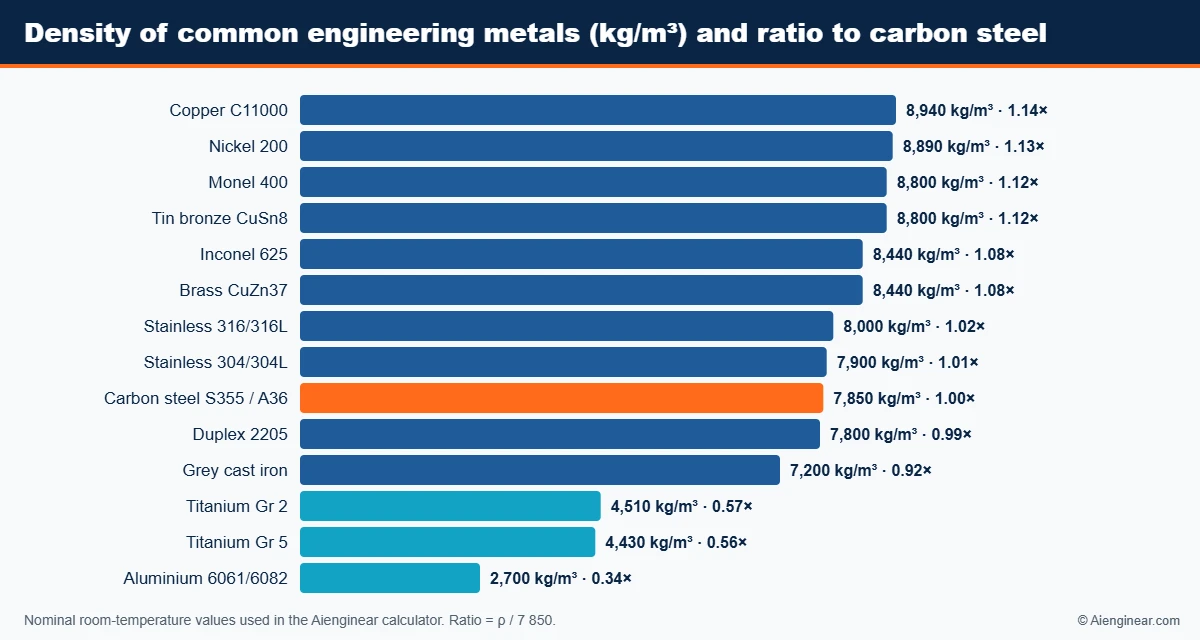
Field shortcut: to convert a carbon-steel weight to another metal, multiply by the ratio in Table 1. A steel part of 100 kg becomes 34.4 kg in aluminium, 100.6 kg in 304 stainless and 101.9 kg in 316 stainless. Using the steel value for a stainless BOQ therefore under-states the weight by up to about 2 %.
Metal weight formulas for every profile
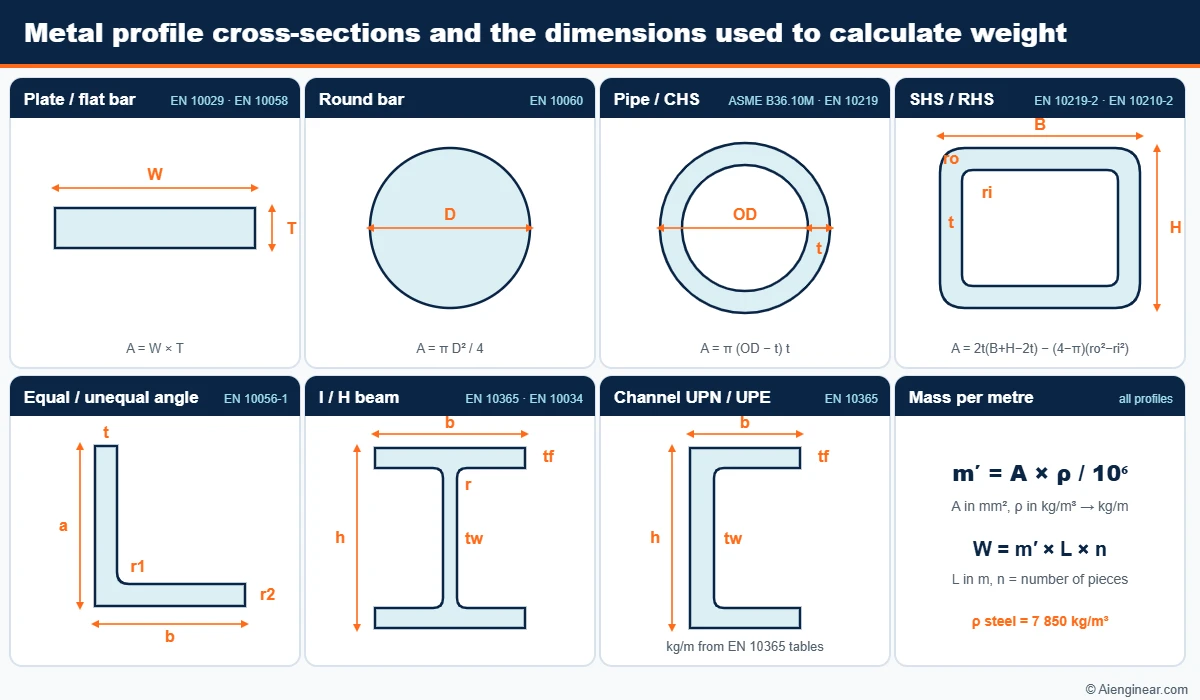
Every formula below gives the cross-sectional area A. Convert it to mass per metre with m′ = A × ρ ÷ 10⁶ (A in mm², ρ in kg/m³, m′ in kg/m), then multiply by the length in metres and the number of pieces. For carbon steel the constant becomes m′ = 0.00785 × A.
Aienginear · Table 2
Cross-section area and carbon-steel weight formulas
Dimensions in mm · results in kg/m for ρ = 7,850 kg/m³
| Profile | Area formula (mm²) | Steel kg/m shortcut | Dimension standard |
|---|---|---|---|
| Plate / sheet | A = W × T (or mass = L × W × T × ρ) | 78.5 kg/m² per 10 mm | EN 10029, EN 10051 |
| Flat bar | A = W × T | 0.00785 × W × T | EN 10058:2018 |
| Square bar | A = S² | 0.00785 × S² | EN 10059 |
| Round bar | A = π D² / 4 | 0.006165 × D² | EN 10060 |
| Hex bar (across flats s) | A = (√3 / 2) × s² | 0.006798 × s² | EN 10061 |
| Pipe / CHS | A = π (OD − t) t | 0.02466 × (OD − t) × t | ASME B36.10M, EN 10219-2 |
| SHS / RHS (with radii) | A = 2t(B + H − 2t) − (4 − π)(ro² − ri²) | see Table 5 for ro, ri | EN 10219-2, EN 10210-2 |
| Equal / unequal angle | A = t(a + b − t) + (1 − π/4)(r1² − 2 r2²) | tabulated in EN 10056-1 | EN 10056-1:2017 |
| I/H beams, channels | tabulated (fillets and tapers) | use kg/m from tables | EN 10365:2017, GOST 8240-97 |
ro, ri = outside and inside corner radii; r1 = root radius; r2 = toe radius. For other metals multiply the shortcut by ρ / 7,850. © Aienginear.com
Imperial equivalents (carbon steel, inches → lb/ft): plate 40.8 × t lb/ft²; round bar 2.673 × D²; square bar 3.403 × S²; flat bar 3.403 × W × T; pipe 10.69 × (OD − t) × t.
Worked examples you can check with the calculator
Example 1 — Steel plate. 2,000 × 1,000 × 10 mm S355 plate.
Volume = 2.0 × 1.0 × 0.010 = 0.020 m³ → mass = 0.020 × 7,850 = 157.0 kg (78.5 kg/m²).
Example 2 — Round bar. Ø50 mm × 6 m, carbon steel.
m′ = 0.006165 × 50² = 15.41 kg/m → 15.41 × 6 = 92.5 kg.
Example 3 — Stainless pipe. NPS 6 Sch 40 (168.3 × 7.11 mm) in 316L, 12 m.
Steel m′ = 0.02466 × (168.3 − 7.11) × 7.11 = 28.26 kg/m. For 316L multiply by 8,000 / 7,850: 28.80 kg/m → 345.6 kg for 12 m.
Example 4 — Cold-formed SHS. 100 × 100 × 5 mm to EN 10219-2.
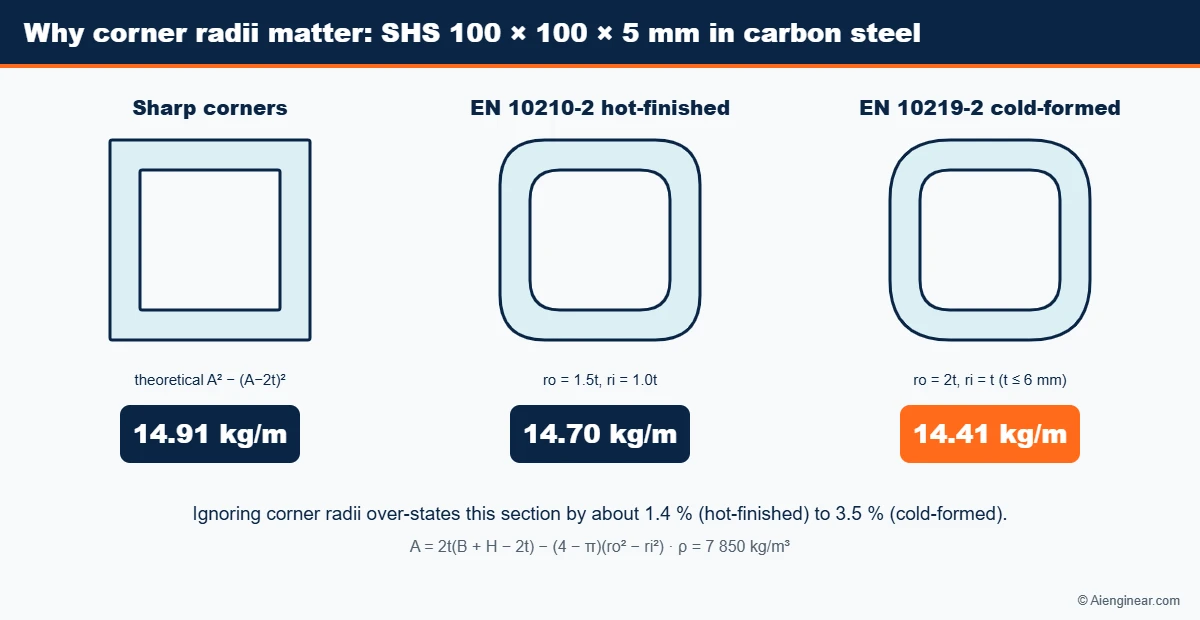
t ≤ 6 mm so ro = 10 mm, ri = 5 mm. A = 2 × 5 × (200 − 10) − 0.8584 × (100 − 25) = 1,900 − 64.4 = 1,835.6 mm² → 14.41 kg/m. The sharp-corner shortcut gives 14.91 kg/m, about 3.5 % heavy.
Example 5 — Equal angle with fillets. L100 × 100 × 10, r1 = 12 mm, r2 = 6 mm.
A = 10 × (200 − 10) + 0.2146 × (144 − 72) = 1,915.5 mm² → 15.04 kg/m, matching the EN 10056-1 table value of 15.0 kg/m.
Aienginear · Table 3
Calculator verification against standard values
Aienginear metal weight calculator v5.0 results compared with published section data
| Item | Standard / hand value | Calculator v5.0 | Source |
|---|---|---|---|
| Plate 2000 × 1000 × 10 mm | 157.0 kg | 157.0 kg | arithmetic |
| Round bar Ø50 × 6 m | 92.5 kg | 92.48 kg | arithmetic |
| Pipe NPS 6 Sch 40 | 28.26 kg/m | 28.26 kg/m | ASME B36.10M |
| SHS 100 × 100 × 5 (cold-formed) | 14.4 kg/m | 14.41 kg/m | EN 10219-2 |
| SHS 100 × 100 × 5 (hot-finished) | 14.7 kg/m | 14.70 kg/m | EN 10210-2 |
| RHS 200 × 100 × 8 (cold-formed) | 33.9 kg/m | 33.95 kg/m | EN 10219-2 |
| Angle L100 × 100 × 10 | 15.0 kg/m | 15.04 kg/m | EN 10056-1 |
| IPE 200 | 22.4 kg/m | 22.4 kg/m | EN 10365 |
| HEB 200 | 61.3 kg/m | 61.3 kg/m | EN 10365 |
| UPE 200 | 22.8 kg/m | 22.8 kg/m | EN 10365 |
Carbon steel, ρ = 7,850 kg/m³. Differences of ±0.5 % arise from rounding in published tables. © Aienginear.com
Steel pipe weight per metre (ASME B36.10M)
Plain-end pipe weight depends only on the outside diameter and wall thickness. ASME B36.10M fixes the OD for each nominal pipe size (NPS) and the wall for each schedule, so the weight per metre of any pipe can be read from a table or computed with 0.02466 × (OD − t) × t. Stainless pipe to ASME B36.19M shares the same ODs; use the stainless density ratio from Table 1. For full dimension data see our pipe sizes and schedule chart. For grade-specific chemistry, strength and tolerances see our ASTM A53 pipe guide, and for fitting take-offs use the ASME B16.9 pipe elbow dimensions chart.
Aienginear · Table 4
Carbon steel pipe weight per metre — Sch 40 and Sch 80
OD and wall per ASME B36.10M · plain end · ρ = 7,850 kg/m³
| NPS | DN | OD (mm) | Sch 40 wall (mm) | Sch 40 (kg/m) | Sch 80 wall (mm) | Sch 80 (kg/m) |
|---|---|---|---|---|---|---|
| 1/2 | 15 | 21.3 | 2.77 | 1.27 | 3.73 | 1.62 |
| 3/4 | 20 | 26.7 | 2.87 | 1.69 | 3.91 | 2.20 |
| 1 | 25 | 33.4 | 3.38 | 2.50 | 4.55 | 3.24 |
| 1-1/2 | 40 | 48.3 | 3.68 | 4.05 | 5.08 | 5.41 |
| 2 | 50 | 60.3 | 3.91 | 5.44 | 5.54 | 7.48 |
| 3 | 80 | 88.9 | 5.49 | 11.29 | 7.62 | 15.27 |
| 4 | 100 | 114.3 | 6.02 | 16.08 | 8.56 | 22.32 |
| 6 | 150 | 168.3 | 7.11 | 28.26 | 10.97 | 42.56 |
| 8 | 200 | 219.1 | 8.18 | 42.55 | 12.70 | 64.64 |
| 10 | 250 | 273.0 | 9.27 | 60.29 | 15.09 | 95.98 |
| 12 | 300 | 323.8 | 10.31 | 79.71 | 17.48 | 132.05 |
| 16 | 400 | 406.4 | 12.70 | 123.31 | 21.44 | 203.54 |
| 20 | 500 | 508.0 | 15.09 | 183.43 | 26.19 | 311.19 |
| 24 | 600 | 610.0 | 17.48 | 255.43 | 30.96 | 442.11 |
Calculated with 0.0246615 × (OD − t) × t. Sch 40 equals STD up to NPS 10; Sch 80 equals XS up to NPS 8. Multiply by 1.019 for 316 stainless. © Aienginear.com
Need contents weight too? Our MechCore pipe weight calculator adds water or product, insulation and cladding for pipe-support loads, and the pipe support spacing calculator turns that load into support spans.
Hollow sections (CHS, SHS, RHS) and corner radii
Square and rectangular hollow sections are never truly sharp-cornered. Hot-finished sections to EN 10210 have tight corners, while cold-formed sections to EN 10219 are bent around larger radii that grow with wall thickness. Both standards give the radii to use when calculating section properties, and the calculator applies them automatically once you pick the corner profile.
Aienginear · Table 5
Corner radii used to calculate SHS and RHS mass
Per EN 10210-2:2019 and EN 10219-2:2019
| Section type | Wall thickness t | Outside radius ro | Inside radius ri |
|---|---|---|---|
| Hot-finished (EN 10210-2) | all | 1.5 t | 1.0 t |
| Cold-formed (EN 10219-2) | t ≤ 6 mm | 2.0 t | 1.0 t |
| Cold-formed (EN 10219-2) | 6 < t ≤ 10 mm | 2.5 t | 1.5 t |
| Cold-formed (EN 10219-2) | t > 10 mm | 3.0 t | 2.0 t |
Area A = 2t(B + H − 2t) − (4 − π)(ro² − ri²). Actual corner radii vary within the standard tolerance; these are the values for calculation. © Aienginear.com
Aienginear · Table 6
SHS and RHS weight: sharp vs hot-finished vs cold-formed (kg/m)
Carbon steel, ρ = 7,850 kg/m³ · calculated with the radii in Table 5
| Section (mm) | Sharp corners | Hot-finished EN 10210-2 | Cold-formed EN 10219-2 |
|---|---|---|---|
| SHS 50 × 50 × 3 | 4.43 | 4.35 | 4.25 |
| SHS 100 × 100 × 5 | 14.91 | 14.70 | 14.41 |
| SHS 150 × 150 × 8 | 35.67 | 35.13 | 33.95 |
| SHS 200 × 200 × 10 | 59.66 | 58.82 | 56.96 |
| RHS 100 × 50 × 4 | 8.92 | 8.78 | 8.59 |
| RHS 200 × 100 × 8 | 35.67 | 35.13 | 33.95 |
| RHS 300 × 200 × 10 | 75.36 | 74.52 | 72.66 |
Values from the Aienginear metal weight calculator v5.0. Check the stockist catalogue for the exact series you order. © Aienginear.com
Circular hollow sections and pipe have no corners, so the plain ring formula is exact. The only choice is whether you are buying pipe (ASME B36.10M or EN 10216/10217 sizes) or structural CHS (EN 10210 or EN 10219 sizes); the calculator accepts any OD and wall.
IPE, HEA, HEB and IPN beam weights
Hot-rolled I and H sections have tapered or parallel flanges joined to the web by large root fillets, so their weight cannot be found accurately from three rectangles. Their dimensions and nominal mass per metre are now collected in EN 10365:2017, which replaced the older DIN 1025 parts. Rolling tolerances are set by EN 10034 for IPE and HE sections and by EN 10024 for taper-flange IPN beams.
- IPE — parallel-flange I-beams, the default choice for floor beams and rafters.
- HEA, HEB, HEM — wide-flange H-sections in light, standard and heavy series; the same nominal size gets progressively thicker flanges and webs.
- IPN — the older taper-flange I-beam (about 14 % slope on the inner flange face), still used for crane runways and machinery frames.
Aienginear · Table 7
IPE, HEA, HEB and IPN beam weight per metre (kg/m)
Nominal mass per EN 10365:2017 · carbon steel
| Nominal size | IPE | HEA | HEB | IPN |
|---|---|---|---|---|
| 100 | 8.1 | 16.7 | 20.4 | 8.34 |
| 120 | 10.4 | 19.9 | 26.7 | 11.1 |
| 140 | 12.9 | 24.7 | 33.7 | 14.3 |
| 160 | 15.8 | 30.4 | 42.6 | 17.9 |
| 180 | 18.8 | 35.5 | 51.2 | 21.9 |
| 200 | 22.4 | 42.3 | 61.3 | 26.2 |
| 220 | 26.2 | 50.5 | 71.5 | 31.1 |
| 240 | 30.7 | 60.3 | 83.2 | 36.2 |
| 260 | — | 68.2 | 93 | 41.9 |
| 270 | 36.1 | — | — | — |
| 280 | — | 76.4 | 103 | 47.9 |
| 300 | 42.2 | 88.3 | 117 | 54.2 |
| 320 | — | 97.6 | 127 | 61 |
| 330 | 49.1 | — | — | — |
| 340 | — | 105 | 134 | 68 |
| 360 | 57.1 | 112 | 142 | 76.1 |
| 400 | 66.3 | 125 | 155 | 92.4 |
| 450 | 77.6 | 140 | 171 | 115 |
| 500 | 90.7 | 155 | 187 | 141 |
| 550 | 106 | 166 | 199 | 166 |
| 600 | 122 | 178 | 212 | 199 |
— = size not produced in that series. HEA/HEB/HEM continue to 1000 mm and HEM data are in the calculator. For other metals multiply by ρ / 7,850. © Aienginear.com
UPN, UPE and GOST channel weights
European channels come in two shapes. UPN has tapered inner flange faces, while UPE has parallel flanges that make bolted connections simpler; for the same height a UPE is slightly lighter. In Russia, Central Asia and many Middle East projects you will also meet channels to GOST 8240-97, numbered by height in centimetres, for example 20П (200 mm, parallel flanges) or 20У (sloped flanges).
Aienginear · Table 8
UPN, UPE and GOST 8240-97 channel weight per metre
Nominal mass in kg/m · carbon steel
| Height (mm) | UPN (kg/m) | UPE (kg/m) | GOST size | GOST П (kg/m) |
|---|---|---|---|---|
| 80 | 8.64 | 7.90 | 8П | 7.05 |
| 100 | 10.6 | 9.82 | 10П | 8.59 |
| 120 | 13.4 | 12.1 | 12П | 10.4 |
| 140 | 16.0 | 14.5 | 14П | 12.3 |
| 160 | 18.8 | 17.0 | 16П | 14.2 |
| 180 | 22.0 | 19.7 | 18П | 16.3 |
| 200 | 25.3 | 22.8 | 20П | 18.4 |
| 220 | 29.4 | 26.6 | 22П | 21.0 |
| 240 | 33.2 | 30.2 | 24П | 24.0 |
| 260 | 37.9 | — | — | — |
| 270 | — | 35.2 | 27П | 27.7 |
| 280 | 41.8 | — | — | — |
| 300 | 46.2 | 44.4 | 30П | 31.8 |
| 320 | 59.5 | — | — | — |
| 330 | — | 53.2 | 33П | 36.5 |
| 350 | 60.6 | — | — | — |
| 360 | — | 61.2 | 36П | 41.9 |
| 380 | 63.1 | — | — | — |
| 400 | 71.8 | 72.2 | 40П | 48.3 |
UPN and UPE per EN 10365:2017 (tolerances EN 10279); GOST channels per GOST 8240-97 П series. Small UPN sizes (30 to 65) are in the calculator. © Aienginear.com
Adding galvanizing, paint and other coatings
The calculator returns the weight of bare metal. Hot-dip galvanizing adds a measurable mass that matters for transport and lifting on large orders. Zinc has a density of about 7,140 kg/m³, so each micrometre of coating weighs roughly 7.14 g/m². A typical 85 µm coating on steel thicker than 6 mm (the ISO 1461 local minimum is 70 µm with a mean of 85 µm) therefore adds about 0.61 kg per m² of surface.
- Find the painted or galvanized surface area per metre: for pipe use π × OD (the calculator shows outer surface area), for plate use both faces plus edges.
- Multiply by the coating mass per m² (thickness in µm × 7.14 g/m²).
- Add the result to the bare weight. For a 6 m length of NPS 6 pipe galvanized inside and outside, the area is about 6 × π × (0.1683 + 0.1541) = 6.08 m², adding about 3.7 kg to 169.6 kg of steel (2.2 %).
Why calculated weights differ from the weighbridge
- Rolling tolerances. Hot-rolled sections may deviate from nominal mass by a few per cent; EN 10034, EN 10024 and EN 10279 set the limits. Plate thickness tolerances in EN 10029 can push heavy plate over nominal weight.
- Pipe wall tolerance. ASME B36.10M is a dimension standard, and the purchasing specification (for example ASTM A53 and ASTM A106 allow −12.5 % on wall) controls the actual wall, so real pipe is often lighter than the table.
- Mill length. Random lengths, cut allowances and offcuts all change the shipped weight; add a wastage factor (often 3 % to 5 % for sections and 8 % to 10 % for plate nests) in your BOQ.
- Coatings, welds and bolts. Add galvanizing, paint, weld metal and connection hardware separately. On bolted frames, connections can add 5 % to 10 % to the member weight.
- Density assumption. Some suppliers quote stainless at 7,930 or 8,000 kg/m³; differences of 1 % are normal, so state the density on your BOQ.
Lifting safety: never use a calculated weight alone to plan a critical lift. Add rigging, attachments and an allowance for weight uncertainty, and follow your site lifting plan. Our field safety and construction suite includes rigging checks.
How to build a steel Bill of Quantities (BOQ)
A steel BOQ is the bridge between the drawings, the purchase order and the transport plan. Each line should state the profile and size, the material grade and standard, the mass per metre, the length, the number of pieces and the line total. The Aienginear metal weight calculator builds this list for you:
- Calculate a profile and press Add to BOQ; the line keeps its material, kg/m, length and quantity.
- Repeat for every member, including plates, stiffeners and bracing.
- Review the running total, then export the PDF for the client or purchasing, the CSV for Excel, or the JSON to archive the calculation.
- Apply wastage and coating allowances before you request transport or crane capacity.
If you also need welding consumables and labour, carry the BOQ weights into our welding cost calculator. For tanks and vessels, combine plate weights with the tank volume calculator and the pressure vessel calculator.
Standards referenced by the calculator
Aienginear · Table 9
Standards used for metal profile weights
Check that your project specification calls up the same editions
| Standard | Scope | Used for |
|---|---|---|
| EN 10365:2017 | Hot-rolled steel channels, I and H sections — dimensions and masses | IPE, IPN, HEA, HEB, HEM, UPN, UPE |
| EN 10034:1993 | Structural steel I and H sections — tolerances | IPE, HE |
| EN 10024:1995 | Hot-rolled taper-flange I sections — tolerances | IPN |
| EN 10279:2000 | Hot-rolled steel channels — tolerances | UPN, UPE |
| EN 10056-1:2017 | Equal and unequal leg angles — dimensions | Angles |
| EN 10210-2:2019 | Hot-finished structural hollow sections — tolerances, dimensions, properties | CHS, SHS, RHS |
| EN 10219-2:2019 | Cold-formed welded structural hollow sections — tolerances, dimensions, properties | CHS, SHS, RHS |
| ASME B36.10M | Welded and seamless wrought steel pipe | Pipe (carbon, alloy) |
| ASME B36.19M | Stainless steel pipe | Pipe (stainless) |
| EN 10058 / 10059 / 10060 / 10061 | Hot-rolled flat, square, round and hexagon bars | Bars |
| EN 10029:2010 | Hot-rolled steel plates 3 mm and above — tolerances | Plate |
| GOST 8240-97 | Hot-rolled steel channels — dimensions | GOST channels |
| ASTM A6/A6M | General requirements for rolled structural steel, incl. W-shapes | AISC W-shapes |
| EN 10025-2 | Non-alloy structural steels — technical delivery conditions | S235, S275, S355 |
| ISO 1461 | Hot-dip galvanized coatings on fabricated iron and steel | Coating mass |
Older references such as DIN 1025-1/2/3/5, DIN 1026-1 and EN 10055 have been superseded for dimensions by EN 10365:2017. © Aienginear.com
Related Aienginear tools and guides
Key takeaways
- Weight = area × length × density; for carbon steel use 7,850 kg/m³ and m′ = 0.00785 × A (mm²).
- Use standard tables (EN 10365, GOST 8240-97, ASTM A6) for beams and channels instead of rectangle maths.
- Hollow sections are lighter than sharp-corner maths suggests: apply EN 10219-2 or EN 10210-2 corner radii.
- Convert between metals with the density ratio: aluminium ≈ 0.34 × steel, 316 stainless ≈ 1.02 × steel.
- Add rolling tolerances, wastage and coatings before using weights for transport or lifting.
- Use the free Aienginear metal weight calculator to build the BOQ and export a branded PDF, CSV or JSON record in one step.
Frequently asked questions
How do I calculate the weight of a steel plate?
Multiply length × width × thickness (all in metres) by 7,850 kg/m³. A 2,000 × 1,000 × 10 mm plate is 0.02 m³ and weighs 157 kg. A quick rule is 7.85 kg per m² for every millimetre of thickness, so a 10 mm plate weighs 78.5 kg/m².
What is the formula for steel pipe weight per metre?
For carbon steel, weight in kg/m = 0.02466 × (OD − t) × t, with the outside diameter OD and wall t in millimetres. In US units, lb/ft = 10.69 × (OD − t) × t with dimensions in inches. NPS 6 Sch 40 (168.3 × 7.11 mm) gives 28.26 kg/m.
What density should I use for carbon steel and stainless steel?
Use 7,850 kg/m³ for carbon and low-alloy steels such as S235, S355, A36 and A106. Use about 7,900 kg/m³ for 304/304L and 8,000 kg/m³ for 316/316L, the nominal values given in EN 10088-1.
How much does one cubic metre of steel weigh?
One cubic metre of carbon steel weighs about 7,850 kg, or 7.85 tonnes. The same volume of aluminium weighs about 2,700 kg and of 316 stainless steel about 8,000 kg.
Why does my sharp-corner SHS weight not match the supplier table?
Supplier tables include the corner radii. EN 10219-2 cold-formed sections use outside radii of 2t to 3t, and EN 10210-2 hot-finished sections use 1.5t. Ignoring them over-states weight by roughly 1.5 % to 4 %. Select the corner profile in the calculator to match the table.
How do I calculate the weight of an IPE, HEA or HEB beam?
Read the nominal mass per metre from EN 10365:2017 (for example IPE 200 = 22.4 kg/m, HEA 200 = 42.3 kg/m, HEB 200 = 61.3 kg/m) and multiply by the length. The calculator does this and corrects the value if you choose a material other than carbon steel.
What is the difference between UPN and UPE channels?
UPN channels have tapered inner flange faces, while UPE channels have parallel flanges that are easier to bolt. Both are listed in EN 10365:2017. For the same height a UPE is usually a little lighter, for example UPN 200 = 25.3 kg/m and UPE 200 = 22.8 kg/m.
Can I use steel weight tables for aluminium?
Yes. Multiply the steel weight by the density ratio 2,700 / 7,850 = 0.344. Note that aluminium extrusions are usually made to their own shapes and sizes, so check the actual profile drawing rather than assuming a steel section shape.
How do I convert kg/m to lb/ft?
Multiply kg/m by 0.672 to get lb/ft, or multiply lb/ft by 1.488 to get kg/m. For example, a W10x22 beam is 22 lb/ft, or about 32.7 kg/m.
How accurate is the Aienginear metal weight calculator?
It reproduces published standard values to within table rounding (see Table 3). Real delivered weight can differ by a few per cent because of rolling tolerances, wall-thickness tolerance, coatings and cut lengths, so treat results as nominal weights for estimating, purchasing and planning, and confirm critical lifts with actual weights.
Aienginear · Quiz
Test your knowledge: metal weight calculation
10 questions · instant feedback with explanations
References
- EN 10365:2017, Hot rolled steel channels, I and H sections — Dimensions and masses. CEN, Brussels.
- EN 10034:1993, Structural steel I and H sections — Tolerances on shape and dimensions. CEN.
- EN 10024:1995, Hot rolled taper flange I sections — Tolerances on shape and dimensions. CEN.
- EN 10279:2000, Hot rolled steel channels — Tolerances on shape, dimension and mass. CEN.
- EN 10056-1:2017, Structural steel equal and unequal leg angles — Part 1: Dimensions. CEN.
- EN 10210-2:2019 and EN 10219-2:2019, Hot finished and cold formed structural hollow sections — Tolerances, dimensions and sectional properties. CEN.
- ASME B36.10M, Welded and Seamless Wrought Steel Pipe; ASME B36.19M, Stainless Steel Pipe. ASME, New York.
- GOST 8240-97, Hot-rolled steel channels — Dimensions. EASC.
- EN 10088-1, Stainless steels — Part 1: List of stainless steels (physical properties). CEN.
- EN 10025-2, Hot rolled products of structural steels — Part 2: Non-alloy structural steels. CEN.
- ISO 1461:2022, Hot dip galvanized coatings on fabricated iron and steel articles. ISO, Geneva.
- ASTM A6/A6M-26, Standard Specification for General Requirements for Rolled Structural Steel Bars, Plates, Shapes, and Sheet Piling. ASTM International.
Disclaimer: the Aienginear Metal Weight Calculator is a preliminary engineering and estimating tool. Results are nominal weights; verify against the governing standard, supplier data and mill certificates before use in design, procurement or lifting.

Written by Muhammad Raza
Founder of Aienginear. Engineering and digital solutions professional with 26+ years managing projects, plant shutdowns and turnarounds in oil & gas, petrochemical and power generation.