
AIENGINEAR · FREE ENGINEERING TOOLKIT
Aienginear’s engineering calculators are free, browser-based tools for the calculations that process, piping and mechanical engineers repeat every week: line sizing, pressure drop, relief loads, vessel thickness, flange torque, test pressures and material take-offs. This page lists every tool in one place, explains which one to use at each project stage, and shows the standard or method behind each result so you can judge it with confidence.
What are engineering calculators?
Engineering calculators are tools that apply published design equations and code rules to your inputs and return a sized or checked result — for example a pipe diameter, a relief-valve orifice or a vessel wall thickness. Aienginear offers 33 free calculators across process and flow, pressure integrity and relief, piping and fabrication, and energy. They run in your browser with no signup, cite the method used (such as ASME Section VIII, API 520/521, ISO 5167 or IEC 60534-2-1), and give screening-grade results that a qualified engineer then verifies against the governing code edition.
Find your calculator in seconds
Use the tables below, or press Ctrl + F to search this page.
1. How to choose the right engineering calculator
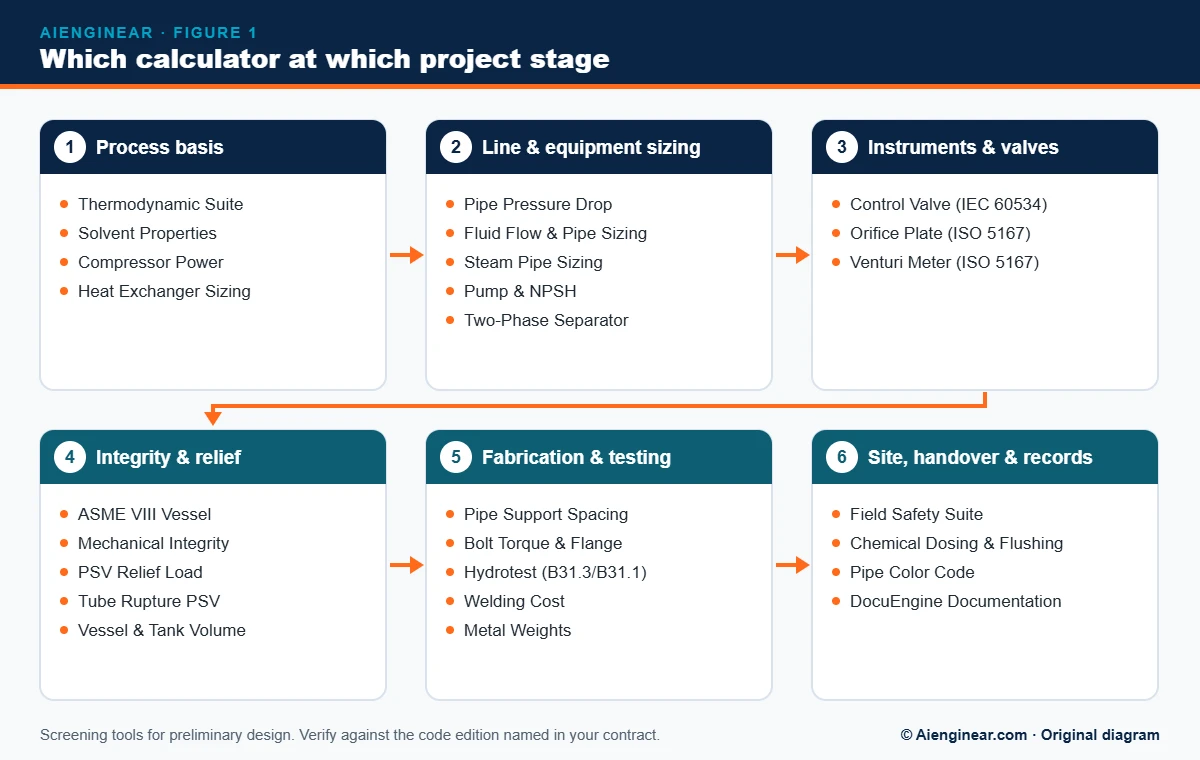
Start from the question you need answered, not from the tool name. Most calculation chains on a plant project follow the same order: fix the process basis, size lines and equipment, select instruments and valves, protect against overpressure, then fabricate, test and hand over. Figure 1 maps every Aienginear calculator to that sequence, so the output of one tool becomes the input of the next.
Three habits make any calculator more reliable: confirm the unit system before entering data, use actual pipe inside diameters rather than nominal sizes, and keep the design margin you apply visible in the record instead of hiding it in the inputs.
2. Quick selector: which calculator answers your question?
Aienginear · Table 1
Quick selector: engineering task to Aienginear calculator
15 everyday questions and the tool that answers each one
| Your question | Calculator | Key output |
|---|---|---|
| Will this line size meet my allowable pressure drop? | Pipe Pressure Drop | ΔP per 100 m, velocity, Reynolds number |
| What size should a new steam main be? | Steam Pipe Sizing | Minimum diameter on velocity and ΔP |
| Is there enough NPSH margin for this pump? | Pump Sizing | TDH, power, NPSHa minus NPSHr |
| What Cv does my control valve need? | Control Valve Sizing | Cv/Kv, choked-flow and cavitation flags |
| What flow does this orifice ΔP represent? | Orifice Plate Flow | Mass and volume flow, bore, uncertainty inputs |
| How big must the separator be? | Two-Phase Separator | Diameter, length, liquid levels |
| What wall thickness does my vessel need? | ASME VIII Pressure Vessel | Required thickness, MAWP |
| What relief load and orifice letter do I need? | PSV Relief Load | Required area, API 526 letter |
| Does a tube rupture need its own PSV? | Tube Rupture Relief | 10/13 rule check, relief load |
| What is the hydrotest pressure for this package? | Hydrotest & Pressure Test | Test pressure, water volume, duration |
| What torque should the flange bolts get? | Bolt Torque & Flange | Target preload, torque, pass sequence |
| How far apart can the pipe supports be? | Pipe Support Spacing | Maximum span, governing criterion |
| How much liquid is in the tank at this level? | Tank Volume | Partial volume, ullage, capacity table |
| How much will these welds cost? | Welding Cost | Consumables, arc time, cost per joint |
| How heavy is this steel? | Metal Profiles Weight | Mass per piece and per metre |
Reviewed 17 October 2026. Screening tools — verify results against the code edition named in your contract.
3. Process, flow and thermal calculators (13)
These tools cover fluid behaviour from properties to delivered head. Use them in front-end and detailed design to size lines, pumps, compressors, control valves, flow elements, separators and exchangers. Each one shows the correlation it uses, so you can tell whether the method suits your fluid and flow regime.
Aienginear · Table 2
Process, flow and thermal calculators
13 free tools · click a name to open the calculator
| Calculator | What it calculates | Standards / methods | Use it for |
|---|---|---|---|
| Pipe Pressure Drop Calculator | Friction and fitting losses for liquid, gas, steam, slurry and two-phase lines | Darcy-Weisbach, Colebrook-White, Crane-type K-values | Checking a line against allowable ΔP |
| Fluid Flow & Pipe Sizing Calculator (HydraFlow Pro) | Line size, velocity, compressible and gas-pipeline flow, erosional velocity, Moody chart | ASME B36.10M/19M pipe data, API RP 14E | Selecting a line size for a new service |
| Steam Pipe Sizing Calculator | Steam main and branch diameter checked on both velocity and pressure drop | Steam property data, actual pipe ID | Sizing saturated or superheated steam lines |
| Pump Sizing Calculator | Total dynamic head, hydraulic and shaft power, NPSH available vs required margin | Energy balance, Darcy friction | Pump duty point and cavitation check |
| Compressor Power & Performance Calculator | Gas power, head, discharge temperature, multistage with intercooling, driver size | Real-gas Z, isentropic and polytropic methods | Screening reciprocating, centrifugal or screw compressors |
| Control Valve Sizing Calculator | Required Cv/Kv, choked flow, cavitation, flashing, noise and % opening | IEC 60534-2-1 (ISA-75.01.01 equivalent) | Valve sizing for liquid, gas and steam |
| Orifice Plate Flow Calculator | Flow from ΔP or bore from target flow; discharge coefficient and expansibility | ISO 5167-1 and ISO 5167-2 (Reader-Harris/Gallagher) | Flow element design and verification |
| Venturi Meter Calculator | Mass and volume flow, discharge coefficient, beta ratio, permanent pressure loss | ISO 5167-1 and ISO 5167-4 | Low-loss flow measurement |
| Two-Phase Separator Sizing Calculator | Vessel diameter and length, K-factor, retention and surge volumes, LLL/NLL/HLL | Souders-Brown, API 12J guidance | Horizontal or vertical gas-liquid separators |
| Heat Exchanger Sizing Calculator | Duty, LMTD and F-factor, area, preliminary shell-and-tube layout, ΔP, fouling | Bell-Delaware shell-side method, TEMA screening | Early exchanger sizing and datasheets |
| Advanced Process & Thermodynamic Suite (ProcessFlow Intelligence) | Vapour pressure, saturated-liquid density, hydraulic screening | Antoine and Rackett correlations | Quick physical-property estimates |
| Solvent Property & Sizing Calculator (SolventMaster) | Solvent properties with temperature correction and hazard classification | NFPA 704 hazard rating | Solvent selection and handling design |
| Chemical Dosing & Flushing Calculator (CommishPro) | Chemical dose rates, flushing volumes and commissioning sequences | Mass-balance dosing, commissioning practice | Pre-commissioning cleaning and dosing |
Reviewed 17 October 2026. Screening tools — verify results against the code edition named in your contract.
4. Pressure integrity, relief and testing calculators (9)
This group keeps pressure equipment inside its design envelope. It covers vessel thickness and MAWP, relief loads and orifice selection, pressure testing, flange make-up, volumes for level and fire-case work, and the site-safety checks that go with them. Relief and vessel results are the most consequential on a project, so always pair them with an independent review.
Aienginear · Table 3
Pressure integrity, relief and testing calculators
9 free tools · click a name to open the calculator
| Calculator | What it calculates | Standards / methods | Use it for |
|---|---|---|---|
| ASME VIII Pressure Vessel Calculator (VesselCalc Pro) | Shell and head thickness, MAWP, geometry, MDMT screening | ASME BPVC Section VIII Div. 1 and 2, EN 13445-3, PD 5500, API 510 | New vessel sizing and code reviews |
| Mechanical Integrity & Pressure Vessel Calculator (ASME Guard) | Integrity and compliance checks for vessels and pressure equipment | ASME Section VIII methods, in-service inspection practice | Checking existing assets and skids |
| PSV Relief Load Calculator | Relief load and effective orifice area for gas, vapour, liquid, steam and two-phase | API 520 Part I, API 521, API 526 orifice letters | Relief scenario screening and PSV sizing |
| Tube Rupture Relief Valve Suite | Tube-rupture relief load, 10/13 rule screening, PSV and orifice selection | API 521 tube rupture, API 520, API 526 | Heat-exchanger overpressure protection |
| Hydrotest & Pressure Test Calculator | Minimum test pressure with stress-ratio correction, fill water, pump, duration, pneumatic stored energy | ASME B31.3 and ASME B31.1 leak-test rules | Planning piping test packages |
| Bolt Torque & Flange Joint Integrity Calculator | Bolt preload and torque, gasket seating and operating loads, tightening passes | ASME B16.5/B16.47, ASME VIII Appendix 2, ASME PCC-1 | Flange make-up during shutdowns |
| Vessel Volume & Calibration Calculator | Partial and total volumes with elliptical, torispherical, hemispherical or conical heads; strapping table; wetted area | Exact head geometry; wetted area for API 521 fire case | Level gauging and fire-case inputs |
| Tank Volume Calculator | Level-to-volume and volume-to-level for cylindrical, spherical, conical, rectangular and composite tanks | Exact geometric integration, capacity tables | Inventory and tank calibration charts |
| Field Safety & Construction Utility Suite (SafeSite Construct) | Pressure-test exclusion screening, rigging and crane checks, steel member checks, confined-space logic | AISC steel checks, site safety practice | Site supervision and lift planning |
Reviewed 17 October 2026. Screening tools — verify results against the code edition named in your contract.
Safety-critical results: relief-device sizing, vessel thickness and pneumatic-test energy feed directly into life-safety decisions. Treat calculator output as a check on, not a replacement for, the approved relief study, the vessel design report and the site test procedure.
5. Piping, mechanical and fabrication calculators (7)
The fabrication and mechanical tools turn a design into steel on site: support spans, pipe dimensions and weights, identification colours, welding cost, insulation economics and controlled documentation. They are built for take-offs, quotations and shutdown planning as much as for design.
Aienginear · Table 4
Piping, mechanical and fabrication calculators
7 free tools · click a name to open the calculator
| Calculator | What it calculates | Standards / methods | Use it for |
|---|---|---|---|
| Pipe Support Spacing Calculator | Maximum support span from bending stress and deflection limits | ASME B31.1 / MSS SP-58 reference framework | Pipe rack and support layout |
| Piping Specification & Component Calculator | OD, ID, wall, weight by NPS and schedule; component lists by class | ASME B36.10M, B36.19M, B16 component standards | Pipe class and take-off work |
| Pipe Color Code Calculator | Marker colours, legend size and arrows by fluid and pipe OD; label generator | ASME A13.1, BS 1710, IS 2379 | Pipe identification and labelling |
| Welding Cost & Consumables Calculator | Weld metal, electrode or wire, gas, arc time, labour and cost per joint or metre | SMAW, GMAW, FCAW, GTAW and SAW deposition data | Fabrication quotes and spool costing |
| Metal Profiles Weight Calculator | Weight of plates, bars, pipes, beams and hollow sections in common metals | Density × section geometry | Material take-off and procurement |
| Mechanical & Energy Utility Suite (EcoThermal) | Insulation heat loss, economic thickness with NPV/IRR, steam and HVAC, Scope 1-3 GHG | Heat-transfer methods, GHG Protocol | Insulation and energy studies |
| Engineering Documentation Software (DocuEngine) | Offline P&ID drafting and engineering document control in the browser | Document control practice | Turning calculations into records |
Reviewed 17 October 2026. Screening tools — verify results against the code edition named in your contract.
6. Energy and electricity calculators (4)
The electricity tools are aimed at households, offices and small sites rather than process plants. They estimate kWh, monthly bills, solar payback and air-conditioning savings from appliance ratings and local tariffs.
Aienginear · Table 5
Energy and electricity calculators
4 free tools · click a name to open the calculator
| Calculator | What it calculates | Standards / methods | Use it for |
|---|---|---|---|
| Electricity, Solar & AC Savings Calculator | kWh use and cost, solar payback and AC efficiency savings, downloadable report | kWh = kW × hours; simple payback | Home and small-site energy decisions |
| Smart Electricity Calculator | Appliance-by-appliance monthly and annual bill with regional tariffs | Load × duty hours × tariff | Quick bill estimates |
| Energy Consumption Calculator with Quantity | Consumption for multiple identical appliances (quantity × power × hours) | Load × quantity × hours | Facility or household load lists |
| Smart Energy & Power Consumption Calculator | Daily, monthly and yearly kWh with PKR bill estimates | Pakistan tariff-based estimate | Bill planning for Pakistan users |
Reviewed 17 October 2026. Screening tools — verify results against the code edition named in your contract.
7. Standards behind the results
Every calculator states the method it applies. Table 6 lists the main codes and standards referenced across the toolkit, the edition position on the review date, and which tools use them. Aienginear paraphrases and applies published methods; it does not reproduce copyrighted code tables. Where a project names an older or newer edition, that edition governs.
Aienginear · Table 6
Codes and standards referenced by Aienginear calculators
Edition status checked 17 October 2026
| Code / standard | Edition position | What it governs | Aienginear tools |
|---|---|---|---|
| ASME BPVC Section VIII, Div. 1 and 2 | 2025 edition | Pressure vessel design, thickness and MAWP | ASME VIII Pressure Vessel, Mechanical Integrity, Bolt Torque (App. 2) |
| ASME B31.3 Process Piping | 2024 edition | Process piping design and leak testing | Hydrotest & Pressure Test, Pipe Pressure Drop context |
| ASME B31.1 Power Piping | 2024 edition | Power piping design, testing and support guidance | Hydrotest & Pressure Test, Pipe Support Spacing, Steam Pipe Sizing |
| ASME B16.5 / B16.47 | B16.5-2025; B16.47 per contract | Flange dimensions and pressure-temperature ratings | Bolt Torque & Flange, Piping Specification |
| ASME PCC-1 | Edition per contract | Bolted flange joint assembly | Bolt Torque & Flange |
| ASME B36.10M / B36.19M | Edition per contract | Steel and stainless pipe dimensions | Fluid Flow & Pipe Sizing, Piping Specification |
| ASME A13.1 | Edition per contract | Pipe identification colours and legends | Pipe Color Code |
| API Std 520 Part I / API Std 521 | Current API editions | Relief sizing and pressure-relieving system design | PSV Relief Load, Tube Rupture, Vessel Volume (fire-case wetted area) |
| API Std 526 | Current API edition | Flanged steel PSV orifice designations | PSV Relief Load, Tube Rupture |
| API RP 14E / API Spec 12J | Current API editions | Erosional velocity; oil and gas separators | Fluid Flow & Pipe Sizing; Two-Phase Separator |
| ISO 5167-1, -2 and -4 | 2022 editions | Differential-pressure flow meters (orifice, Venturi) | Orifice Plate Flow, Venturi Meter |
| IEC 60534-2-1 | 2011 edition (ISA-75.01.01 equivalent) | Control valve sizing equations | Control Valve Sizing |
| TEMA Standards | Edition per contract | Shell-and-tube exchanger mechanical classes | Heat Exchanger Sizing |
| MSS SP-58 | Edition per contract | Pipe hangers and supports | Pipe Support Spacing |
| NFPA 704 / GHG Protocol | Current editions | Hazard rating; Scope 1-3 emissions accounting | Solvent Property; Mechanical & Energy Utility Suite |
Reviewed 17 October 2026. Screening tools — verify results against the code edition named in your contract.
8. Worked example: one steam line, six calculators
Consider a new carbon-steel steam header between a boiler house and a process unit. The calculation chain below shows how the tools hand results to each other.
- Size the line with the Steam Pipe Sizing Calculator: enter flow, pressure and temperature, then accept the smallest size that meets both the velocity and the pressure-drop limit.
- Confirm the loss over the full route, including bends and valves, with the Pipe Pressure Drop Calculator.
- Lay out the supports using the Pipe Support Spacing Calculator with the insulated, water-filled weight for the test case.
- Set flange make-up with the Bolt Torque & Flange Calculator for the selected class and gasket.
- Plan the hydrotest with the Hydrotest & Pressure Test Calculator.
- Record the package in DocuEngine, attaching the printed tables from each tool.
Hydrotest pressure check (ASME B31.3 method)
ASME B31.3 hydrostatic leak test:  PT = 1.5 × P × RR
RR = ST / S   (stress ratio, limited to a maximum of 6.5)

Design pressure P = 20 barg, assumed stress ratio RR = 1.20
PT = 1.5 × 20 × 1.20 = 36 barg minimum test pressure

Then confirm the test does not stress any part above yield
and that attached equipment can take the test pressure.
The ratio 1.20 is an illustration only; take ST and S from the allowable-stress table of the B31.3 edition in your contract for the actual material and design temperature. Power piping under B31.1 uses its own test rules, which the calculator applies separately.
9. How accurate are the results?
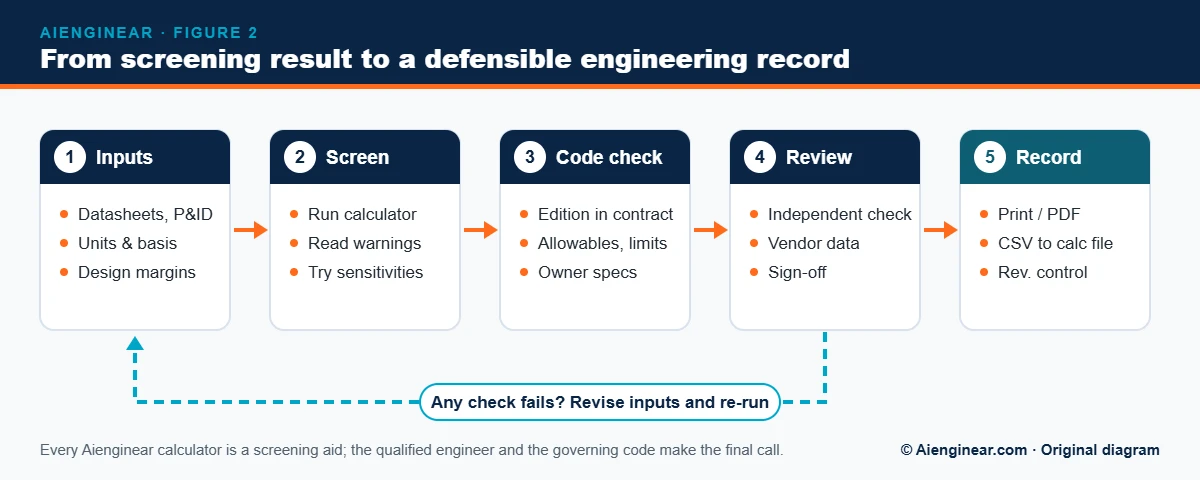
The calculators implement published equations exactly, so the arithmetic is not the weak point — the inputs and the method choice are. Results are as good as the fluid properties, pipe data and assumptions you supply. Figure 2 shows the review loop we recommend before any number goes on a datasheet or drawing.
- Check the method fits the case. A single-phase friction model will understate losses in flashing or slug flow.
- Match the code edition. Allowable stresses and rules change between editions; the edition in your contract governs.
- Read every warning. Choked-flow, cavitation, erosional-velocity and minimum-thickness flags are there for a reason.
- Keep an independent check for relief, vessel and test calculations, and confirm against vendor data at purchase.
- Print or export the table and file it with the revision of the drawing or datasheet it supports.
10. Why engineers use Aienginear calculators
Aienginear is built by a working EPC project engineer for engineers who need answers they can defend. Table 7 sums up how the toolkit differs from a typical free calculator page.
Aienginear · Table 7
Aienginear calculators compared with typical free calculator pages
Feature comparison
| Feature | Aienginear | Typical free calculator page |
|---|---|---|
| Coverage | 33 tools across process, integrity, piping and energy in one directory | Single-purpose pages scattered across sites |
| Method shown | Equation or standard named for every tool | Often a black-box answer |
| Standards | Referenced to current ASME, API, ISO and IEC editions, review date stated | Edition rarely stated |
| Output | Printable, branded tables plus CSV export | Screen-only results |
| Access | Free, no signup, works on phone and desktop | Logins, trials or paywalls common |
| Privacy | Calculations run in your browser | Inputs often sent to a server |
| Workflow | Tools mapped to project stages and linked to each other | Each tool stands alone |
Reviewed 17 October 2026. Screening tools — verify results against the code edition named in your contract.
11. Aienginear calculator hubs
If you prefer to browse by discipline, the three hubs group the core suites with background notes and workflow guidance:
- FlowStack — Process & Hydraulics hub: properties, pipe sizing, pressure drop, pumps and NPSH.
- IntegriShield — Pressure Integrity & Site Safety hub: ASME VIII vessels, volumes, API 520/521 relief and field safety.
- MechCore — Mechanical, Energy & Documentation hub: insulation economics, metal weights and DocuEngine.
12. Related engineering guides
Background reading that pairs with the calculators:
- Piping guides library — every Aienginear piping article in one place
- Pipe sizes and schedules and pipe dimensions — the data behind line sizing
- Piping specifications and components — how pipe classes are built
- ASTM A53 pipe and ASTM A105 forgings — common carbon-steel materials
- Pipe material types and selection and stainless steels in process piping
- Pipe fittings inspection guide — acceptance checks before installation
- Piping colour codes and identification standards
- Heat exchangers explained — background for the exchanger and tube-rupture tools
- Plant turnaround and shutdown planning — where torque, test and welding tools earn their keep
- Piping interview questions — test your knowledge
13. Frequently asked questions
Are Aienginear engineering calculators free?
Yes. All 33 calculators are free to use with no signup, login, usage limit or paywall. They run in your web browser on desktop, tablet or phone.
Which engineering standards do the calculators use?
Each tool names its method. Key references include ASME BPVC Section VIII for pressure vessels, ASME B31.3 and B31.1 for piping and pressure tests, API 520, 521 and 526 for relief devices, ISO 5167 for orifice and Venturi meters, IEC 60534-2-1 for control valves, API 12J for separators and ASME PCC-1 for flange assembly.
Can I use the results for final design?
Use them for screening, checking and preliminary design. Final design, relief studies and code compliance must be confirmed by a qualified engineer against the code edition and project specifications named in the contract.
How do I print or save a calculator table?
Every Aienginear table has a Print / PDF button that opens a clean, branded print layout, and a CSV button that downloads the rows for Excel. You can also print the whole page with Ctrl + P.
Which calculator should I use for pipe sizing?
Use the Fluid Flow and Pipe Sizing Calculator to select a line size, the Pipe Pressure Drop Calculator to confirm losses over the full route, and the Steam Pipe Sizing Calculator for steam service.
Which tool sizes a pressure relief valve?
The PSV Relief Load Calculator sizes relief devices for gas, vapour, liquid, steam and two-phase cases to API 520 and 521 and selects an API 526 orifice. For heat-exchanger tube failure, use the Tube Rupture Relief Valve Suite.
Do the calculators store my data?
Calculations run in your browser. Inputs are not sent to Aienginear for processing, which makes the tools suitable for confidential project data.
Who builds and reviews the calculators?
They are developed and reviewed by Muhammad Raza, founder of Aienginear and Head of Projects in industrial EPC delivery, with more than 26 years in oil and gas, petrochemical, power and cement projects.

Written by Muhammad Raza
Founder of Aienginear. Engineering and digital solutions professional with 26+ years managing projects, plant shutdowns and turnarounds in oil & gas, petrochemical and power generation.