
AIENGINEAR · MECHCORE™ · HUB 03 OF 03
MechCore is the Aienginear hub for the mechanical side of a project — the work that turns a design into steel on site and keeps it running efficiently. It brings together eleven free calculators for pipe and steel weights, support spans, welding cost, insulation and energy economics, pipe identification, electricity use and controlled engineering records. This page explains how they fit together, gives the reference data you need most often and adds a quick weight and energy-cost checker.
What are mechanical and energy engineering calculators?
Mechanical and energy calculators work out the quantities a project needs to buy, build, support and run: steel weights, pipe support spans, welding consumables and cost, insulation heat loss, energy use and its cost and emissions. Aienginear’s MechCore hub offers eleven free tools that use ASME B36.10M pipe dimensions, ASME B31.1 support guidance, ASME A13.1 pipe marking, and energy and emissions methods consistent with ISO 50001 and the GHG Protocol. Every table and result can be printed or exported for the project file.
1. The MechCore workflow: take-off to controlled records
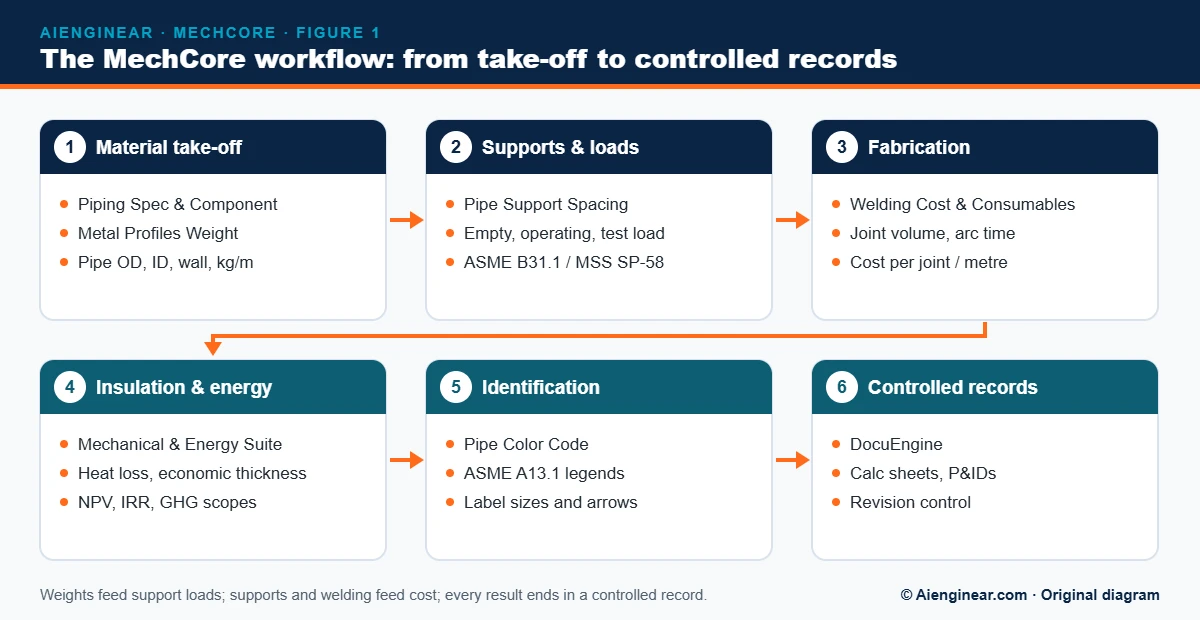
Mechanical calculations feed each other. Weights from the take-off set support loads; supports and welding set fabrication cost; insulation and energy decide running cost; and everything ends up in a controlled document. Figure 1 shows where each MechCore tool sits.
2. All 11 MechCore calculators
Seven tools cover mechanical work, insulation and records; four cover electricity use and bills for homes, offices and small sites.
Aienginear MechCore · Table 1
MechCore mechanical, energy and documentation calculators
11 free tools · grouped by workflow step
| Step | Calculator | Typical inputs | Key outputs | Method / reference |
|---|---|---|---|---|
| Take-off | Piping Specification & Component Calculator | NPS, schedule, material, pipe class | OD, ID, wall, weight per metre, component lists | ASME B36.10M / B36.19M, B16 standards |
| Take-off | Metal Profiles Weight Calculator | Profile, dimensions, length, material | Weight of plates, bars, pipes, beams and hollow sections | Section area × density |
| Supports | Pipe Support Spacing Calculator | Pipe size, schedule, contents, insulation, limits | Maximum span on stress and deflection, governing case | ASME B31.1 / MSS SP-58 reference framework |
| Fabrication | Welding Cost & Consumables Calculator | Joint type, thickness, process, rates | Weld metal, consumables, gas, arc time, cost per joint | SMAW, GMAW, FCAW, GTAW, SAW data |
| Insulation & energy | Mechanical & Energy Utility Suite (EcoThermal) | Pipe size, temperatures, insulation, fuel cost | Heat loss, economic thickness, NPV/IRR, steam, HVAC, GHG | Heat-transfer methods, GHG Protocol |
| Identification | Pipe Color Code Calculator | Fluid or hazard, pipe OD | Marker colours, legend height, label length, arrows | ASME A13.1, BS 1710, IS 2379 |
| Records | Engineering Documentation Software (DocuEngine) | Project data, calculations, drawings | Controlled calc sheets, P&ID drafting, registers | Document-control practice |
| Electricity | Electricity, Solar & AC Savings Calculator | Loads, hours, tariff, solar size | kWh, cost, solar payback, AC savings, report | kWh = kW × h; simple payback |
| Electricity | Smart Electricity Calculator | Appliances, hours, region | Monthly and annual bill estimate | Load × hours × tariff |
| Electricity | Energy Consumption Calculator with Quantity | Power, quantity, hours | Daily, monthly, yearly kWh | Load × quantity × hours |
| Electricity | Smart Energy & Power Consumption Calculator | Appliances, hours, PKR tariff | kWh and bill estimate for Pakistan | Tariff-based estimate |
Reviewed 17 October 2026. Screening tools — verify against your project specification, vendor data and the code edition in your contract.
3. Quick weight and energy-cost checker
Find the weight of a pipe run — empty, full and insulated — for support and lifting loads, or estimate the yearly energy, cost and emissions of a motor or other electrical load.
Aienginear MechCore · Free tool
Quick weight and energy-cost checker
Pipe weight per metre · yearly kWh, cost and CO₂e
Enable JavaScript to use the checker, or follow the worked examples below by hand.
Screening aid only. Defaults reproduce the worked examples on this page.
4. Steel pipe weights (ASME B36.10M)
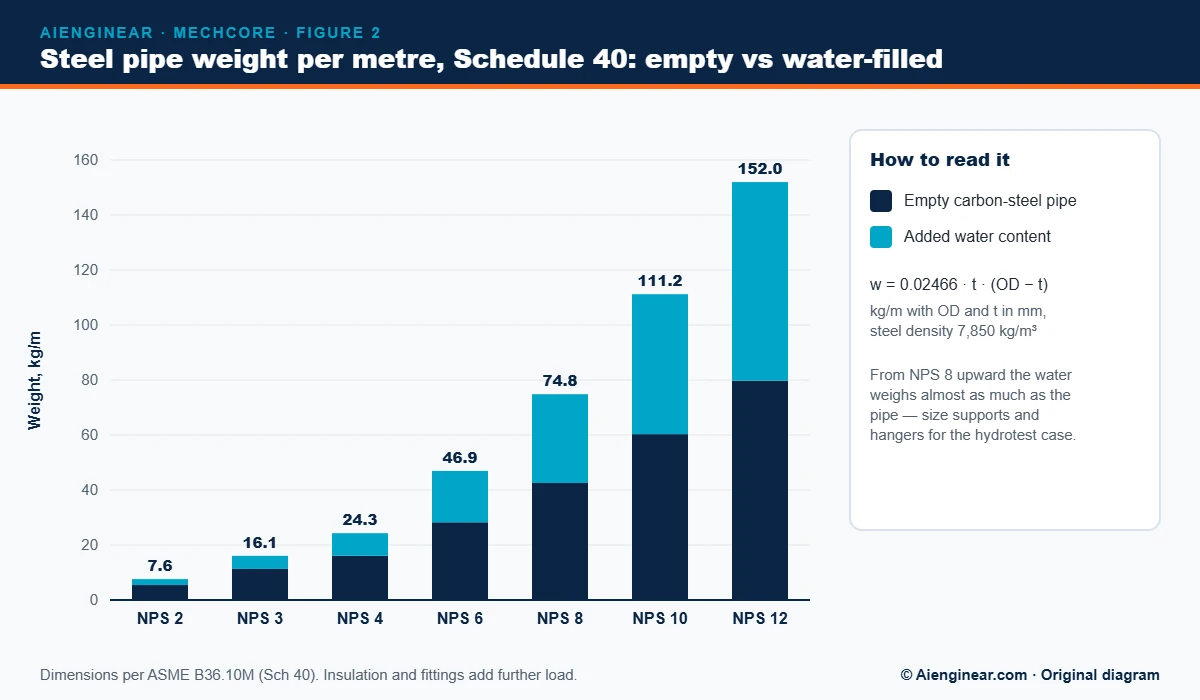
Carbon-steel pipe weight per metre follows directly from the outside diameter and wall thickness: w = 0.02466 × t × (OD − t) kg/m, with OD and t in millimetres and a density of 7,850 kg/m³. The water a pipe holds matters just as much for supports, as Figure 2 shows.
Aienginear MechCore · Table 2
Carbon-steel pipe weight per metre, Sch 40 and Sch 80
Calculated from ASME B36.10M OD and wall · water at 1,000 kg/m³
| NPS | OD, mm | Sch 40 wall, mm | Sch 40 empty, kg/m | Sch 40 water-filled, kg/m | Sch 80 wall, mm | Sch 80 empty, kg/m |
|---|---|---|---|---|---|---|
| ½ | 21.3 | 2.77 | 1.27 | 1.46 | 3.73 | 1.62 |
| 1 | 33.4 | 3.38 | 2.50 | 3.06 | 4.55 | 3.24 |
| 2 | 60.3 | 3.91 | 5.44 | 7.60 | 5.54 | 7.48 |
| 3 | 88.9 | 5.49 | 11.29 | 16.06 | 7.62 | 15.27 |
| 4 | 114.3 | 6.02 | 16.08 | 24.29 | 8.56 | 22.32 |
| 6 | 168.3 | 7.11 | 28.26 | 46.91 | 10.97 | 42.56 |
| 8 | 219.1 | 8.18 | 42.55 | 74.83 | 12.70 | 64.64 |
| 10 | 273.1 | 9.27 | 60.31 | 111.21 | 15.09 | 96.02 |
| 12 | 323.9 | 10.31 | 79.73 | 151.97 | 17.48 | 132.09 |
Reviewed 17 October 2026. Plain-end weights from nominal dimensions; actual weights vary with mill tolerance. Stainless steel is about 1 – 2 % heavier.
Worked example: 6 m of insulated NPS 6 Sch 40 at hydrotest
NPS 6 Sch 40: OD = 168.3 mm, t = 7.11 mm, ID = 154.08 mm
Pipe:        0.02466 × 7.11 × (168.3 − 7.11)          = 28.26 kg/m
Water:       π/4 × 0.15408² × 1,000                     = 18.65 kg/m
Insulation:  π/4 × (0.2683² − 0.1683²) × 120 (50 mm)    = 4.11 kg/m
Total:       28.26 + 18.65 + 4.11                       = 51.02 kg/m  →  0.50 kN/m
For a 6 m spool: 51.02 × 6 = 306 kg before valves and flanges
5. Material densities for weight calculations
Aienginear MechCore · Table 3
Typical material densities
Use in the checker and the Metal Profiles Weight Calculator
| Material | Density, kg/m³ | Notes |
|---|---|---|
| Carbon steel | 7,850 | Default for pipe, plate and structural sections |
| Stainless steel 304 / 316 | 7,900 – 8,000 | Austenitic grades |
| Duplex stainless | ≈ 7,800 | 22Cr and 25Cr grades |
| Cast iron | ≈ 7,200 | Grey iron |
| Aluminium alloys | 2,700 | About one third of steel |
| Copper | 8,940 | Tube and bus bar |
| Brass | 8,400 – 8,700 | Depends on zinc content |
| Titanium | 4,510 | Commercially pure grades |
| Mineral wool insulation | ≈ 100 – 140 | Pipe sections |
| Calcium silicate insulation | ≈ 220 – 260 | High-temperature service |
Reviewed 17 October 2026. Typical published values — your project specification and the code edition in your contract govern.
6. Pipe support spans
ASME B31.1 gives suggested maximum spans between supports for standard-wall steel pipe on straight horizontal runs. They limit sag and bending stress for the stated service, and assume no heavy concentrated loads such as valves or flanges between supports. Shorten spans near such loads, at changes of direction and for thin-wall or plastic pipe.
Aienginear MechCore · Table 4
Suggested maximum support spans, standard-wall steel pipe
ASME B31.1 suggested spacing · metres (feet)
| NPS | Water service, m (ft) | Steam, gas or air, m (ft) |
|---|---|---|
| 1 | 2.1 (7) | 2.7 (9) |
| 2 | 3.0 (10) | 4.0 (13) |
| 3 | 3.7 (12) | 4.6 (15) |
| 4 | 4.3 (14) | 5.2 (17) |
| 6 | 5.2 (17) | 6.4 (21) |
| 8 | 5.8 (19) | 7.3 (24) |
| 12 | 7.0 (23) | 9.1 (30) |
| 16 | 8.2 (27) | 10.7 (35) |
| 20 | 9.1 (30) | 11.9 (39) |
| 24 | 9.8 (32) | 12.8 (42) |
Reviewed 17 October 2026. Summary of ASME B31.1 suggested spans; check the edition in your contract and use the Pipe Support Spacing Calculator for insulated, heavy-wall or loaded lines.
For a site-specific answer that accounts for insulation, contents, schedule and your own deflection limit, use the Pipe Support Spacing Calculator.
7. Welding cost basics
Weld cost is driven by the volume of weld metal, the deposition efficiency of the process and the arc time. Consumable mass = weld metal mass ÷ deposition efficiency; labour time = arc time ÷ operating factor. The Welding Cost & Consumables Calculator runs this for each joint and adds NDT and PWHT.
Aienginear MechCore · Table 5
Typical deposition efficiency and rate by process
Screening values for cost estimates
| Process | Deposition efficiency | Typical deposition rate | Notes |
|---|---|---|---|
| SMAW (stick) | ≈ 55 – 65 % | ≈ 1 – 2 kg/h | Stub ends and spatter reduce efficiency |
| GMAW (solid wire) | ≈ 90 – 95 % | ≈ 2 – 5 kg/h | Shielding gas required |
| FCAW (flux-cored) | ≈ 80 – 85 % | ≈ 2 – 6 kg/h | Good for site work and positional welds |
| GTAW (TIG) | ≈ 95 – 100 % | ≈ 0.5 – 1 kg/h | Root passes and thin wall |
| SAW (submerged arc) | ≈ 95 – 100 % (wire) | ≈ 5 – 12 kg/h | Shop, flat position, heavy wall |
Reviewed 17 October 2026. Typical ranges; use your qualified WPS and measured shop data for quotations.
8. Pipe colour codes (ASME A13.1)
Aienginear MechCore · Table 6
ASME A13.1 colour scheme for pipe markers
Text colour on field colour
| Fluid category | Marker colours | Typical services |
|---|---|---|
| Fire-quenching fluids | White on red | Water, foam, CO₂ fire systems |
| Toxic and corrosive fluids | Black on orange | Acids, caustic, toxic gases |
| Flammable fluids | Black on yellow | Fuels, solvents, flammable gases |
| Combustible fluids | White on brown | Oils and other combustible liquids |
| Potable, cooling, boiler feed and other water | White on green | Most water services |
| Compressed air | White on blue | Plant and instrument air |
| User-defined | White on purple, black on white, white on grey, white on black | For services the owner defines |
Reviewed 17 October 2026. Legend size and marker length depend on pipe OD — see the Pipe Color Code Calculator and the A13.1 edition in your contract.
Our guide to piping colour codes and identification standards compares ASME A13.1 with BS 1710 and IS 2379.
9. Energy, cost and emissions
Energy cost studies start from the power drawn at the meter, not the nameplate output. Motor input power is the shaft power divided by efficiency, and yearly energy is input power multiplied by running hours. Multiply by the tariff for cost and by the grid emission factor for location-based Scope 2 emissions, as defined in the GHG Protocol.
Aienginear MechCore · Table 7
Core energy and cost equations
Used by the EcoThermal suite and electricity calculators
| Quantity | Equation | Notes |
|---|---|---|
| Annual energy | E = Pin × h | kWh = kW × hours |
| Motor input power | Pin = Pshaft × load / η | η = motor efficiency |
| Three-phase power | P = √3 × V × I × PF | V line-to-line, I line current |
| Energy cost | Cost = E × tariff | Use the blended tariff incl. demand charges if known |
| Scope 2 emissions | CO₂e = E × grid factor | Location-based method |
| Simple payback | Payback = investment / annual saving | Use NPV/IRR for longer projects |
Reviewed 17 October 2026. Typical published values — your project specification and the code edition in your contract govern.
15 kW pump motor, 92 % efficient, full load, 8,000 h/year
Input power  = 15 / 0.92            = 16.30 kW
Energy       = 16.30 × 8,000        = 130,435 kWh/year
Cost         = 130,435 × 0.12       = 15,652 per year (at 0.12 per kWh)
Emissions    = 130,435 × 0.5 / 1000 = 65.2 t CO₂e/year (grid factor 0.5)
Each point of motor efficiency on this duty is worth about 1,400 kWh a year. For insulation economics, steam and HVAC, open the Mechanical & Energy Utility Suite; for household and small-site bills, use the Electricity, Solar & AC Savings Calculator or the Pakistan kWh and bill estimator.
10. Standards behind MechCore
Aienginear MechCore · Table 8
Codes and references used in MechCore
Edition status checked 17 October 2026
| Standard | Edition position | Scope |
|---|---|---|
| ASME B36.10M / B36.19M | Edition per contract | Welded and seamless steel and stainless pipe dimensions |
| ASME B31.1 | 2024 edition | Power piping, including suggested support spacing |
| MSS SP-58 | Edition per contract | Pipe hangers and supports — materials, design and manufacture |
| ASME A13.1 | Edition per contract | Scheme for the identification of piping systems |
| ASME BPVC Section IX | 2025 edition | Welding and brazing qualifications |
| AWS D1.1 | 2025 edition | Structural welding code — steel |
| ASTM C680 | Current edition | Heat loss and surface temperature of insulated pipe |
| ISO 50001 | 2018 (with amendment) | Energy management systems |
| GHG Protocol | Corporate and Scope 2 guidance | Emissions accounting, Scopes 1, 2 and 3 |
| ISO 9001 | 2015 edition | Quality management, including control of documented information |
Reviewed 17 October 2026. Aienginear paraphrases published methods and does not reproduce copyrighted tables. The edition named in your contract governs.
11. Related hubs and guides
- All 33 Aienginear engineering calculators — the full directory
- FlowStack — Process & Hydraulics hub — line sizing, pressure drop, pumps and NPSH
- IntegriShield — Pressure Integrity & Site Safety hub — ASME VIII vessels, PSV relief, hydrotests and flange torque
- Pipe sizes and schedules and pipe dimensions — the data behind the weight table
- Piping specifications and components and pipe material selection
- Non-metallic piping materials and stainless steels in process piping — densities and support needs differ
- Plant turnaround and shutdown and long activities and critical path — planning the work these tools estimate
12. Frequently asked questions
What is MechCore?
MechCore is Aienginear’s mechanical, energy and documentation hub: eleven free calculators for pipe and steel weights, pipe support spans, welding cost, insulation and energy economics, pipe colour coding, electricity use and controlled engineering records.
How do you calculate the weight of steel pipe per metre?
Use w = 0.02466 × t × (OD − t), with the outside diameter OD and wall thickness t in millimetres, to get kilograms per metre for carbon steel at 7,850 kg/m³. For example, NPS 6 Schedule 40 (168.3 × 7.11 mm) weighs 28.26 kg/m.
How much does water add to pipe weight?
Water adds π/4 × ID² × 1,000 kg/m with ID in metres. For NPS 6 Schedule 40 that is 18.65 kg/m, so the water-filled pipe weighs 46.91 kg/m. Supports should be checked for the hydrotest case.
What is the maximum support span for steel pipe?
ASME B31.1 suggests, for standard-wall steel pipe on straight runs, about 5.2 m for NPS 6 in water service and 6.4 m in steam, gas or air service, rising to 7.0 m and 9.1 m for NPS 12. Shorten spans for valves, flanges, changes of direction and insulated or thin-wall lines.
What are the ASME A13.1 pipe colours?
Fire-quenching fluids white on red; toxic and corrosive black on orange; flammable black on yellow; combustible white on brown; water services white on green; compressed air white on blue. Purple, white, grey and black fields are user-defined.
How do I calculate the annual energy cost of a motor?
Divide the shaft power by the motor efficiency to get input power, multiply by operating hours for kWh, and multiply by the tariff. A 15 kW motor at 92 % efficiency running 8,000 hours uses about 130,000 kWh a year.
How are Scope 2 emissions calculated?
Location-based Scope 2 emissions equal purchased electricity in kWh multiplied by the grid emission factor in kg CO₂e per kWh, following the GHG Protocol Scope 2 guidance.
Are MechCore results suitable for final design?
They are screening and estimating tools. Final support design, weld procedures, insulation specifications and energy audits must follow the project specification and be checked by qualified engineers.

Written by Muhammad Raza
Founder of Aienginear. Engineering and digital solutions professional with 26+ years managing projects, plant shutdowns and turnarounds in oil & gas, petrochemical and power generation.