
Updated technical edition: ASTM A53/A53M-24 | Dimensional reference: ASME B36.10-2022
ASTM A53/A53M is a widely specified carbon-steel pipe standard covering black and hot-dipped zinc-coated welded and seamless pipe. The current edition verified for this article is ASTM A53/A53M-24. It covers NPS 1/8 through NPS 26 (DN 6 through DN 650) and includes Type F furnace-butt-welded pipe, Type E electric-resistance-welded (ERW) pipe, and Type S seamless pipe, with Grade A and/or Grade B combinations defined by the specification.
This updated Aienginear guide separates the product requirements of ASTM A53/A53M from the dimensional standard ASME B36.10-2022 and from piping design codes such as ASME B31.3. That distinction is important: ASTM A53/A53M tells you what the pipe product must be, while the applicable design code, project specification, service conditions and corrosion requirements determine whether that pipe is acceptable for a particular system.
ASTM A53/A53M-24 at a glance
- Scope: black and hot-dip galvanized, welded and seamless steel pipe, NPS 1/8 to NPS 26 (DN 6 to DN 650)
- Types: Type F (furnace-butt welded), Type E (ERW), Type S (seamless)
- Grade B: 415 MPa (60 ksi) min. tensile, 240 MPa (35 ksi) min. yield
- Grade A: 330 MPa (48 ksi) min. tensile, 205 MPa (30 ksi) min. yield
- Tolerances: wall not more than 12.5% under nominal; mass ±10%
- Dimensions: per ASME B36.10 (Schedule 40, Schedule 80, STD, XS, XXS)
What Is ASTM A53/A53M?
ASTM A53/A53M is a material and manufacturing specification for steel pipe. It covers seamless and welded black pipe and hot-dipped galvanized pipe. The standard is intended for mechanical and pressure applications and is also acceptable for ordinary steam, water, gas and air lines, subject to the limitations and requirements stated in the specification.
The standard is not itself a complete piping-design code. For a process-piping application, the engineer must also apply the governing design code, such as ASME B31.3 where applicable, together with the project piping material specification, design pressure and temperature, corrosion allowance, joining requirements, fluid service classification and any purchaser-specified supplementary requirements.
ASTM A53 Pipe Types and Grades
ASTM A53/A53M-24 defines three manufacturing types: Type F, Type E and Type S. Type F is furnace-butt-welded continuous welded pipe; Type E is electric-resistance-welded pipe; and Type S is seamless pipe. Each of the three types (F, E and S) is available in Grade A and Grade B, subject to the type/grade combinations and supplementary requirements in the specification.
For Type E and Type F Grade B pipe, the weld seam is heat treated after welding to at least 1000 °F (540 °C), or processed so that untempered martensite does not remain. When pipe is cold expanded, the current specification limits expansion to no more than 1.5% of the specified outside diameter.
ASTM A53 Grade A vs Grade B
Grade B has higher minimum tensile and yield strengths than Grade A. Grade A is also the preferred grade when Type E or Type S pipe is required for close coiling or cold bending, although the specification does not prohibit cold bending of Grade B pipe.
Do not select Grade B simply because its strength is higher. Pipe selection must consider design code allowable stress, fabrication requirements, forming, welding, corrosion, temperature, service fluid and the complete project specification.
ASTM A53 Grade A and Grade B Pipe Dimensions
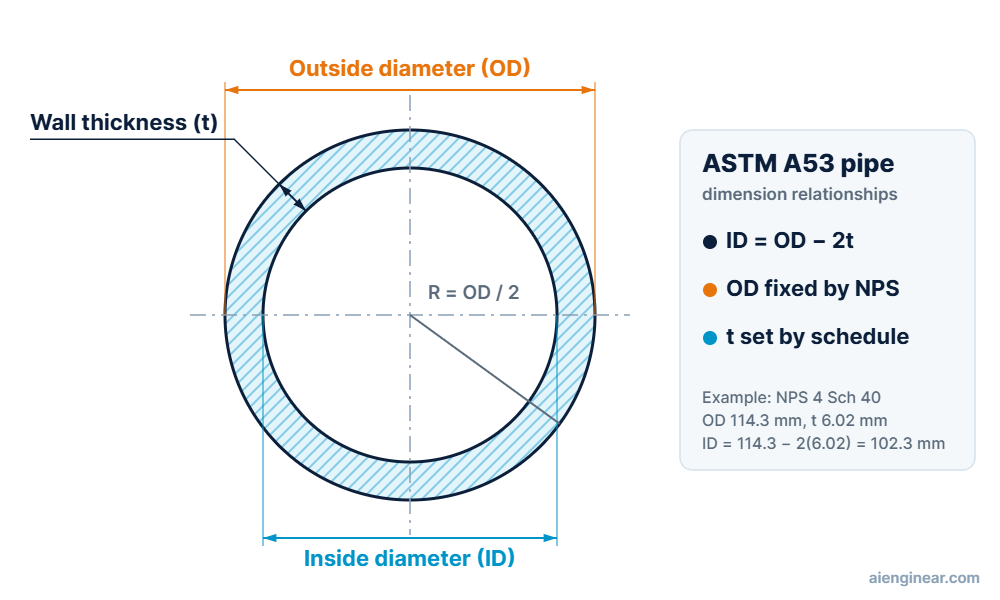
The OD of a given NPS is fixed by ASME B36.10, while the wall thickness changes with the schedule. Use the Schedule 40 and Schedule 80 tables below, or the pipe sizes and schedule chart, for complete data.
Chemical Composition
The following limits are maximum composition values from the current ASTM A53/A53M-24 requirements. The five residual/alloying elements copper, nickel, chromium, molybdenum and vanadium have a combined limit of 1.00%. The standard also contains permitted manganese adjustments tied to reductions in the specified carbon maximum; those provisions should be checked when reviewing a mill test certificate (MTC).
| Pipe type | Grade | C max % | Mn max % | P max % | S max % | Cu max % | Ni max % | Cr max % | Mo max % | V max % |
|---|---|---|---|---|---|---|---|---|---|---|
| Type S (Seamless) | A | 0.25 | 0.95 | 0.050 | 0.045 | 0.40 | 0.40 | 0.40 | 0.15 | 0.08 |
| Type S (Seamless) | B | 0.30 | 1.20 | 0.050 | 0.045 | 0.40 | 0.40 | 0.40 | 0.15 | 0.08 |
| Type E (ERW) | A | 0.25 | 0.95 | 0.050 | 0.045 | 0.40 | 0.40 | 0.40 | 0.15 | 0.08 |
| Type E (ERW) | B | 0.30 | 1.20 | 0.050 | 0.045 | 0.40 | 0.40 | 0.40 | 0.15 | 0.08 |
| Type F (Furnace-butt welded) | A | 0.30 | 1.20 | 0.050 | 0.045 | 0.40 | 0.40 | 0.40 | 0.15 | 0.08 |
| Type F (Furnace-butt welded) | B | 0.30 | 1.20 | 0.050 | 0.045 | 0.40 | 0.40 | 0.40 | 0.15 | 0.08 |
Notes: The combined Cu + Ni + Cr + Mo + V content is limited to 1.00%. ASTM A53/A53M-24 also contains permitted manganese increases when carbon is reduced below the specified maximum; the detailed footnotes in the purchased standard govern.
Mechanical Properties
ASTM A53/A53M-24 requires tensile properties to meet the applicable Grade A or Grade B limits. The yield strength determination is based on a 0.2% permanent offset or a 0.5% extension-under-load criterion as specified by the standard. Elongation requirements are also part of the tension test and depend on the specimen area and the standard’s calculation procedure.
| Pipe type | Grade | Tensile strength, min | Yield strength, min |
|---|---|---|---|
| Type E & S | Grade A | 330 MPa (48,000 psi) | 205 MPa (30,000 psi) |
| Type E & S | Grade B | 415 MPa (60,000 psi) | 240 MPa (35,000 psi) |
| Type F | Grade A | 330 MPa (48,000 psi) | 205 MPa (30,000 psi) |
| Type F | Grade B | 415 MPa (60,000 psi) | 240 MPa (35,000 psi) |
Elongation is also a mandatory tensile property. Its minimum value is determined using the specimen area and the formula/rounding provisions of ASTM A53/A53M-24.
Inspection and Testing
Quality verification under ASTM A53/A53M includes chemical/product analysis provisions, tension testing, bend testing where applicable, flattening testing where applicable, hydrostatic testing and nondestructive electric examination requirements for specified welded products.
The purchaser may perform product analysis on two pipes from each lot of 500 lengths, or fraction thereof. If either analysis fails, additional analyses are required from double the original number of pipes and each additional result must conform.
Each length is subject to the hydrostatic-test requirement unless the applicable standard provision permits an alternative. The hydrostatic test is an inspection test; its pressure is not a design pressure and has no direct relationship to allowable working pressure. For Type S, Type E and Type F Grade B pipe, the hydrostatic pressure is maintained for at least 5 seconds. Nondestructive electric examination requirements apply to specified Type E and Type F Grade B welded pipe, including weld-seam inspection provisions.
Pipe Dimensions: NPS, DN, OD, ID and Wall Thickness
ASTM A53/A53M provides pipe dimension and mass tables, while ASME B36.10-2022 is the principal dimensional reference for welded and seamless wrought steel pipe. NPS is a nominal designator, not a direct measurement of the outside diameter. For example, NPS 4 pipe has an outside diameter of 4.500 in (114.3 mm) in the common B36.10 dimensional system.
Inside diameter is not a fixed property of an NPS designation; it changes with wall thickness or schedule. For a quick check, ID can be calculated from the nominal dimensions as ID = OD − 2t, but published standard tables should be used for procurement and final engineering because nominal mass, tolerances and end condition also matter. See pipe dimensions explained for more on NPS, DN and bore.
Schedule 40 and Schedule 80: Practical Engineering Tables
Schedule numbers describe standardized wall-thickness series. They are not material grades and they do not, by themselves, establish a pipe’s allowable pressure. The following tables provide convenient reference data for common NPS 1/8 through NPS 12 Schedule 40 and NPS 1/8 through NPS 8 Schedule 80 entries. For procurement, always confirm the exact ordered NPS, schedule/weight class, end finish and edition of the applicable dimensional/product standard.
ASTM A53 Schedule 40 Pipe Dimensions (NPS 1/8 to 12)
| NPS | DN | OD (mm) | ID (mm) | Wall (mm) | Plain-end mass (kg/m) | Threaded & coupled mass (kg/m) |
|---|---|---|---|---|---|---|
| 1/8 | 6 | 10.3 | 6.8 | 1.73 | 0.37 | 0.37 |
| 1/4 | 8 | 13.7 | 9.2 | 2.24 | 0.63 | 0.63 |
| 3/8 | 10 | 17.1 | 12.5 | 2.31 | 0.84 | 0.84 |
| 1/2 | 15 | 21.3 | 15.8 | 2.77 | 1.27 | 1.27 |
| 3/4 | 20 | 26.7 | 20.9 | 2.87 | 1.69 | 1.69 |
| 1 | 25 | 33.4 | 26.6 | 3.38 | 2.5 | 2.5 |
| 1-1/4 | 32 | 42.2 | 35.1 | 3.56 | 3.39 | 3.4 |
| 1-1/2 | 40 | 48.3 | 40.9 | 3.68 | 4.05 | 4.04 |
| 2 | 50 | 60.3 | 52.5 | 3.91 | 5.44 | 5.46 |
| 2-1/2 | 65 | 73.0 | 62.7 | 5.16 | 8.63 | 8.67 |
| 3 | 80 | 88.9 | 77.9 | 5.49 | 11.29 | 11.35 |
| 3-1/2 | 90 | 101.6 | 90.1 | 5.74 | 13.57 | 13.71 |
| 4 | 100 | 114.3 | 102.3 | 6.02 | 16.07 | 16.23 |
| 5 | 125 | 141.3 | 128.2 | 6.55 | 21.77 | 22.07 |
| 6 | 150 | 168.3 | 154.1 | 7.11 | 28.26 | 28.58 |
| 8 | 200 | 219.1 | 202.7 | 8.18 | 42.55 | 43.73 |
| 10 | 250 | 273.0 | 254.5 | 9.27 | 60.29 | 63.36 |
| 12 | 300 | 323.8 | 304.8 | 9.52 | 73.78 | 76.21 |
ASTM A53 Schedule 80 Pipe Dimensions (NPS 1/8 to 8)
| NPS | DN | OD (mm) | ID (mm) | Wall (mm) | Plain-end mass (kg/m) | Threaded & coupled mass (kg/m) |
|---|---|---|---|---|---|---|
| 1/8 | 6 | 10.3 | 5.5 | 2.41 | 0.47 | 0.46 |
| 1/4 | 8 | 13.7 | 7.7 | 3.02 | 0.8 | 0.8 |
| 3/8 | 10 | 17.1 | 10.7 | 3.2 | 1.1 | 1.1 |
| 1/2 | 15 | 21.3 | 13.9 | 3.73 | 1.62 | 1.62 |
| 3/4 | 20 | 26.7 | 18.8 | 3.91 | 2.2 | 2.21 |
| 1 | 25 | 33.4 | 24.3 | 4.55 | 3.24 | 3.25 |
| 1-1/4 | 32 | 42.2 | 32.5 | 4.85 | 4.47 | 4.49 |
| 1-1/2 | 40 | 48.3 | 38.1 | 5.08 | 5.41 | 5.39 |
| 2 | 50 | 60.3 | 49.3 | 5.54 | 7.48 | 7.55 |
| 2-1/2 | 65 | 73.0 | 59.0 | 7.01 | 11.41 | 11.52 |
| 3 | 80 | 88.9 | 73.7 | 7.62 | 15.27 | 15.39 |
| 3-1/2 | 90 | 101.6 | 85.4 | 8.08 | 18.63 | 18.82 |
| 4 | 100 | 114.3 | 97.2 | 8.56 | 22.32 | 22.6 |
| 5 | 125 | 141.3 | 122.3 | 9.52 | 30.94 | 31.42 |
| 6 | 150 | 168.3 | 146.3 | 10.97 | 42.56 | 43.05 |
| 8 | 200 | 219.1 | 193.7 | 12.7 | 64.64 | 65.41 |
Need the mass of a different section or length? Use the free metal profiles weight calculator, or size the line hydraulically with the pipe pressure drop calculator.
Permissible Dimensional and Mass Variations
ASTM A53/A53M controls dimensional and mass variation. For NPS 1/8 through NPS 1-1/2, outside diameter is permitted to vary by ±1/64 in (±0.4 mm); for NPS 2 and larger, the outside-diameter variation is ±1%. Minimum wall thickness at any point may not be more than 12.5% below the specified wall thickness, and mass per unit length is subject to a ±10% tolerance.
| Parameter | Permissible variation |
|---|---|
| NPS 1/8 to 1-1/2 (DN 6 to DN 40) | ±1/64 in (±0.4 mm) |
| NPS 2 and larger (DN 50 and larger) | ±1% of specified outside diameter |
| Wall thickness at any point | Not more than 12.5% below specified wall thickness |
| Weight (mass) per unit length | ±10% |
Applications and Selection Guidance
A53 pipe is commonly encountered in utility, mechanical and general industrial piping and in suitable steam, water, gas and air services. Galvanized versions are used where zinc coating is specified for corrosion protection in the intended environment.
It is sometimes claimed that A53 is never used for hydrocarbon service. That statement is too absolute. A53/A53M itself describes pressure/mechanical applications and ordinary steam, water, gas and air lines; whether A53 is permitted for a hydrocarbon or process service must be determined from the governing piping code, project specification, material class, service conditions and owner requirements. Do not treat this article as authorization for a particular hydrocarbon service.
Where line-pipe requirements apply, API 5L may be the appropriate product specification instead of ASTM A53. Where process-piping design applies, ASME B31.3 or another governing code may impose additional requirements. Material selection should therefore begin with the service and governing code, not simply with a familiar ASTM grade.
ASTM A53 vs API 5L vs ASME B36.10
ASTM A53/A53M is primarily a product specification for steel pipe. API 5L is a line-pipe specification with requirements tailored to pipeline service and additional grades/PSL concepts. ASME B36.10 is a dimensional standard for welded and seamless wrought steel pipe. These documents are related but not interchangeable.
A good procurement description identifies the product specification, grade, type where relevant, NPS, wall/schedule or weight class, end finish, coating, testing requirements and any supplementary/project requirements.
Engineering Procurement Checklist
Before purchasing ASTM A53 pipe, verify: (1) ASTM A53/A53M edition; (2) Grade A or B; (3) Type E, F or S where applicable; (4) NPS and dimensional series; (5) wall thickness/schedule or weight class; (6) black or galvanized condition; (7) plain, beveled, threaded or coupled ends; (8) design temperature and pressure against the governing code; (9) MTC/traceability requirements; (10) required tests and NDE; and (11) project-specific supplementary requirements.
For a high-quality MTC review, compare heat/lot identification, chemistry, tensile/yield/elongation results, manufacturing type, dimensions, heat treatment where applicable, hydrostatic/NDE records and coating information against the purchase order and applicable standard.
Aienginear Engineering Quick Reference
Use this article as a technical reference and starting point—not as a substitute for the purchased ASTM or ASME standards, the governing piping code, a qualified engineer’s design review, or the project specification. Standards are revised, reaffirmed or superseded; always verify the edition specified by the project and the edition currently in force before procurement or fabrication.
Related Aienginear Tools and Guides
- Carbon steel piping materials and ASTM grades – A106, A333, API 5L and A53 compared
- Pipe sizes and pipe schedule chart – full ASME B36.10 / B36.19 data
- Pipe dimensions explained – NPS, DN, OD, ID and wall thickness
- Hydrotest & pressure test calculator – ASME B31.3 test pressure for your system
- Pipe support spacing calculator – spans for A53 Schedule 40 and 80 lines
- Piping materials interview questions
Frequently Asked Questions
What is ASTM A53/A53M pipe?
It is a steel pipe product specification covering black and hot-dipped zinc-coated welded and seamless pipe from NPS 1/8 to NPS 26, with Type F, Type E and Type S classifications and Grade A and/or Grade B requirements.
What is the difference between ASTM A53 Grade A and Grade B?
Grade B has higher minimum tensile strength (415 MPa) and yield strength (240 MPa) than Grade A (330 MPa tensile and 205 MPa yield). Selection still depends on design, forming, welding and service requirements.
Is ASTM A53 seamless or welded?
Both. Type S is seamless; Type E is electric-resistance welded; Type F is furnace-butt welded continuous welded.
What is the maximum size covered by ASTM A53?
ASTM A53/A53M covers NPS 1/8 through NPS 26, equivalent to DN 6 through DN 650.
Is Schedule 40 a material grade?
No. Schedule 40 is a standardized wall-thickness series. It does not replace the material specification or grade.
Can ASTM A53 be used for hydrocarbon service?
Not automatically. Suitability must be established from the governing piping code, project material specification, service conditions and owner requirements. A53 should not be treated as a universal hydrocarbon-service specification.
What is the difference between ASTM A53 and API 5L?
ASTM A53 is a general steel pipe product specification, while API 5L is a line-pipe specification intended for pipeline applications and includes different grade and product-level requirements.
Is the ASTM A53 hydrostatic test pressure a design pressure?
No. The hydrostatic test pressure specified by ASTM A53/A53M is an inspection test pressure and is not a basis for design or a direct indication of allowable working pressure.
References and Standards
- ASTM A53/A53M-24, Standard Specification for Pipe, Steel, Black and Hot-Dipped, Zinc-Coated, Welded and Seamless.
- ASME B36.10-2022, Welded and Seamless Wrought Steel Pipe.
- ASME B31.3, Process Piping — use the edition specified by the applicable project/jurisdiction.
- API Specification 5L, where line-pipe requirements apply — use the edition specified by the applicable project.
Engineering disclaimer: This article is an educational/reference resource for Aienginear.com. It does not reproduce the purchased standards. Always verify the exact edition, project specification, jurisdictional requirements and design code before engineering, procurement, fabrication or operation.

Written by Muhammad Raza
Founder of Aienginear. Engineering and digital solutions professional with 26+ years managing projects, plant shutdowns and turnarounds in oil & gas, petrochemical and power generation.