
About this quiz
This free stub end dimensions quiz tests what a piping engineer, QA/QC inspector or buyer needs to know about lap-joint stub ends: the ASME B16.9 symbols G, F, T and R, long vs short pattern lengths, stub-end tolerances, MSS SP-43 Type A and Type B, weld-coverage behind thick flanges and the B16.25 weld bevel. Every answer is explained and linked to the matching section of our ASME B16.9-2024 stub end dimensions chart.
Keyboard: press A–D or 1–4 to answer, Enter or → for next, ← for previous.
Keys: A–D or 1–4 answer · Enter / → next · ← previous
What the stub end quiz covers
- Standards: ASME B16.9-2024 for wrought stub ends, MSS SP-43 for light-wall corrosion-resistant stub ends, ASME B16.25 for weld bevels.
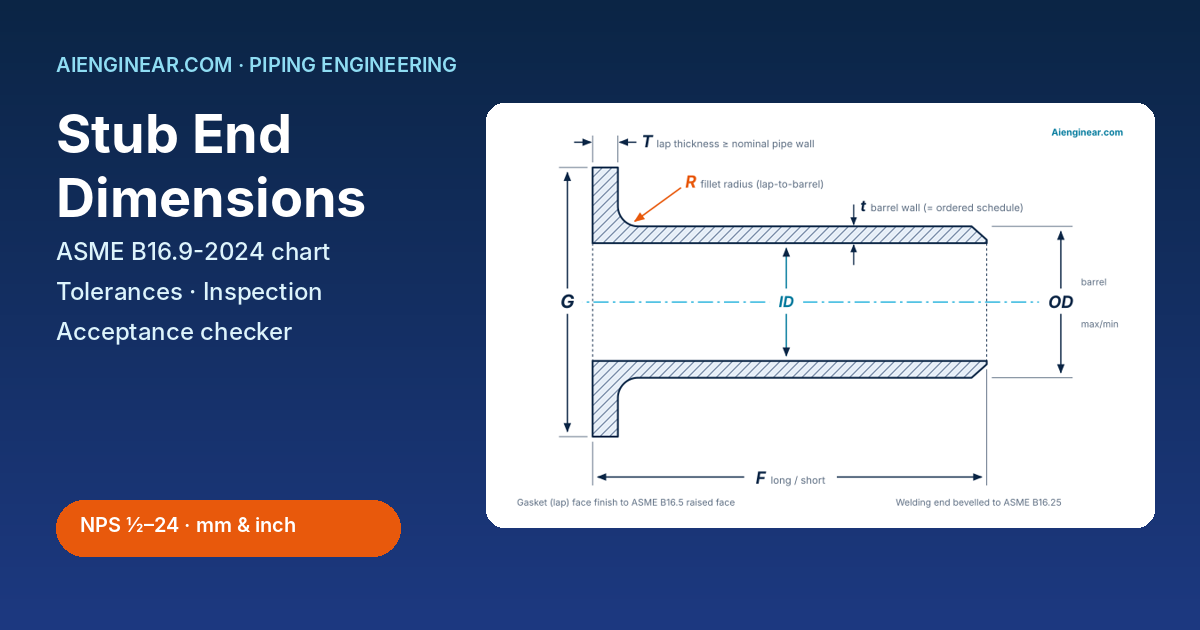
- Symbols and dimensions: G (lap diameter), F (overall length), T (lap thickness), R (fillet radius), barrel OD and wall.
- Tolerances: F ±2 mm, G and R plus-zero, T minus-zero, 87.5 % minimum wall.
- Selection and assembly: long vs short pattern, Type A vs Type B, weld coverage behind Class 600–2500 flanges, why the backing flange can be carbon steel.
Quick revision sheet before you start
| Item | Rule or value | Example |
|---|---|---|
| Lap diameter G | Equals B16.5 raised-face diameter; tolerance +0 / −1 mm (NPS ½–8), +0 / −2 mm (NPS 10–24) | NPS 4: 157 mm (6.19 in) |
| Overall length F | Long or short pattern, must be stated on the PO; tolerance ±2 mm | NPS 4: 152 mm long / 76 mm short |
| Fillet radius R | Tolerance +0 / −1 mm (NPS ½–3½), +0 / −2 mm (NPS 4–24) | NPS 4: 11 mm; NPS 6–24: 13 mm |
| Lap thickness T | Not less than nominal pipe wall; +1.6 mm (to NPS 8) or +3.2 mm (NPS 10–24) / −0 | NPS 4 Sch 40S: T ≥ 6.02 mm |
| Barrel wall | Minimum 87.5 % of nominal unless PO states otherwise | NPS 4 Sch 40S: ≥ 5.27 mm |
| Weld bevel (B16.25) | Wall 3–22 mm: 37.5° ± 2.5°, root face 1.6 ± 0.8 mm | Walls ≤ 3 mm may be square-cut |
| MSS SP-43 | Light-wall, low-pressure, corrosion-resistant; Type A (lap-joint flange) and Type B (slip-on backing) | Sch 5S/10S, class CR |
Basis: ASME B16.9-2024, MSS SP-43, ASME B16.25-2022. Compiled by Aienginear.com – full chart at aienginear.com/stub-end-dimensions/
Stub end quiz answer key and explanations
Try the quiz first – then open the answer key to check every question, the correct option and the engineering reason behind it.
Show all 15 questions with answers (spoilers)
Which standard sets the dimensions and tolerances of factory-made wrought lap-joint stub ends from NPS ½ to NPS 24?
- ASME B16.5
- ASME B16.9-2024
- ASME B16.11
- ASME B16.20
Answer: B. ASME B16.9-2024 (Factory-Made Wrought Buttwelding Fittings) covers stub end lap diameter G, length F, fillet radius R, barrel OD and their tolerances. B16.5 covers the matching lap-joint flange, B16.11 forged socket-weld/threaded fittings and B16.20 metallic gaskets. Read more
On an ASME B16.9 stub end, what does the letter F designate?
- Lap (gasket face) outside diameter
- Fillet radius between lap and barrel
- Overall length from the lap face to the welding end
- Barrel outside diameter
Answer: C. F is the overall length measured from the lap (gasket) face to the bevelled welding end. It is the only dimension that changes between long and short pattern. Read more
What does dimension G represent on a lap-joint stub end?
- Lap outside diameter – the gasket seating face
- Nominal bore
- Fillet radius
- Root face of the weld bevel
Answer: A. G is the outside diameter of the lap. It equals the raised-face diameter of an ASME B16.5 flange of the same size, for example 157 mm for NPS 4. Read more
What is the overall length F of an NPS 4 (DN 100) stub end in long and short pattern?
- 152 mm long / 76 mm short
- 203 mm long / 89 mm short
- 102 mm long / 51 mm short
- 152 mm long / 64 mm short
Answer: A. ASME B16.9 gives F = 152 mm (6.00 in) for the long pattern and 76 mm (3.00 in) for the short pattern at NPS 4. G is 157 mm and R is 11 mm for both patterns. Read more
What is the dimensional difference between long pattern and short pattern stub ends of the same size?
- Long pattern has a thicker lap
- Short pattern has a smaller lap diameter G
- Long pattern has a larger fillet radius R
- Only the overall length F differs – G, R and barrel OD limits are the same
Answer: D. Both patterns share the same lap diameter, fillet radius and barrel OD limits. Only F changes, so the purchaser must state the pattern on the order. Read more
What is the ASME B16.9 tolerance on overall length F for stub ends?
- ±1 mm
- ±2 mm (±0.06 in to NPS 8, ±0.09 in for NPS 10–24)
- ±3 mm to NPS 8 and ±6 mm above
- +5 / −2 mm
Answer: B. The stub end length tolerance is ±2 mm for every size. The ±3 / ±6 mm values belong to caps and are a common charting error. Read more
An NPS 6 stub end is ordered with nominal G = 216 mm. Which measured lap diameter is acceptable?
- 216.8 mm
- 217.0 mm
- 215.4 mm
- 214.5 mm
Answer: C. The G tolerance is +0 / −1 mm up to NPS 8, so the acceptance band is 215.0 to 216.0 mm. Any oversize lap is a reject, and 214.5 mm is below the minus tolerance. Read more
What does ASME B16.9 require for the lap thickness T?
- Twice the nominal pipe wall
- Up to 12.5 % thinner than nominal wall
- A fixed 6.4 mm for all sizes
- Not less than the nominal pipe wall, with a plus-only tolerance
Answer: D. Lap thickness T must not be less than the nominal wall of the connected pipe. Its tolerance is plus-only: +1.6 mm to NPS 8 and +3.2 mm for NPS 10–24. Read more
What is the minimum acceptable barrel wall reading when no other tolerance is specified on the PO?
- 95 % of nominal wall
- 90 % of nominal wall
- 87.5 % of nominal wall
- 80 % of nominal wall
Answer: C. ASME B16.9 requires the wall at any point to be at least 87.5 % of nominal unless the purchaser specifies otherwise. For NPS 4 Sch 40S (6.02 mm) that is 5.27 mm. Read more
Which standard covers light-wall (typically Sch 5S/10S), low-pressure, corrosion-resistant stub ends of Type A and Type B?
- MSS SP-43
- MSS SP-75
- MSS SP-97
- API 605
Answer: A. MSS SP-43 covers wrought and fabricated butt-welding fittings for low-pressure, corrosion-resistant service, including Type A and Type B stub ends. SP-75 covers high-strength fittings, SP-97 integrally reinforced branch outlets and API 605 (withdrawn) large-diameter flanges. Read more
How does an MSS SP-43 Type B stub end differ from Type A?
- Type B is threaded
- Type B is only for Class 2500
- Type B has no lap
- Type B has a near-square lap corner (small maximum R) so a standard slip-on flange can be used as the backing flange
Answer: D. Type A has a lap and fillet made to suit standard lap-joint flanges. Type B has a near-square corner with a small maximum radius so a slip-on flange can serve as the loose backing flange. Read more
Why are stub ends with loose lap-joint flanges common in stainless, duplex and nickel-alloy piping?
- They need no gasket
- Only the stub end is wetted, so the backing flange can be economical carbon steel and rotates for bolt-hole alignment
- They have twice the pressure rating of weld neck flanges
- They remove the need for weld inspection
Answer: B. The process fluid touches only the stub end and gasket. The dry backing flange can be carbon steel (e.g. ASTM A105) and turns freely to line up bolt holes. The trade-off is lower bending and fatigue strength than a weld neck joint. Read more
Why must the fillet radius R of a stub end not exceed its nominal value?
- An oversize radius stops the lap-joint flange seating flat on the lap, causing uneven gasket load and leakage
- To leave room for a spiral-wound gasket inner ring
- To reduce flow turbulence
- To provide a UT cavity
Answer: A. R has a +0 tolerance. If it is too large, the backing flange bore corner rides on the fillet instead of bearing flat on the back of the lap, giving point loading, misalignment and leaks. Read more
A short-pattern stub end is paired with a thick Class 900 flange. What is the main risk ASME B16.9 warns about?
- The gasket will be too small
- The lap thickness will be reduced
- The bolts will be too short
- The flange may cover the butt weld, so extra length must be agreed with the manufacturer
Answer: D. B16.9 notes that short-pattern stub ends with larger Class 300 and 600 flanges, and with most Class 900 and higher flanges, may need extra length so the flange does not sit over the butt weld. Read more
For a stub end wall between 3 mm and 22 mm, what weld bevel does ASME B16.25 specify?
- 30° ± 5° with no root face
- 45° ± 2.5° with a 3 mm root face
- 37.5° ± 2.5° with a 1.6 ± 0.8 mm root face
- Square cut
Answer: C. ASME B16.25 specifies a 37.5° ± 2.5° bevel with a 1.6 ± 0.8 mm root face for walls over 3 mm up to 22 mm, unless the WPS requires another preparation. Walls of 3 mm and less may be square-cut or slightly chamfered. Read more
Keep learning on Aienginear

Written by Muhammad Raza
Founder of Aienginear. Mechanical engineer (BSc, UET Lahore) and Head of Projects with 18+ years managing piping, mechanical installation, plant shutdowns and turnarounds in power, cement, fertilizer and oil & gas plants.