
Pipe fittings are essential mechanical components used to connect pipe sections, change the direction of fluid flow, adjust pipe diameters, or completely isolate flow. Selecting the correct type of fitting and material grade is critical for mechanical integrity and ensuring compliance with industry codes like ASME B31.3.
From residential plumbing to offshore oil and gas platforms, power plants, chemical facilities, refineries, pharmaceutical plants, food processing industries, and water treatment systems, properly selected pipe fittings ensure safe, reliable, and efficient fluid transportation.
Selecting the correct pipe fitting involves more than matching pipe sizes. Engineers must consider operating pressure, temperature, corrosion resistance, flow characteristics, manufacturing standards, material compatibility, welding requirements, maintenance accessibility, and lifecycle costs. Incorrect fitting selection can lead to pressure loss, excessive turbulence, erosion, leakage, premature failure, and costly downtime.
This comprehensive guide explains the most common pipe fittings used in industrial piping systems, their functions, materials, end connections, pressure classes, manufacturing methods, applications, and the engineering standards governing their design and manufacture.
What are Pipe Fittings?
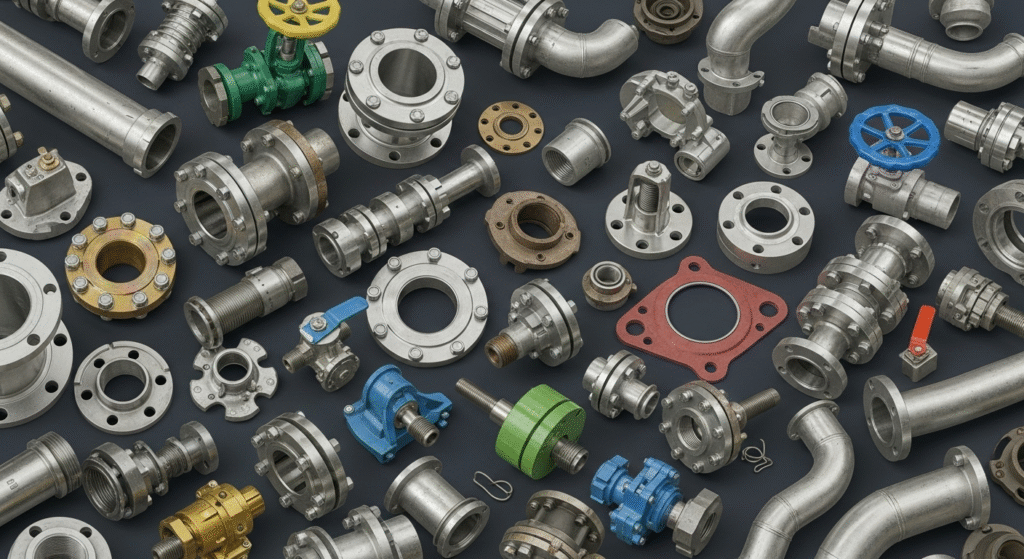
Pipe fittings play a crucial role in industrial pipelines by serving various functions. Common types include elbows and tees, which change the direction of flow; reducers, which adjust the size of the pipeline; couplings, which join different segments; and caps, which stop the flow of fluids.
Constructing an effective piping network would be impossible without these fittings. Every industrial process depends on them to safely control fluid movement while ensuring system integrity and minimizing pressure losses.
Typical fluids transported through pipelines include:
- Water
- Steam
- Crude oil
- Natural gas
- Chemicals
- Acids
- Petroleum products
- Compressed air
- Hydrogen
- Liquefied natural gas (LNG)
- Food products
- Pharmaceutical fluids
Pipe fittings are manufactured in a wide variety of sizes, pressure ratings, materials, and end connection configurations to accommodate different industries and operating conditions.
Why Are Pipe Fittings Important?
Properly selected fittings provide:
- Safe directional changes
- Reliable branch connections
- Pipe size transitions
- Equipment connections
- Isolation points
- Future expansion provisions
- Pressure containment
- Reduced leakage risk
- Improved maintenance access
- Better hydraulic performance
In critical industries such as oil and gas, petrochemicals, nuclear energy, and power generation, pipe fittings significantly impact plant reliability, safety, and maintenance costs.
| Function | Typical Fitting |
|---|---|
| Change flow direction | Elbow, Bend |
| Split flow | Tee |
| Combine flow | Tee, Wye |
| Change pipe size | Reducer |
| Close pipeline | Cap, Plug |
| Branch pipeline | Olet, Tee |
| Connect two pipes | Coupling |
| Easy dismantling | Union |
| Instrument connection | Half Coupling |
| Pigging connection | Barred Tee |
| Future expansion | Cap |
Types of Pipe Fittings
The most commonly used pipe fittings include:
- Elbow
- Tee
- Reducer
- Union
- Coupling
- Adapters
- Olet (Weldolet, Sockolet, Elbowlet, Thredolet, Nipolet, Letrolet, Swepolet)
- Valve
- Cross
- Cap
- Swage Nipple
- Plug
- Bush
- Expansion Joint
- Steam Traps
- Long Radius Bend
- Flanges
Each fitting is essential for specific engineering purposes and should be chosen based on piping design requirements.
The chart above shows the most commonly used standard pipe fittings, which fall into two categories: forged fittings and wrought fittings. Wrought fittings are made exclusively from seamless pipes, whereas large-diameter welded fittings are produced from plate material. Furthermore, these fittings are available in various end connection types.
These Fittings are available in different types of end connections.
Pipe Fitting Classification
Pipe fittings can be classified in several ways.
1. By Manufacturing Method
- Forged Fittings
- Wrought Butt Weld Fittings
- Cast Fittings
- Fabricated Fittings
- Extruded Fittings
2. By End Connection
- Butt Weld
- Socket Weld
- Threaded
- Flanged
- Grooved
- Compression
- Clamp Type
3. By Function
- Direction Change
- Branch Connection
- Size Reduction
- Pipe Termination
- Equipment Connection
- Instrument Connection
4. By Material
- Carbon Steel
- Stainless Steel
- Duplex Stainless Steel
- Super Duplex
- Alloy Steel
- PVC
- CPVC
- HDPE
- Copper
- Brass
- Bronze
- Nickel Alloys
- Titanium
5. By Pressure Rating
- Class 150
- Class 300
- Class 600
- Class 900
- Class 1500
- Class 2500
Forged fittings are commonly available in:
- 2000#
- 3000#
- 6000#
- 9000#
Pipe Fitting End Connections
Selecting the right end connection is crucial for ensuring leak-free operation and easy maintenance.
| End Connection | Typical Application |
|---|---|
| Butt Weld | High pressure & high temperature piping |
| Socket Weld | Small bore process piping |
| Threaded | Utility piping |
| Flanged | Equipment connections |
| Grooved | Fire protection systems |
| Compression | Instrument tubing |
| Clamp | Hygienic process systems |
Common Engineering Standards
Industrial pipe fittings are produced in accordance with international standards to ensure dimensional interchangeability, pressure integrity, material quality, and safe operation.
| Standard | Description |
|---|---|
| ASME B16.9 | Factory-made butt-welding fittings |
| ASME B16.11 | Forged socket weld and threaded fittings |
| ASME B16.28 | Short-radius elbows and returns |
| ASME B16.5 | Pipe flanges |
| ASME B31.3 | Process piping |
| ASTM A234 | Carbon steel butt weld fittings |
| ASTM A403 | Stainless steel butt weld fittings |
| ASTM A420 | Low-temperature fittings |
| ASTM A815 | Duplex stainless fittings |
| MSS SP-75 | High-test wrought fittings |
| MSS SP-95 | Swage nipples and bull plugs |
| MSS SP-97 | Integrally reinforced branch fittings |
Pipe Elbows
Pipe elbows are the most widely used fittings in industrial piping systems. Their primary function is to change the direction of fluid flow while maintaining pressure integrity and minimizing turbulence.
Elbows are commonly available in:
- 45°
- 90°
- 180°
They are manufactured in various materials, wall thicknesses, pressure classes, and end connection types.
Typical applications include:
- Oil & Gas pipelines
- Chemical plants
- Refineries
- Offshore platforms
- Water treatment plants
- HVAC systems
- Fire protection systems
- Power plants
Types of Pipe Elbows
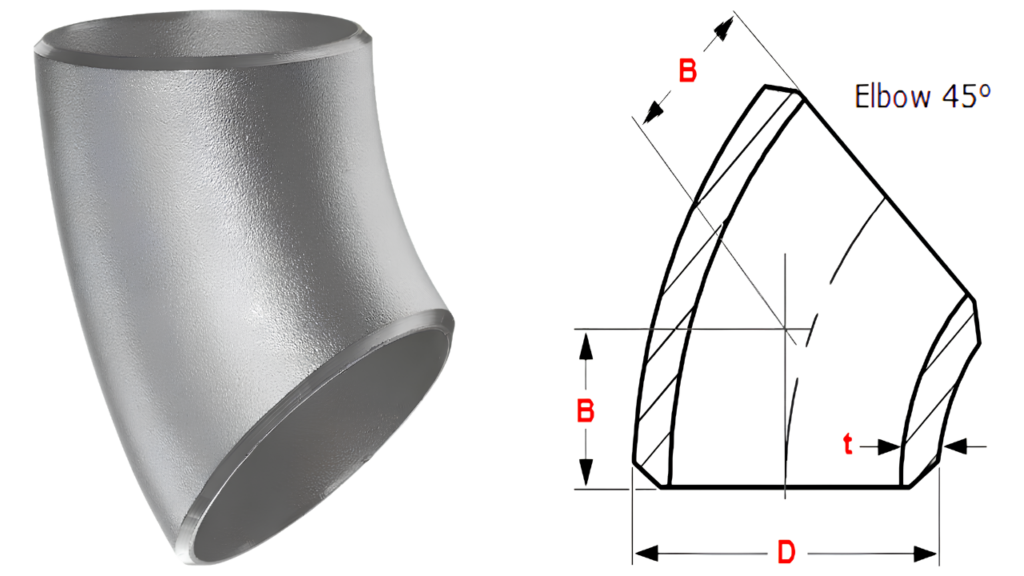
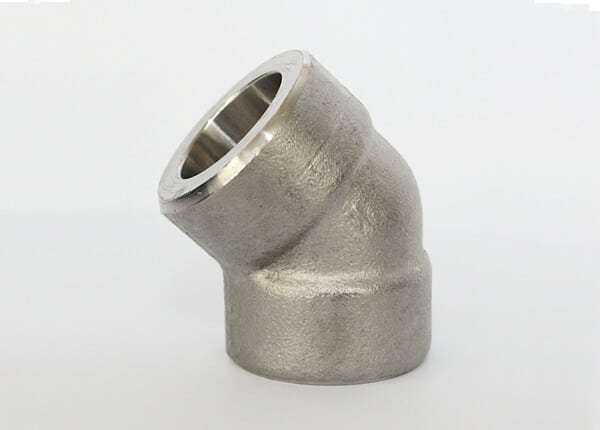
45° Elbow
A 45-degree elbow changes the direction of flow by 45 degrees.
Advantages
- Lower pressure loss
- Reduced turbulence
- Smooth flow transition
- Lower erosion
Applications
- Cooling water systems
- Process piping
- Utility piping
- Pump discharge lines
90° Elbow
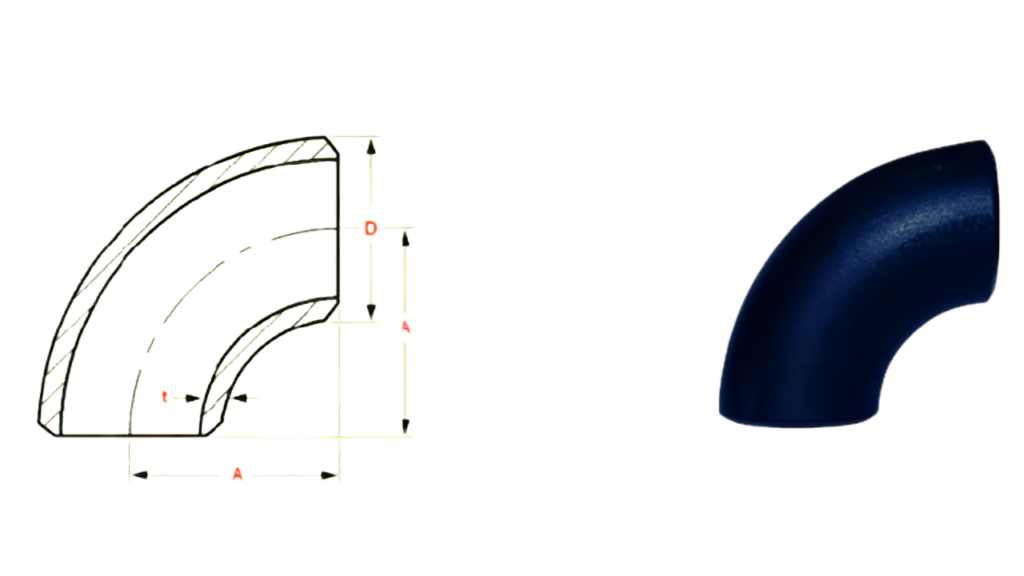
The 90-degree elbow is the most frequently used fitting in industrial piping.
It changes the flow direction by ninety degrees while occupying relatively little installation space.
Typical applications include:
- Pipe rack routing
- Equipment connections
- Vertical risers
- Utility services
- Process plants
Long Radius Elbow (LR Elbow)
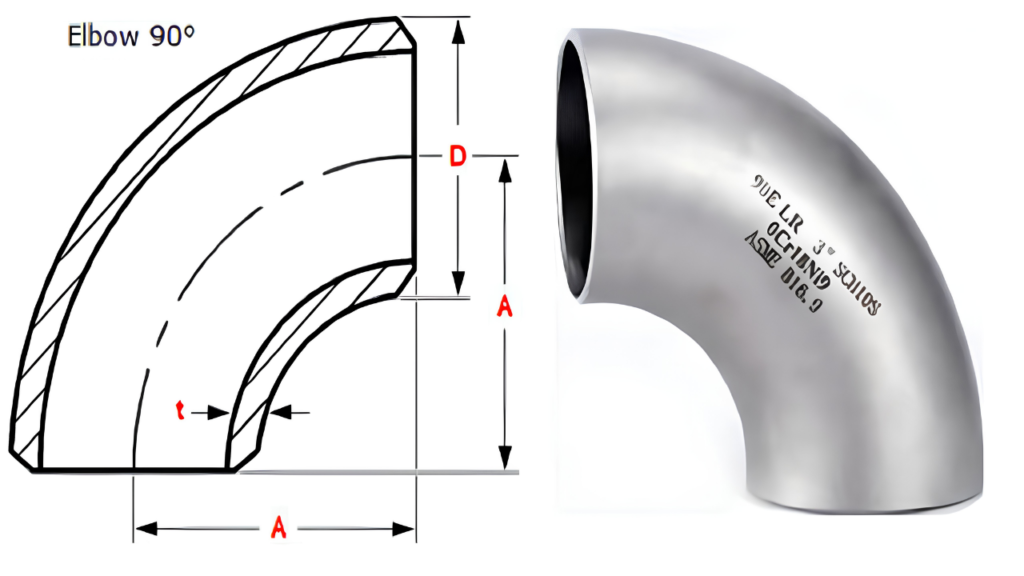
A long-radius elbow has a centerline radius equal to 1.5 × the nominal pipe size (1.5D).
Example:
For an 8-inch pipe:
Centerline Radius = 12 inches
Advantages
- Lowest pressure drop
- Reduced turbulence
- Lower erosion
- Better hydraulic efficiency
- Longer service life
Long-radius elbows are the preferred choice for most industrial process piping because they improve flow efficiency and reduce pumping energy.
Short Radius Elbow (SR Elbow)
A short-radius elbow has a centerline radius equal to 1 × the nominal pipe size (1D).
These elbows occupy less installation space but create greater turbulence and pressure loss.
Typical Applications
- Compact equipment skids
- Shipbuilding
- Offshore modules
- Congested pipe racks
Advantages
- Compact installation
- Lower material cost
- Space saving
Limitations
- Higher pressure loss
- Increased erosion
- Greater flow disturbance
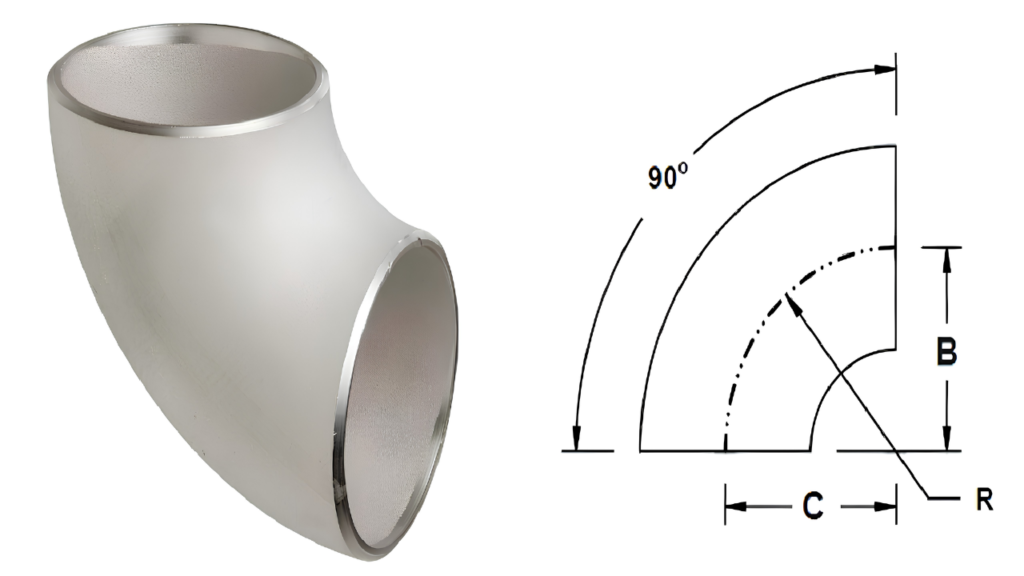
Long Radius vs Short Radius Elbow
| Feature | Long Radius | Short Radius |
|---|---|---|
| Radius | 1.5D | 1D |
| Pressure Loss | Low | High |
| Turbulence | Low | High |
| Space Required | More | Less |
| Erosion | Lower | Higher |
| Preferred for Process Plants | Yes | Limited applications |
Reducing Elbow
A reducing elbow combines two functions into a single fitting:
- Changes the direction of flow
- Reduces the pipe diameter
Using a reducing elbow eliminates the need for a separate reducer, reducing weld joints, installation time, and overall system weight.
Benefits
- Fewer welds
- Lower pressure loss than separate fittings
- Compact piping layout
- Reduced fabrication cost
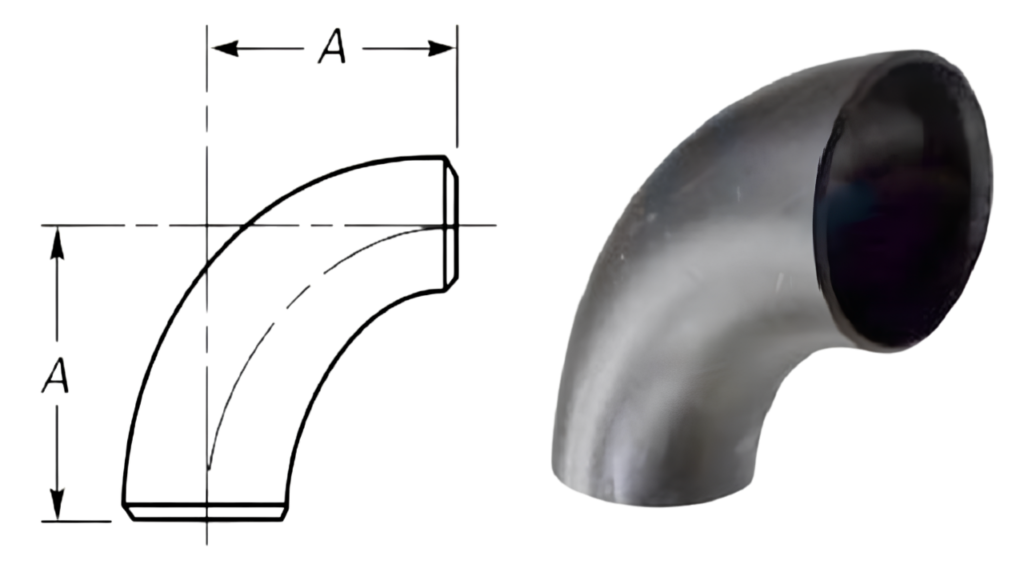
Pipe Bend
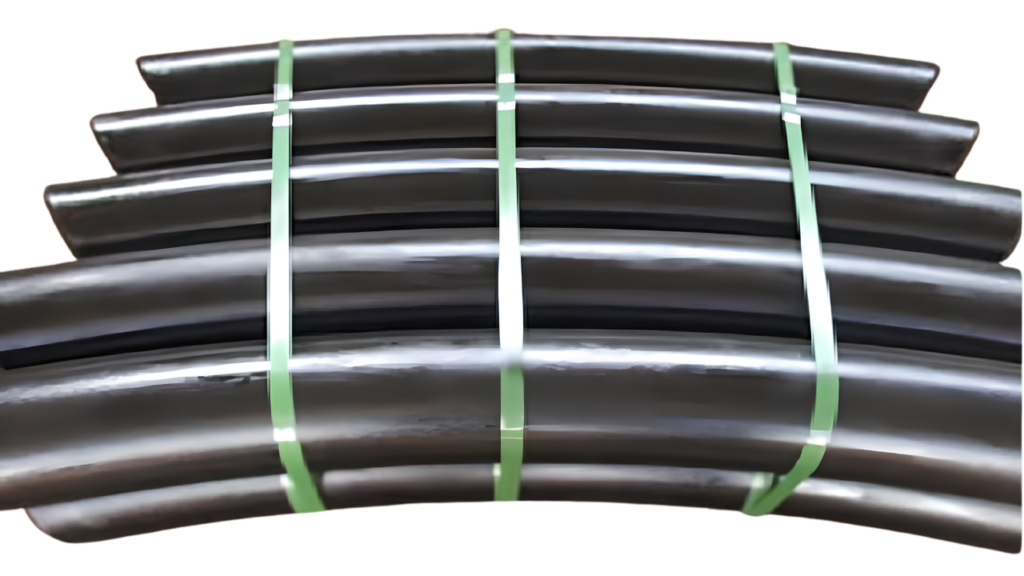
Unlike standard elbows, pipe bends are manufactured from straight pipe using specialized bending equipment. They provide a smoother directional change and significantly lower pressure losses.
Common bend radii include:
- 3D
- 5D
- 8D
- 10D
Pipe bends are widely used in:
- Long-distance pipelines
- Piggable systems
- Transmission pipelines
- Offshore pipelines
Because of their gradual curvature, bends reduce turbulence, erosion, and pumping energy compared with standard elbows.
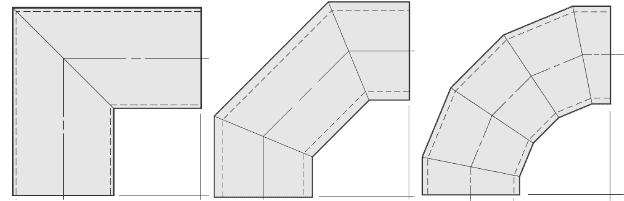
Miter Bend
A miter bend is fabricated by cutting and welding straight pipe sections together to achieve the required change in direction.
Typical configurations include:
- Two-piece miter
- Three-piece miter
- Five-piece miter
Although economical for large diameters, miter bends introduce higher turbulence and stress concentrations. They are generally restricted to low-pressure utility services unless specifically engineered.
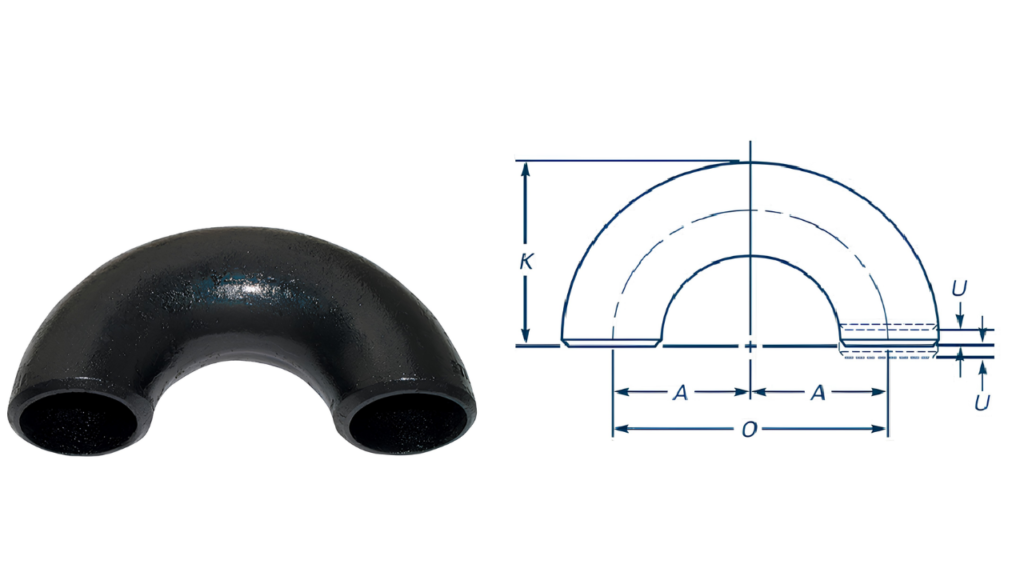
Return Bend (180° Elbow)
A return bend changes the flow direction by 180 degrees, allowing the fluid to reverse direction within the piping system.
Return bends are commonly used in:
- Heat exchangers
- Boiler coils
- Cooling coils
- Condensers
- Tank vent piping
- Process heating systems
Available configurations include:
- Long Radius Return
- Short Radius Return
Long-radius return bends are generally preferred because they reduce pressure losses and improve flow characteristics.
Pipe Tee
A pipe tee is a commonly used branch fitting in industrial piping systems. It consists of one inlet and two outlets (or the reverse), enabling fluid to either split into two directions or combine into a single flow path. A standard tee creates a 90-degree branch from the main pipeline.
Functions of a Pipe Tee
Pipe tees are primarily used to:
- Create branch connections
- Combine two fluid streams
- Divide flow into multiple directions
- Install instruments
- Connect valves
- Connect drain lines
- Connect vent lines
- Future pipeline expansion
Types of Pipe Tees
The most common tee types include:
- Equal Tee
- Reducing Tee
- Barred Tee
- Wye Tee (Lateral Tee)
- Split Tee
- Fabricated Tee
- Lateral Tee
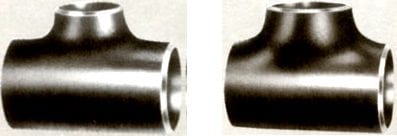
Equal Tee (Straight Tee)
An equal tee has three openings of identical diameter.
Example:
10" × 10" × 10"All three branches have the same nominal pipe size.
Applications
- Water distribution
- Firewater systems
- Utility piping
- Process piping
- Cooling water
Advantages
- Simple installation
- Uniform flow distribution
- Readily available
- Economical
Reducing Tee
A reducing tee has one branch smaller than the run pipe.
Example
12" × 12" × 6"The branch diameter is reduced while the run pipe size remains unchanged.
Applications
- Instrument connections
- Chemical injection
- Utility branches
- Pump bypasses
- Small service lines
Advantages
- Eliminates separate reducer
- Reduces welding
- Compact piping layout
- Lower installation cost
Equal Tee vs Reducing Tee
| Feature | Equal Tee | Reducing Tee |
|---|---|---|
| Branch Size | Same | Smaller |
| Flow Distribution | Equal | Unequal |
| Pressure Loss | Lower | Slightly Higher |
| Typical Use | Process Distribution | Branch Connections |
Barred Tee (Piggable Tee)
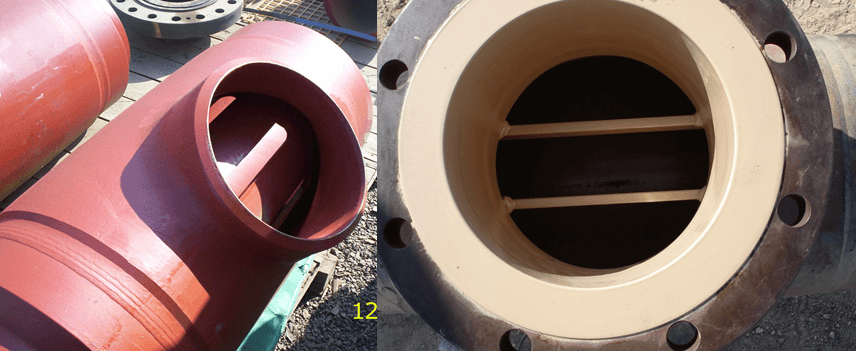
A barred tee is specially designed for pipelines that are cleaned using pigs or scrapers.
Inside the branch, steel bars prevent the pig from entering the branch connection while allowing unrestricted passage through the main pipeline.
Applications
- Oil Pipelines
- Gas Pipelines
- Cross-country Pipelines
- Crude Oil Transmission
Benefits
- Safe pigging operation
- Prevents pig blockage
- Improves maintenance
- Reduces operational risk
Wye Tee (Lateral Tee)
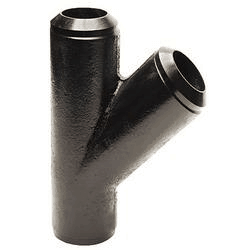
Unlike a standard tee, a Wye Tee has a branch at 45 degrees or another angle less than 90°.
The smoother branch angle minimizes:
- Turbulence
- Pressure loss
- Erosion
Applications
- Slurry pipelines
- Drainage
- Gravity flow systems
- Process piping
- Sewer systems
Standard Tee vs Wye Tee
| Feature | Standard Tee | Wye Tee |
|---|---|---|
| Branch Angle | 90° | 45° |
| Turbulence | Higher | Lower |
| Pressure Loss | Higher | Lower |
| Flow Efficiency | Moderate | Better |
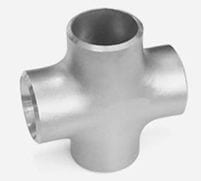
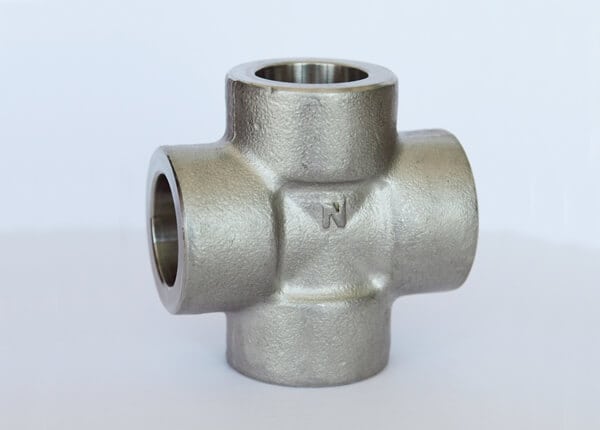
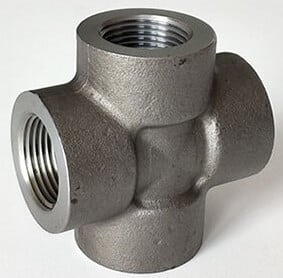
Pipe Cross
A cross fitting has four openings.
It is essentially a four-way tee.
Although common in sprinkler systems, crosses are rarely used in process piping because intersecting flows create excessive turbulence and stress.
Applications
- Fire Protection Systems
- Utility Water
- Instrument Manifolds
- Low-pressure Distribution Systems
Types of Cross
- Equal Cross
- Reducing Cross
- Forged Cross
- Threaded Cross
- Socket Weld Cross
Pipe Reducers
Reducers connect pipes of different diameters while maintaining proper hydraulic performance.
They are used to:
- Match equipment nozzles
- Connect different pipe sizes
- Reduce velocity changes
- Optimize pressure losses
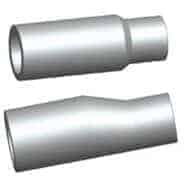
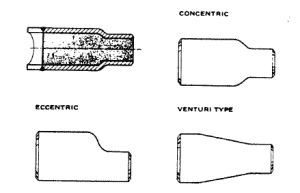
There are two primary types:
- Concentric Reducer
- Eccentric Reducer
Concentric Reducer
A concentric reducer has a common centerline between the larger and smaller diameters.
The fitting forms a symmetrical cone.
Applications
- Vertical piping
- Pump discharge
- Compressor discharge
- General process piping
Advantages
- Uniform flow
- Easy installation
- Symmetrical design

Eccentric Reducer
An eccentric reducer has offset centerlines.
One side remains flat.
This design prevents air pockets or liquid accumulation depending on installation orientation.
Applications
- Pump suction lines
- Horizontal pipelines
- Drain systems
- Slurry pipelines
Installation Rule
For pump suction:
Flat Side Up
to avoid air pockets.
For drainage service:
Flat Side Down
to prevent liquid accumulation.
Offset = ( Larger ID – Smaller ID) / 2
Concentric vs Eccentric Reducer
| Feature | Concentric | Eccentric |
|---|---|---|
| Centerline | Same | Offset |
| Horizontal Pump Suction | Not Preferred | Preferred |
| Vertical Pipe | Preferred | Acceptable |
| Air Pocket Prevention | Poor | Excellent |
| Drainage | Moderate | Excellent |
Swage Nipples (Swage Reducers)
Swage nipples perform the same function as reducers but are used primarily in small-bore piping systems.
They connect:
- Socket Weld fittings
- Threaded fittings
- Instrument piping
- Valve connections
Types of Swages
- Concentric Swage
- Eccentric Swage
End Configurations
Available combinations include:
- Plain × Plain
- Plain × Threaded
- Threaded × Threaded
- Socket Weld × Plain
- Socket Weld × Threaded
Applications
- Instrument Air
- Steam Tracing
- Utility Services
- Sampling Lines
- Small Bore Process Piping
Pipe Caps
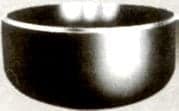
A pipe cap permanently seals the end of a pipeline.
Caps are welded or threaded depending upon service requirements.
Applications
- Future pipeline extensions
- Dead ends
- Pressure testing
- Temporary isolation
- Spare equipment connections
Types of Pipe Caps
- Butt Weld Cap
- Threaded Cap
- Socket Weld Cap
- Plastic Cap
- End Protection Cap
Pipe Plugs
Unlike caps, plugs fit inside threaded openings.
Common Types
- Hex Plug
- Square Head Plug
- Round Head Plug
- Internal Hex Plug
Applications
Drain connections
Vent connections
Pressure gauge ports
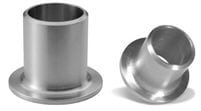
Stub Ends
Stub ends are used together with Lap Joint Flanges.
The stub end is welded to the pipe while the flange rotates freely.
This arrangement simplifies bolt alignment during installation.
Advantages
- Easy flange alignment
- Reduced flange cost
- Ideal for stainless steel systems
- Simplifies maintenance
Types of Stub Ends
- Type A
- Type B
- Type C
Pipe Union
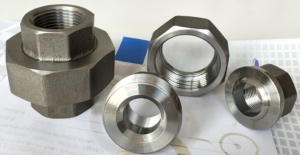
A union is a detachable fitting that allows rapid disassembly of piping without cutting or welding.
Unlike couplings, unions can be repeatedly disconnected.
Components
A union consists of:
- Male End
- Female End
- Union Nut
Applications
- Instrumentation
- Pumps
- Valves
- Maintenance-intensive systems
- Utility piping
Pipe Couplings
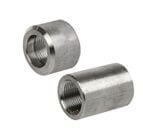
Couplings join two straight pipe sections.
Unlike unions, couplings are generally permanent.
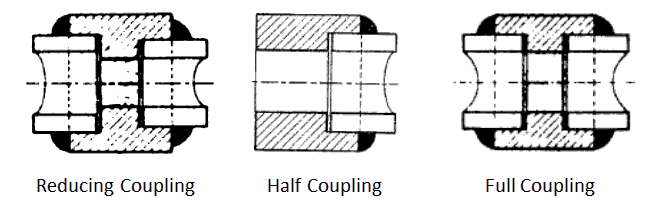
There are three types of coupling available;
- Full Coupling
- Half Coupling
- Reducing Coupling
Full Coupling
Full Coupling is used for connecting small-bore pipes. It is used to connect pipe to pipe, pipe to swage, or pipe to nipple. It can have threaded or socket ends.
Both ends connect pipes of equal diameter.
Applications:
- Pipe extension
- Pipe repair
- Utility systems
Half Coupling
Half Coupling is used for small-bore branching from a vessel or large pipe. It can be threaded or socket type. It has a socket or threaded end on only one side.
Used for branch connections.
Often welded onto vessels and large headers.
Applications:
- Instrument taps
- Drain connections
- Vent connections
Reducing Coupling
A reducing coupling is used to connect two different sizes. It is like a concentric reducer that maintains the centerline of the pipe but is small in size.
Connects two different pipe sizes.
Suitable for small bore transitions.
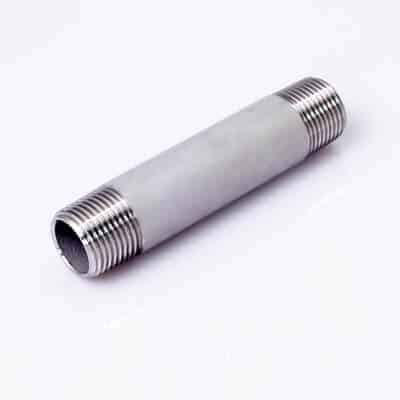
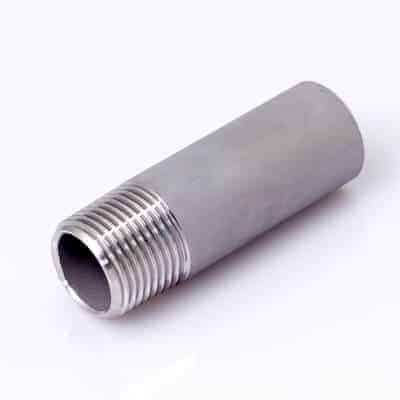
Pipe Nipple
The nipple is a short pipe stub with a male pipe thread at each end or one end. It is used for connecting two other fittings. Nipples are used for connecting pipes, hoses, and valves. Pipe nipples are used in low-pressure piping.
A nipple is a short pipe section having male threads on one or both ends.
It is commonly used between valves, fittings, and instruments.
Types of Pipe Nipples
- Close Nipple
- Hex Nipple
- Barrel Nipple
- Weld Nipple
- Reducing Nipple
- Hose Nipple
Tee, Reducer and Coupling Selection Guide
| Requirement | Recommended Fitting |
|---|---|
| Split Flow | Equal Tee |
| Smaller Branch | Reducing Tee |
| Piggable Pipeline | Barred Tee |
| Smooth Branch Flow | Wye Tee |
| Pipe Size Reduction | Concentric Reducer |
| Pump Suction | Eccentric Reducer |
| Small Bore Reduction | Swage |
| Future Connection | Cap |
| Detachable Joint | Union |
| Permanent Joint | Coupling |
| Instrument Connection | Half Coupling |
| Pipe Extension | Full Coupling |
Engineering Design Tips
✔ Use Long Radius Elbows whenever space permits to minimize pressure loss.
✔ Install Eccentric Reducers (Flat Side Up) on horizontal pump suction lines to prevent vapor pockets.
✔ Select Concentric Reducers for vertical pipelines and compressor discharge lines.
✔ Use Barred Tees in piggable pipelines to prevent pig entry into branch lines.
✔ Prefer Lap Joint Flanges with Stub Ends where frequent dismantling is required or where corrosion-resistant piping is paired with lower-cost backing flanges.
✔ For high-pressure and high-temperature services, specify fittings that comply with the applicable ASME dimensional standards and material specifications to ensure compatibility with the piping class
Olets (Branch Connection Fittings)
Olets are integrally reinforced branch fittings designed to create branch connections directly from a run pipe without using a standard tee. They provide a strong, compact, and economical solution, especially for branch connections where the branch size is smaller than the main pipeline.
Unlike fabricated branch connections, olets minimize welding, reduce stress concentration, and maintain structural integrity under high-pressure and high-temperature operating conditions.
Olets are extensively used in:
- Oil & Gas Facilities
- Refineries
- Petrochemical Plants
- LNG Plants
- Offshore Platforms
- Power Plants
- Chemical Industries
Most branch fittings are manufactured in accordance with MSS SP-97.
Advantages of Olets
- Strong integral reinforcement
- Reduced fabrication time
- Lower welding cost
- Compact design
- Excellent pressure integrity
- Suitable for high-pressure services
- Better fatigue resistance
- Reduced stress concentration
Types of Olets
The most common branch fittings include:
- Weldolet
- Sockolet
- Threadolet
- Elbolet
- Latrolet
- Nippolet
- Sweepolet
- Coupolet
Weldolet
The Weldolet is the most widely used branch fitting in industrial piping. It provides a reinforced branch connection by welding directly onto the run pipe, while the branch end is prepared for butt welding.
Applications
- High-pressure process piping
- Steam lines
- Refinery piping
- Petrochemical plants
- Power generation
- Offshore facilities
Advantages
- Excellent strength
- Smooth flow path
- Reduced stress concentration
- Suitable for cyclic loading
- Ideal for large branch sizes
Sockolet
A Sockolet is similar to a Weldolet, except that the branch outlet has a socket weld connection.
It is primarily used for small-bore piping systems.
Applications
- Utility piping
- Instrument air
- Cooling water
- Steam tracing
- Small process lines
Typical Size Range
- NPS 1/8″ to 2″
Threadolet
A Threadolet provides a threaded branch outlet instead of a socket or butt weld connection.
Applications
- Low-pressure piping
- Instrument connections
- Utility services
- Air lines
- Water systems
Advantages
- Easy installation
- No welding required
- Easy maintenance
- Ideal for temporary systems
Elbolet
An Elbolet is specifically designed for making branch connections on elbows.
Instead of welding a tee into a bend, an Elbolet provides a compact and reinforced branch.
Typical Applications
- Drain connections
- Vent connections
- Instrument taps
- Sampling points
Latrolet
A Latrolet creates a branch connection at approximately 45 degrees.
This design improves flow characteristics and reduces turbulence compared with a standard 90-degree branch.
Applications
- Slurry services
- Drain systems
- Process piping
- Gravity flow systems
Nippolet
A Nippolet consists of a Weldolet combined with an integral pipe nipple.
It eliminates the need for separate nipples during installation.
Applications
- Valve connections
- Instrumentation
- Pressure gauges
- Drain piping
Sweepolet
A Sweepolet provides a long-radius reinforced branch connection.
Compared with a standard Weldolet, the Sweepolet offers smoother flow transition and improved fatigue performance.
Typical Applications
- High-cycle piping
- Offshore systems
- High-pressure process lines
- Critical piping systems
Olet Selection Guide
| Branch Requirement | Recommended Olet |
|---|---|
| Butt Weld Branch | Weldolet |
| Socket Weld Branch | Sockolet |
| Threaded Branch | Threadolet |
| Branch on Elbow | Elbolet |
| 45° Branch | Latrolet |
| Integral Nipple | Nippolet |
| High Fatigue Service | Sweepolet |
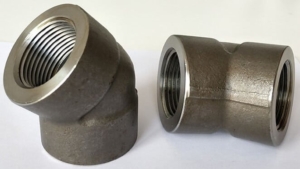
Socket weld and Threaded Pipe Fittings
Socket weld and Threaded Pipe Fittings are forged products and classified based on their pressure-temperature rating. They are available from NPS 1/8” to 4”. These fittings are available in four pressure-temperature rating classes.
- 2000 class fittings are available only in threaded type.
- 3000 & 6000 class fittings are available in both Threaded and socket-weld types.
- 9000 class fittings are available only in the socket weld type.
These fittings are used for small-bore and low-pressure piping.
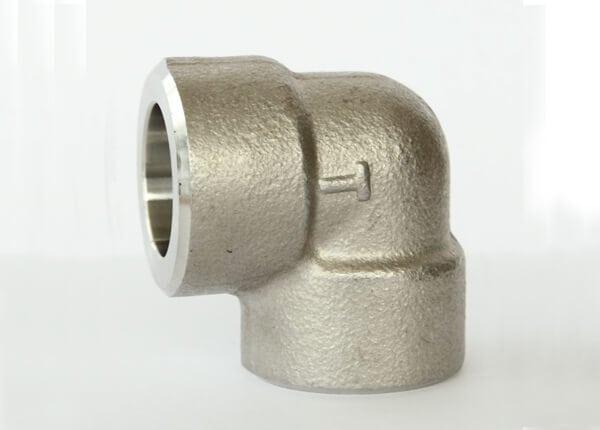
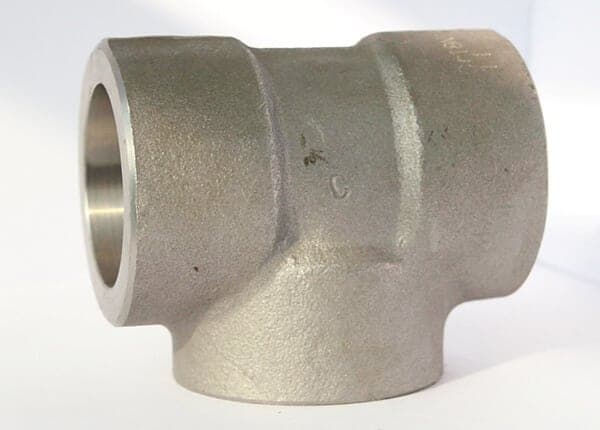
Socket Weld Pipe Fittings
Socket weld fittings are forged fittings used primarily in small-bore piping systems where leak-tight joints and high strength are required.
The pipe is inserted into the fitting socket and welded around the outer edge.
Socket weld fittings are commonly manufactured according to ASME B16.11.
Advantages
- High mechanical strength
- Reliable sealing
- Easy alignment
- Compact installation
- Suitable for high-pressure systems
Common Socket Weld Fittings
- Elbow
- Tee
- Cross
- Coupling
- Half Coupling
- Reducing Coupling
- Union
- Cap
- Plug
- Boss
- Swage
Pressure Classes
Socket weld fittings are commonly available in:
| Pressure Class | Typical Service |
|---|---|
| Class 3000 | Standard Process Piping |
| Class 6000 | High Pressure |
| Class 9000 | Very High Pressure |
Threaded Pipe Fittings
Threaded fittings are connected using tapered pipe threads, eliminating the need for welding.
Most threaded fittings comply with ASME B16.11, while thread forms are typically based on ASME B1.20.1 (NPT).
Advantages
- No welding required
- Easy installation
- Easy replacement
- Suitable for maintenance
- Economical for small-bore piping
Limitations
- Not recommended for severe cyclic loading
- Limited for very high temperatures
- Potential leakage if improperly assembled
- Thread corrosion may reduce service life
Common Threaded Fittings
- Elbow
- Tee
- Cross
- Union
- Coupling
- Cap
- Plug
- Bushing
- Adapter
Socket Weld vs Threaded Fittings
| Feature | Socket Weld | Threaded |
|---|---|---|
| Welding Required | Yes | No |
| Leak Resistance | Excellent | Good |
| Pressure Capability | Higher | Moderate |
| Installation Speed | Moderate | Fast |
| Maintenance | Moderate | Easy |
| Typical Service | High Pressure | Utility & Low Pressure |
The dimensions of the pipe fittings must meet the requirements of the standard.
- For Wrought Product (WP), dimensions are covered in
- ASME B16.9, which is the standard for Factory-made Wrought Butt-welding Fittings for size NPS 1⁄₂ to NPS 48” and
- And B16.28- which is standard for Wrought Steel Butt-Welding Short Radius Elbows and Returns for size NPS 1⁄₂ to NPS 24”
- For Forged Fittings, the Dimensions are covered in,
- ASME B16.11- a standard for Forged Steel Fittings that covers Socket Welding and Threaded fittings