
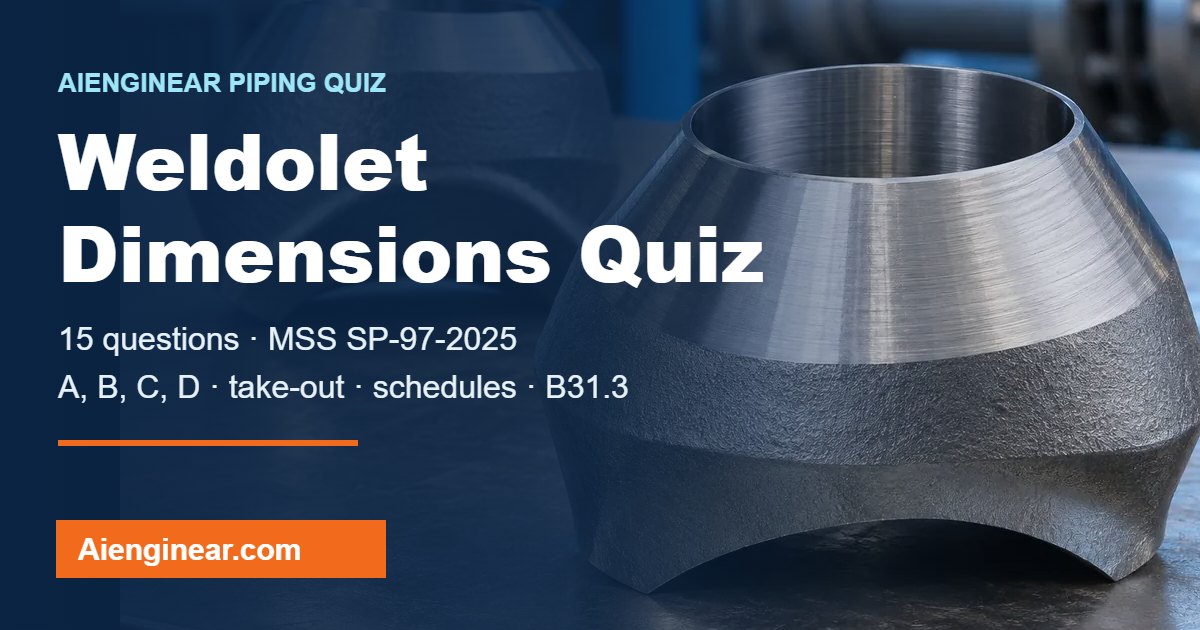
About this quiz
This free Weldolet dimensions quiz tests what a piping engineer, QA/QC inspector or buyer needs to know about butt-weld branch outlets: the dimension letters A, B, C and D, the correct hole size, take-out L, schedule matching, reducing-outlet ordering, pressure rating, the B16.25 bevel and the B31.3 branch-weld rules. Every answer is explained and linked to the matching section of our Weldolet dimensions chart (MSS SP-97-2025).
Keyboard: press A–D or 1–4 to answer, Enter or → for next, ← for previous.
Keys: A–D or 1–4 answer · Enter / → next · ← previous
What the Weldolet quiz covers
- Standards: MSS SP-97-2025 for integrally reinforced branch outlets, ASME B16.25-2022 for weld bevels, ASME B31.3-2024 for branch design, welding and testing.
- Dimensions: A (height), B (base diameter), C (hub diameter), D (bore), root gap X and take-out L.
- Selection: matched schedules, Sch 160 vs XXS bores, size-on-size vs reducing outlets and when to order as run × outlet.
- Installation: hole size, root gap, branch weld details, Elbolet vs Weldolet and the tee comparison.
Quick revision sheet before you start
| Item | Rule or value | Example |
|---|---|---|
| Standard | MSS SP-97-2025; design and examination to the piping code (e.g. ASME B31.3-2024) | Forged butt-weld branch outlet |
| Dimension letters | A height, B base dia., C hub dia., D bore, X root gap | 2-in STD: A 38.1, C 65.1, D 52.4 mm |
| Hole in run pipe | Cut to bore D (branch pipe ID), never to C or B | 2-in STD hole ≈ 52.4 mm |
| Take-out | L = A + run OD / 2 + X | 2 on 6 in STD: L = 123.8 mm |
| Schedules | STD × STD, XS × XS, Sch 160 × Sch 160, XXS × XXS | Mixed = special design |
| Large reducing outlets | STD/XS NPS 8+ and Sch 160 NPS 5+ fit one run size | Order 24 × 10 in STD |
| Pressure rating | No class number; matches seamless pipe of the same schedule | Fully reinforced when matched |
| Weld bevel | 37.5° ± 2.5°, land 1.6 ± 0.8 mm (B16.25-2022) | Compound bevel above 22 mm wall |
| B31.3 references | 304.3 reinforcement, 328.5.4 branch welds, 345 testing | Listed component |
| Related outlets | Elbolet on elbows, Latrolet at 45°, Sockolet/Thredolet small bore | Flat-base outlet on heads |
Weldolet quiz answers and explanations
Try the quiz first – then open the answer key to check every question, the correct option and why it is right.
Show all 15 questions with answers (spoilers)
Which standard sets the essential dimensions, marking, testing and minimum strength of integrally reinforced forged branch outlets such as Weldolets?
- ASME B16.9
- MSS SP-97
- ASME B16.11
- ASME B16.5
Answer: B. MSS SP-97 (current edition 2025) covers 90° and 45° integrally reinforced forged branch outlets with butt-weld, socket-weld and threaded ends. ASME B16.9 covers butt-weld fittings such as tees, and B16.11 covers socket-weld and threaded fittings. Read more
On a Weldolet dimension chart, what does dimension A represent?
- Fitting height from the base to the outlet weld face
- Largest base diameter on the run pipe
- Outside diameter of the outlet hub
- Bore of the outlet
Answer: A. A is the fitting height. It is the main figure for spool and isometric take-out. B is the base diameter, C the hub diameter and D the bore. Read more
What size should the hole in the run pipe be cut to for a Weldolet?
- Hub diameter C
- Base diameter B
- Fitting bore D, which matches the branch pipe ID
- Branch pipe outside diameter
Answer: C. Cut the hole to the bore D. Cutting to C or B leaves an oversized opening and weakens the header. Read more
For a 2-inch STD Weldolet, C is 65.1 mm. Why is C not the hole size?
- C is measured in inches only
- C is larger than the 60.3 mm OD of the branch pipe, so a hole that size would cut through the branch wall
- C applies only to reducing Weldolets
- C is the root gap allowance
Answer: B. C is the outside diameter of the outlet hub just below the bevel. At 65.1 mm it is bigger than the 2-inch pipe OD of 60.3 mm. The hole follows the 52.4 mm bore. Read more
Which formula gives Weldolet take-out L from the run-pipe centreline to the outlet weld face?
- L = A + run OD
- L = A + B / 2
- L = A − root gap
- L = A + run OD / 2 + root gap
Answer: D. Take-out is the fitting height A, plus half the run-pipe OD, plus the root gap X set by the WPS. Read more
A 2-inch STD reducing Weldolet (A = 38.1 mm) sits on a 6-inch run (OD 168.3 mm) with a 1.6 mm root gap. What is take-out L?
- 123.8 mm
- 122.2 mm
- 208.0 mm
- 85.8 mm
Answer: A. L = 38.1 + 168.3 ÷ 2 + 1.6 = 123.8 mm. Leaving out the root gap gives 122.2 mm, so the branch spool would be short. Read more
Which header × branch schedule combination is a standard (not special) Weldolet selection under MSS SP-97?
- STD run with XS branch
- XS run with Sch 160 branch
- XS run with XS branch
- STD run with XXS branch
Answer: C. Butt-weld outlets are intended for matching combinations: STD × STD, XS × XS, Sch 160 × Sch 160 and XXS × XXS. Mixed schedules are selected with the manufacturer. Read more
How should an STD reducing Weldolet with an NPS 10 outlet be ordered?
- By outlet size only, because it fits any run
- As run × outlet, because outlets of NPS 8 and larger are contoured for one run size
- By base diameter B
- As a size-on-size fitting
Answer: B. Small reducing outlets fit a range of run sizes. STD and XS outlets of NPS 8 and larger (NPS 5 and larger for Sch 160) are shaped for one run size, so order them as, for example, 24 × 10 in STD. Read more
What is the pressure rating of a matched-schedule Weldolet branch connection?
- Class 3000
- Class 6000
- It depends only on the base diameter B
- It has no class number; it carries the rating of seamless pipe of the matching schedule and material
Answer: D. Butt-weld outlets have no class number. When the schedule matches and the fitting is attached with a full-penetration weld, MSS SP-97 makes the connection fully reinforced, so it carries the matching pipe rating. Read more
Sch 160 and XXS Weldolets are often forged from one body table. What must be stated on the order?
- The branch schedule (Sch 160 or XXS), so the bore is finished to the right pipe ID
- Nothing; both schedules have the same wall
- Only the run size
- The root gap
Answer: A. Sch 160 and XXS pipes have different walls and different inside diameters. For NPS 2, the Sch 160 ID is 42.8 mm and the XXS ID is 38.2 mm. Read more
What weld bevel does ASME B16.25-2022 give for butt-weld ends with walls up to 22 mm?
- 45° with no land
- 37.5° ± 2.5° with a 1.6 ± 0.8 mm land
- 30° with a 3 mm land
- 60° included angle with no land
Answer: B. B16.25 specifies a 37.5° ± 2.5° bevel with a 1.6 ± 0.8 mm land up to 22 mm wall; thicker walls use a compound bevel. Read more
Which ASME B31.3 paragraph covers weld details for branch connections such as Weldolets?
- Para. 304.3
- Para. 345
- Para. 328.5.4
- Para. 302.2
Answer: C. Para. 328.5.4 covers branch connection welds. Para. 304.3 covers branch reinforcement design and para. 345 covers leak testing. Read more
What root gap X is typical between a Weldolet base and the run pipe?
- 0 mm (tight fit)
- About 1.5–3 mm, as set by the WPS
- 10–12 mm
- Equal to the branch wall thickness
Answer: B. A uniform 1.5–3 mm gap, set with spacers, gives root penetration. Add it to the take-out or the branch will be short. Read more
A branch must be taken off a 90° long-radius elbow. Which outlet fitting is correct?
- Elbolet
- Weldolet
- Latrolet
- Thredolet
Answer: A. An Elbolet is contoured for the curved surface of an elbow. A Latrolet is for 45° laterals; Weldolets and Thredolets suit straight pipe. Read more
Compared with a butt-weld tee, what is a main advantage of a Weldolet branch connection?
- Full radiography of the branch weld is easier
- Smoother flow than a tee
- No welds are needed
- The run pipe stays continuous and only two welds are needed instead of three
Answer: D. A tee needs the run cut and three butt welds. A Weldolet leaves the run continuous with two welds, though volumetric NDE of the branch weld is more limited. Read more
Keep learning on Aienginear

Written by Muhammad Raza
Founder of Aienginear, with 18+ years managing piping, mechanical installation, plant shutdowns and turnarounds in power, cement, fertilizer and oil & gas plants.